

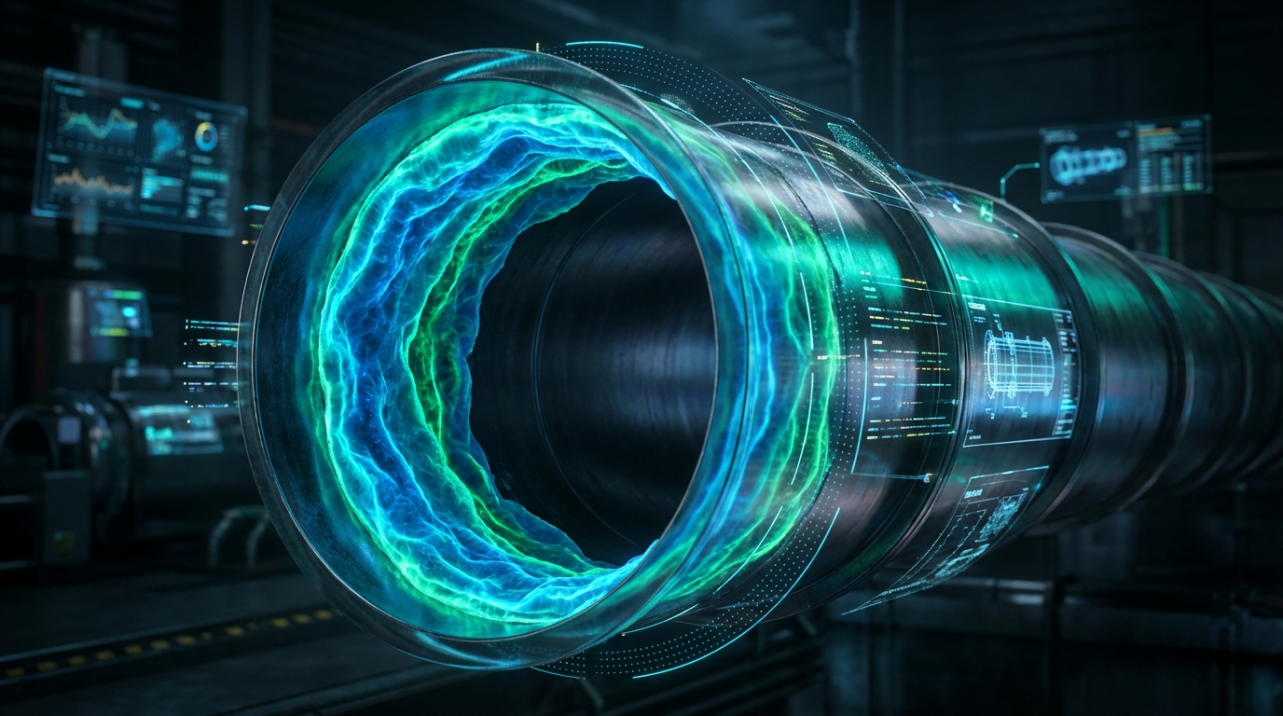
Summary: You find biofilm in pipes by combining smart monitoring of pipe surfaces, targeted lab tests, and trend-based water quality data—rather than relying on a single “clean” water sample.
Why Biofilm in Pipes Is So Easy to Miss
Biofilm is not just “dirty water.” It’s a slimy layer of microbes glued to pipe walls in a protective matrix. Studies in drinking water systems show that well over 90% of bacteria often live on surfaces, not in the water itself.
That means standard grab samples taken from a tap mostly measure free‑floating cells, while the real problem is stuck to the pipe. The CDC notes that heterotrophic plate counts and coliform results can look acceptable even when biofilms are quietly harboring opportunistic pathogens like Pseudomonas or Legionella inside the network.
For anyone responsible for safe hydration—whether in a home, a hospital, or a bottling line—the goal is to see what’s happening on the pipe wall as well as in the water.
Classic Lab Methods: Deep, But Slow
When you need a definitive answer about biofilm, lab-based methods are still the benchmark. Common approaches include:
- Culture and plate counts: Filters or swabs from pipes or tank walls are cultured to count colony-forming units (CFU) and identify key organisms.
- Microtiter “biofilm” assays: Tissue Culture Plate methods, highlighted in several clinical studies, quantify how strongly isolates form biofilms by staining the attached layer in microplates.
- Microscopy: Light, fluorescence, or confocal laser scanning microscopes visualize 2D or 3D biofilm structure, sometimes with live/dead stains.
- Biomass and ATP assays: Crystal violet staining, total protein, or ATP bioluminescence (described in mini-reviews from PubMed Central and BioDtex) estimate total attached biomass or metabolic activity.
These methods are powerful for root-cause investigations and system validation. The tradeoff is time and logistics: sampling, transport, incubation, and interpretation can take days and require a qualified lab.

On-Site Checks: Faster Insight for Operators
Because day-to-day operations can’t wait on full lab reports, many facilities use rapid field tests to flag likely biofilm issues.
For the water itself, heterotrophic plate counts, ATP tests, and targeted PCR (for organisms like Legionella) help reveal when microbial load or specific pathogens are trending up. CDC guidance emphasizes looking at patterns—such as persistent counts above facility norms—rather than single numbers alone.
To assess surfaces inside piping, field teams often:
- Swab representative “risk spots” (dead legs, gaskets, drains, heat exchangers) and run dipslides or ATP swabs.
- Install removable coupons in side-stream loops so lab teams can periodically examine real pipe-wall conditions.
- Pair microbiology data with operational clues like rising disinfectant demand, recurring odors, or slimy deposits at outlets.
This combination does not give the same resolution as microscopy, but it catches trouble early enough to adjust cleaning, disinfection, or flushing before biofilm fully matures.

Smart, Real-Time Sensors on Pipe Walls
The biggest leap forward for piping systems is continuous, in situ monitoring of biofilm. Instead of sampling water, these devices sit directly where biofilm grows.
Electrochemical impedance and related sensors, described in recent PubMed Central and technological reviews, measure how biofilms change the electrical properties of a surface. As cells attach and the matrix thickens, resistance and capacitance shift in predictable ways, allowing real-time tracking without destroying the biofilm.
Thermal sensors such as DEPOSENS detect the increased thermal resistance of deposits; signal drift correlates with biofilm thickness on stainless steel or plastic substrates. Optical approaches like optical coherence tomography, combined with AI image analysis, are now able to map biofilm layers and corrosion on pipe materials in real time.
In industrial water and beverage systems, commercial tools like ALVIM biofilm sensors and BioDtex Scope mount inside or flush with the pipe. Case studies show that:
- With proper chlorine levels, sensor signals remain flat and microscopy confirms mostly dead cells.
- When disinfectant is absent or under-dosed, the signal rises over days as live biofilm develops—even when bulk-water tests still look acceptable.
This feedback loop lets operators tune biocide dosing, flushing, and filtration so they neither under-treat (health risk) nor over-treat (chemical and cost burden).

Turning Data into Safer Hydration
From a smart hydration perspective, the most reliable strategy is layered:
- Use online biofilm or heat-transfer sensors on critical loops to watch pipe walls continuously.
- Track basic microbiology (HPC, ATP, and—where relevant—Legionella or other pathogens) on a routine schedule.
- Focus sampling on low-flow, warm, or complex sections where biofilms are most likely to form.
- Interpret everything as trends, not one-off “pass/fail” results.
Health agencies such as CDC caution that not every facility needs intensive biofilm testing, but in high-risk or high-value systems—pharmaceutical water, dialysis, hospitals, or centralized drinking water—real-time biofilm visibility is quickly becoming a cornerstone of safe, high-quality hydration.
References
- https://pmc.ncbi.nlm.nih.gov/articles/PMC10667638/
- https://www.cdc.gov/infection-control/hcp/environmental-control/appendix-c-water.html
- https://pubs.acs.org/doi/10.1021/acssensors.1c02722
- https://www.frontiersin.org/journals/cellular-and-infection-microbiology/articles/10.3389/fcimb.2023.1335389/full
- https://ijmmtd.org/archive/volume/8/issue/1/article/8738

Share:
Key Differences Between Membrane Blockage and Insufficient Pump Pressure
Strategies for Calibrating Drift in Smart Sensors Effectively in Home Water Systems