

As a Smart Hydration Specialist, I usually focus on what comes out of your tap and into your glass. But the safety and stability of that water are decided much earlier, in places like aquifers, river deltas, and, increasingly, the salty margins around inland lakes.
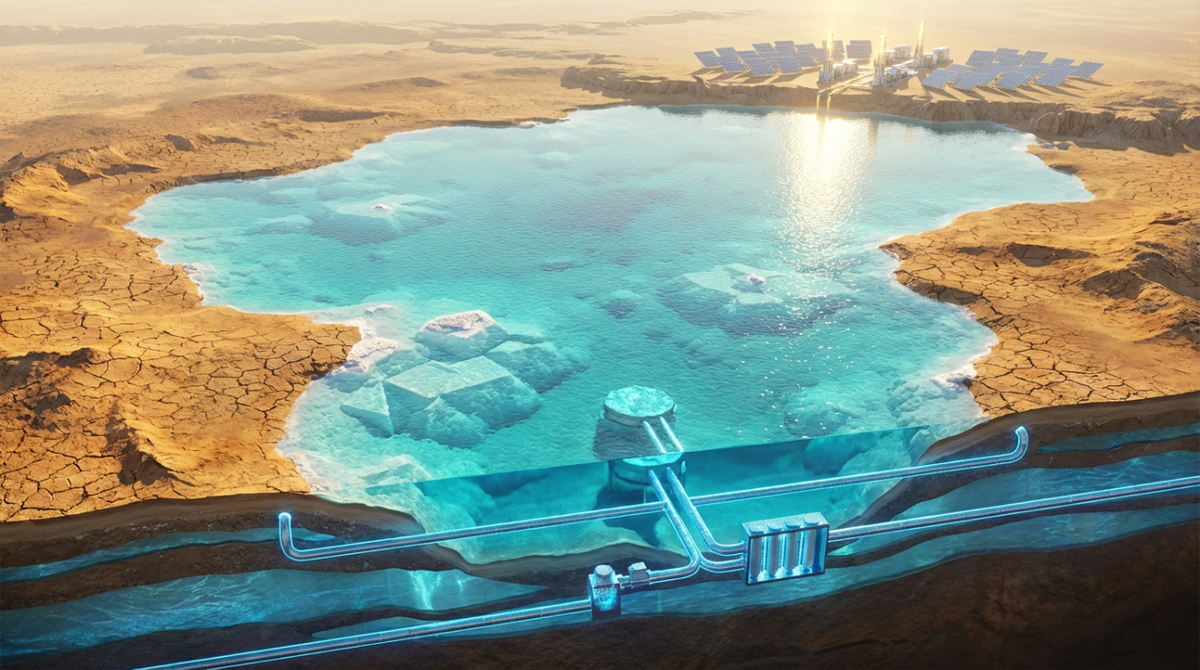
Communities near saline or brackish lakes are asking a hard question: instead of importing more water or drilling ever deeper wells, could we desalinate the brackish groundwater that surrounds these lakes and turn it into a reliable drinking and irrigation supply?
The short answer is that it can be technically and environmentally feasible, and in some places already is. However, it only makes sense where several conditions line up: the right kind of groundwater, realistic costs, and strong safeguards for aquifers and the lake ecosystem.
This guide walks through how to evaluate that feasibility using evidence from actual brackish groundwater desalination projects in Texas, California, and other inland regions, along with life cycle and technology reviews from scientific and engineering sources.
Living Beside A Salty Lake In A Thirsty World
In many arid and semi‑arid regions, surface water is shrinking while demand climbs. Research summarized by Columbia University’s climate group describes the western United States as facing one of the most severe droughts in well over a thousand years, with about forty percent of the country in drought and roughly ninety percent of water use in some western states going to agriculture.
At the same time, groundwater is under serious stress. A global analysis cited by Seven Seas Water Group found falling water levels in about seventy‑one percent of aquifers worldwide, with over‑pumping driving land subsidence, saltwater intrusion, and ecological damage. In the United States alone, more than eighty‑two billion gallons of fresh groundwater are pumped every day, serving nearly half the population.
For communities near saline lakes, this means several things happen at once. The lake itself may become saltier as freshwater inflows decline. Surrounding aquifers may transition from fresh to brackish or moderately saline. Traditional wells begin to yield water that is too salty for safe drinking or sensitive crops.
This is where desalination enters the conversation. According to the Texas Water Development Board and USGS Water Science School, desalination already supplies water to hundreds of inland communities by treating brackish groundwater, not just seawater. Texas alone has dozens of municipal desalination facilities, many focused on brackish aquifers rather than the coast.
So the idea of treating brackish groundwater near a saline lake is not theoretical.

It is an inland variation of strategies already in use in Texas, California’s river delta, and other non‑coastal regions. The key is understanding whether your specific lake‑basin setting can support it.
Technical Feasibility: Can You Treat The Groundwater You Actually Have?
Brackish Aquifers Near Saline Lakes
From a technical standpoint, the first question is not about the lake itself, but about the groundwater around it. USGS classifies water by dissolved salts: freshwater generally has under 1,000 parts per million of salt, slightly saline water roughly 1,000 to 3,000, moderately saline about 3,000 to 10,000, and highly saline from 10,000 up to around 35,000 where it approaches typical ocean water.
Brackish groundwater usually sits in the slightly to moderately saline range. Inland desalination reviews focused on brackish sources often assume roughly 1,000 to 10,000 milligrams per liter of total dissolved solids. That is exactly the band where reverse osmosis and similar membrane technologies work efficiently without the extreme pressures and energy required for seawater.
Near a saline lake, you often find a gradient: fresher groundwater farther from the shoreline, shifting to brackish and sometimes highly saline closer in. Technically, the sweet spot for desalination is to tap these brackish zones that are too salty to use directly but far less salty than the lake itself.
Membrane desalination, especially reverse osmosis, is the workhorse technology in this range. Across the United States, a survey cited by the Texas Water Development Board found more than four hundred municipal brackish groundwater desalination plants, with roughly seventy‑two percent using reverse osmosis as the primary process. These systems pressurize the brackish groundwater and push it through semi‑permeable membranes that pass water and reject salts and many contaminants.
Thermal processes such as multi‑effect distillation or multi‑stage flash distillation also exist, but multiple reviews in ScienceDirect and by organizations such as the Climate Technology Centre and Network highlight that these thermal methods have higher energy requirements and are usually reserved for very high salinity or specialty applications. For brackish groundwater around a salt lake, reverse osmosis and related membrane methods are typically the most technically appropriate.
Real‑World Inland Desalination Examples
To judge feasibility, it helps to look at what similar inland communities already do. A good example is El Paso’s Kay Bailey Hutchison plant in Texas. As summarized by the Texas Water Development Board and a review of inland desalination technologies, this facility treats brackish groundwater and produces about 27.5 million gallons of drinking water per day, with plans to expand to about 42 million gallons per day. That water helps secure supply for a large inland city far from the coast.
On a smaller scale, the City of Antioch in California’s Sacramento–San Joaquin River Delta is building a brackish water desalination facility that will produce up to 6 million gallons per day once fully operational. California’s Department of Water Resources describes this as a climate‑resilient, “drought‑smart” project designed to handle rising salinity in a major river system. Although Antioch is treating brackish surface water rather than aquifer water, the technology and challenges are similar to groundwater desalination near a saline lake: variable salinity, inland brine management, and the need to integrate with existing treatment and distribution infrastructure.
These cases show that inland desalination plants handling salinity levels comparable to those in many lake‑adjacent aquifers are already operating at scales from small cities to regional hubs. If your basin’s brackish groundwater falls into similar salinity ranges and volumes, it is likely technically treatable. The question then becomes how big a facility you truly need and how you will manage brine and energy, not whether the technology works.
Small And Modular Systems For Farms And Small Towns
Not every community near a saline lake is a city. Many are farming valleys or small towns where centralized megaplants would be both overkill and unaffordable. Here, small‑scale and modular desalination becomes relevant.
A comprehensive review of small‑scale desalination technologies published in ScienceDirect defines small systems as producing under about 25 cubic meters per day, which is roughly 6,600 gallons daily. These units can be sized down to serve a single farm, cluster of homes, or a small resort. They can treat brackish groundwater, reuse wastewater, or polish other local sources.
That review notes that seawater desalination typically requires on the order of 2.6 to 9 kilowatt‑hours of electricity per cubic meter, substantially more than treating surface water or normal groundwater. Brackish water requires less energy than seawater, and membrane systems such as reverse osmosis or capacitive deionization can be especially efficient at smaller scales. Capacitive deionization, for example, was reported with energy use around 0.1 to 0.4 kilowatt‑hours per cubic meter for suitable brackish feed water, making it a candidate for inland, moderately saline sources.
On the innovation edge, researchers at MIT and collaborators in Shanghai developed a passive solar desalination device that needs no external electricity. A suitcase‑sized footprint could produce roughly 4 to 6 liters of drinking water per hour under good sun, and modeling suggests costs lower than typical municipal tap water, according to reporting by MIT News. While these prototypes have mostly been tested on seawater, the same physics can apply to brackish sources, and their modular, off‑grid nature is attractive for remote lake basins with strong solar resources.
From a practical perspective, this means that near a saline lake you have a spectrum of technically feasible options, from town‑scale membrane plants to farm‑scale and even household‑level solar units. The technical hurdle is usually not whether brackish groundwater can be desalinated, but whether the system can be sized and powered appropriately for your context.
Economic Feasibility: What Will It Really Cost?
Technical feasibility is only half the story; water that is too expensive to deliver is not truly “available” for families or farms. Desalination’s costs are dominated by capital investment and energy, plus brine management. Fortunately, there are reasonably solid benchmarks for brackish groundwater desalination that help compare options.
Cost Benchmarks From Existing Plants
The Texas Water Development Board has compiled cost estimates for different desalination strategies. For brackish groundwater desalination, they report costs of roughly 357 to 782 dollars per acre‑foot of water produced. For seawater desalination, the estimated range is about 800 to 1,400 dollars per acre‑foot. In plain terms, treating brackish groundwater can often be noticeably cheaper than treating seawater, even before accounting for the higher intake and environmental costs of coastal plants.
Case studies from Southern California help put those figures into context. An analysis summarized by Genesis Water Technologies compares the Carlsbad seawater desalination plant with Orange County’s potable water reuse system. Carlsbad’s water was reported at about 2,300 dollars per acre‑foot, while the Orange County Groundwater Replenishment System, which recycles wastewater, produced drinking‑quality water at roughly 850 dollars per acre‑foot. So even within the same region, a seawater desalination supply can be close to three times as expensive as advanced reuse.
Those data support the conclusion reached by NRDC’s assessment for California: desalination, especially seawater desalination, is one of the most expensive ways to get new water, and brackish groundwater desalination, while cheaper than seawater, should still usually follow conservation, efficiency, stormwater capture, and recycling.
Near a saline lake, the key comparison is between brackish groundwater desalination, continued over‑pumping of existing wells, importing water from far away, and expanded reuse. When brackish groundwater is plentiful and imported water is costly or unreliable, inland desalination can be competitive. When high‑quality surface water or recycled sources are still locally available, desalination tends to be a second‑tier option.
A simplified illustration makes this tangible. Imagine a small city needing 10,000 acre‑feet of additional water per year. If brackish groundwater desalination comes in around the middle of the Texas range, say roughly 600 dollars per acre‑foot, that is about 6 million dollars per year in production costs, before distribution and financing. If the only alternative is trucking or piping in water at higher prices, or facing severe shortages, that may be an acceptable price for reliability.
Energy Demand And Power Options
Multiple sources, including the USGS and technology reviews in ScienceDirect, emphasize that energy represents roughly thirty to fifty percent of desalination operating costs. For seawater reverse osmosis, modern plants may require 3 to 6 kilowatt‑hours of electricity per cubic meter of product water. Brackish groundwater, because of its lower salinity, usually needs significantly less pressure and therefore less energy.
Life cycle analyses published in journals summarized by Frontiers for Young Minds estimated that producing about 1,000 liters of desalinated water with conventional fossil‑powered plants emitted roughly 12.6 kilograms of carbon dioxide. They further noted that agriculture uses about sixty‑five percent of many countries’ water, and growing food for one person can require around 3,000 liters per day, which in their case study translated into about 42.6 kilograms, or roughly 94 pounds, of carbon dioxide per person per day tied to desalinated water for food production.
The same article compared a fossil‑fuel‑powered desalination plant to a solar‑powered equivalent and found that switching to solar reduced carbon dioxide emissions by about seventy‑eight percent for the same water output. Human health impacts related to toxic emissions also dropped by about a factor of three in the solar case.
These findings line up with guidance from the Climate Technology Centre and Network and others: where possible, couple desalination with renewable energy such as solar or wind, especially in sunny, arid regions where saline lakes often occur. For many inland settings, hybrid systems that blend renewables with backup conventional power are recommended to balance reliability and cost.
Financing And Scale Considerations
Beyond raw production cost, the question is who pays and how. The Antioch brackish desal plant in California was funded by a mix of a state desalination grant and a low‑interest loan from state water boards. The Carlsbad seawater plant was made possible by substantial private financing, as described in the Genesis Water Technologies case study, but also faced public concerns about long‑term water rates.
Seven Seas Water Group promotes a “Water‑as‑a‑Service” model, in which a private provider designs, finances, and operates a desalination plant and sells water to a municipality or industry for a fixed per‑volume fee. For smaller communities near saline lakes, such models can reduce up‑front costs but must be weighed against long‑term obligations and the need for strong performance guarantees.
Scale matters as well. Small‑scale desalination, as the ScienceDirect review points out, has different economics than massive coastal plants. It often trades some efficiency for lower capital requirements and the ability to serve isolated communities without expensive pipelines. For lake‑basin towns and farms, right‑sizing the plant to avoid overshooting demand is one of the most important economic decisions you can make.
A concise way to compare options is shown in the table below, using numbers drawn from the Texas Water Development Board and Southern California case studies.
Source type |
Example case or source body |
Approximate cost (per acre‑foot) |
Notes |
Brackish groundwater desalination |
Texas Water Development Board estimates |
About 357–782 dollars |
Inland, moderate salinity, reverse osmosis dominant |
Seawater desalination |
Texas Water Development Board estimates |
About 800–1,400 dollars |
Higher energy, coastal intake and brine challenges |
Seawater desalination |
Carlsbad plant, San Diego County reports |
Around 2,300 dollars |
Large coastal plant, higher local costs |
Potable wastewater reuse |
Orange County Water District GWRS |
About 850 dollars |
Advanced recycling, inland, non‑saline source |
For a community near a saline lake, the realistic economic window for groundwater desalination will usually fall closer to the brackish groundwater range than to the high coastal seawater figures, provided you have access to suitable aquifers and can manage brine without extremely expensive infrastructure.

Environmental And Hydrogeologic Feasibility Near A Saline Lake
As a water‑wellness advocate, I care deeply about the hidden side of a glass of water: what happens to the aquifer, the lake, and the ecosystems that make your region livable. Desalination can reduce pressure on overdrawn rivers and lakes, but it can also create new environmental stresses if poorly designed.
Aquifer Health And Groundwater Balance
The first environmental test is whether you can pump brackish groundwater near a saline lake without further degrading the basin. Studies cited by Seven Seas Water Group show that excessive pumping has already dropped groundwater levels in most of the world’s aquifers, leading to land subsidence and saltwater intrusion. NRDC’s guidance for California warns that even brackish groundwater desalination can cause overdraft, land sinking, and degraded water quality if withdrawals exceed sustainable recharge.
Near a saline lake, the hydrogeology can be complex. If the lake is already shrinking, additional pumping from connected aquifers may accelerate its decline. Some municipalities instead use desalination specifically to reduce groundwater extraction, leveraging seawater or brackish river water so that inland aquifers can recover. Seven Seas Water Group, for instance, positions desalination as a tool to reduce groundwater overuse and allow aquifers to recharge.
From a feasibility standpoint, this means any groundwater desalination project near a saline lake must be grounded in a careful basin‑wide water budget. That budget should account for lake inflows, natural recharge, current pumping, and the added withdrawals needed for desalination feedwater. If your new plant simply shifts the region from one unsustainable practice to another, it is not truly feasible, no matter how advanced the technology.
Brine Management When You Are Far From The Ocean
The second major environmental hurdle is brine, the concentrated salty waste stream that every desalination plant produces. Research summarized by Columbia University’s climate group estimates that, globally, seawater desalination produces roughly one and a half units of brine for every unit of freshwater. The exact ratio and salt load depend on source salinity and recovery rate, but the principle is consistent: you get a lot of concentrated waste.
Coastal plants often discharge brine back to the sea, where, if poorly managed, it can smother seabed life and alter local salinity and oxygen levels. USGS and the Climate Technology Centre and Network both flag this as a major ecological concern. A children’s‑level but scientifically grounded article in Frontiers for Young Minds explains that even diluted brine with chemical additives can be lethal to marine organisms, especially in shallow, weakly mixed waters such as enclosed gulfs.
Inland plants near saline lakes cannot assume that the lake is a harmless dumping ground. Saline lakes are often already stressed by reduced inflows, dust pollution from exposed shorelines, and ecological shifts. Adding high‑density brine can further alter stratification, salinity, and habitat, particularly if the lake is shallow or poorly mixed. While the research notes provided focus on oceans and gulfs rather than lakes, the same underlying physics of density and circulation applies.
Because of this, inland desalination reviews emphasize alternative brine management strategies. An article on inland applications summarizes options including lined evaporation ponds, deep‑well injection into isolated geological formations, mineral recovery, and zero‑liquid‑discharge systems that crystallize salts so that mostly solids need disposal. Last Energy’s overview of desalination also discusses “brine mining,” where valuable minerals such as sodium chloride or other salts are recovered from concentrated brine streams, potentially offsetting some costs while still requiring careful management of residual waste.
For a community near a saline lake, evaporation ponds can be attractive where land and sun are abundant, but they require robust liners and long‑term maintenance to avoid contaminating soils or groundwater. Deep‑well injection depends on favorable geology and strict oversight. Zero‑liquid‑discharge systems can be effective but costly and energy‑intense.
The bottom line is that a feasible project near a saline lake must have a credible, financed, and regulated brine strategy from day one. If that strategy is underdeveloped, the project’s environmental feasibility is weak, regardless of how clean the product water is.
Using Life Cycle Thinking To Keep Impacts In Check
One of the most powerful tools for evaluating environmental feasibility is life cycle assessment, or LCA. The Frontiers for Young Minds article describes LCA as tracing a product or process from cradle to grave and tallying environmental impacts at each step, called “midpoints,” such as climate change, ozone depletion, and human toxicity.
In the desalination example they discuss, replacing fossil‑fuel electricity with solar cuts climate‑related impacts sharply and significantly reduces human toxicity, even though some impacts related to building solar farms increase modestly. This kind of analysis helps decision‑makers see where improvements matter most: for desalination, energy sources and brine handling dominate the footprint.
When you apply LCA thinking to groundwater desalination near a saline lake, three questions emerge. First, what is the carbon and health footprint of your energy mix, and can you realistically shift toward renewables over the project’s life? Second, what is the cumulative impact of brine management on local land, groundwater, and the lake ecosystem? Third, how does desalination compare to alternative strategies such as advanced reuse or demand reduction in terms of environmental burdens per gallon delivered?
A project that scores reasonably well on these three fronts, especially when paired with conservation and reuse, is much more likely to be environmentally feasible in the long term.

What This Means For Drinking Water Quality And Home Hydration
From the perspective of a homeowner or a family investing in smart filtration and hydration systems, the big question is simple: if my community chooses groundwater desalination near our saline lake, what does it do to the water in my glass?
Desalinated water, whether from brackish groundwater or seawater, is very low in dissolved minerals by design. Technology descriptions from organizations such as the Climate Technology Centre and Network and Veolia explain that typical desalination trains include pre‑treatment, the desalination step, and then post‑treatment that often involves remineralization and disinfection. Utilities remineralize to stabilize the water, protect pipes, and meet taste and corrosion standards.
In practice, that means that water from a well‑designed brackish groundwater desalination plant near a saline lake will usually be blended and conditioned before it reaches your tap. It can be extremely consistent in quality, free from many of the hardness, iron, or sulfate issues that often plague well‑based supplies in lake basins. High‑value industries such as semiconductor and pharmaceutical manufacturing already rely on desalinated or desal‑polished water for exactly this consistency, as highlighted in industry summaries by groups like OceanWell and Last Energy.
For home hydration, consistent low‑contaminant water is an excellent foundation. At the point of use, you can then fine‑tune taste and additional safety with certified home filtration, remineralization cartridges, or smart dispensers, depending on your preferences. The crucial point is that groundwater desalination near a saline lake, when done well, can improve the reliability and safety of the source that feeds your home system, rather than leaving you to cope with increasingly variable well water on your own.
Practical Questions To Ask Before You Commit
Deciding whether groundwater desalination near a saline lake is feasible in your region comes down to a few grounded questions that blend engineering, economics, and wellness.
Do You Have The Right Groundwater And Geology?
Start with salinity mapping and hydrogeology. Is there a brackish aquifer in the slightly to moderately saline band, roughly 1,000 to 10,000 parts per million of dissolved salts, that is hydraulically suitable for long‑term pumping? Are there enough data on recharge rates and connections to the lake to avoid depleting the system or accelerating the lake’s decline?
The experience of Texas, with its estimated 2.7 billion acre‑feet of brackish groundwater across major and minor aquifers, shows that such resources can be substantial and still largely untapped. However, NRDC’s cautions about overdraft and subsidence remind us that “brackish” does not mean “limitless.” Independent hydrogeologic assessment is non‑negotiable.
Can You Manage Brine And Energy Responsibly?
Next, look hard at brine and power. What specific brine management pathway will you use: evaporation ponds, deep‑well injection, mineral recovery, or a zero‑liquid‑discharge system? How will you protect soils, groundwater, and the lake from unintended accumulation of salts and process chemicals, which Frontiers for Young Minds and others highlight as key ecological risks?
On the energy side, what is your realistic path to integrate renewable energy, given that multiple studies place energy consumption at up to half of operating costs and as a major driver of carbon emissions? In sunny inland basins, solar‑powered plants, whether conventional or using newer passive designs, can dramatically cut emissions and long‑term operating costs. Hybrid systems that combine renewables with grid or local backup can balance reliability and sustainability.
Are You Pairing Desalination With Conservation And Reuse?
Finally, consider where desalination sits in your overall water strategy. NRDC’s analysis for California is clear: desalination should generally come after aggressive conservation, efficiency, stormwater capture, and wastewater recycling. Orange County’s reuse system, at about 850 dollars per acre‑foot, stands as a concrete example of a lower‑impact, lower‑cost option that can precede seawater or even brackish groundwater desal.
Near a saline lake, this means using desalination to fill the final gap after other measures, not as a license to continue inefficient irrigation or high per‑capita use. Inland desalination literature stresses that combining technologies, such as using nanofiltration as pre‑treatment, reclaiming brine minerals, and improving irrigation efficiency, can significantly improve both economics and environmental outcomes.
When desalination is sized correctly, powered as cleanly as possible, and deployed as one part of a broader water‑smart portfolio, it can become a stabilizing force rather than a last‑ditch gamble.
Brief FAQ
Is brackish groundwater desalination always better than seawater desalination near a saline lake?
Not automatically. Brackish groundwater desalination is usually cheaper and less energy intensive than seawater desalination, as shown in cost ranges compiled by the Texas Water Development Board and technology assessments summarized by USGS and others. However, if brackish aquifers are already overdrawn or tightly connected to a shrinking saline lake, tapping the lake or another source might have fewer long‑term impacts. The hydrogeologic context determines which option is truly “better.”
Can small solar‑powered desalination systems really help communities around saline lakes?
Evidence from the ScienceDirect review on small‑scale desalination and the MIT passive solar desalination work suggests they can. Small systems, often powered by solar, can produce a few thousand gallons per day for isolated farms, villages, or facilities. They are not a substitute for a city‑scale supply but can make a meaningful difference for drinking and cooking water, especially where brackish wells are the only local source.
Does desalinated groundwater change the taste or healthfulness of my tap water?
Desalinated water is low in minerals and is usually remineralized and disinfected in post‑treatment to meet regulatory and taste standards, as described by technology providers and international agencies. From a hydration standpoint, the key benefits are consistency and safety. At the household level, you can then adjust taste and any extra filtration using point‑of‑use systems, building on a very stable and predictable source water.
When I look at groundwater desalination near saline lakes through a hydration‑focused lens, I see a tool that can either protect or undermine water wellness, depending on how thoughtfully it is used. If your community does the homework on aquifers, brine, energy, and conservation, desalination can help keep safe, clean water flowing to your kitchen tap even as climates and lakes change.
References
- https://news.mit.edu/2023/desalination-system-could-produce-freshwater-cheaper-0927
- https://repository.usfca.edu/cgi/viewcontent.cgi?article=2872&context=capstone
- https://www.usgs.gov/water-science-school/science/desalination
- https://wrrc.arizona.edu/sites/default/files/attachment/Arroyo-2011-Desalination.pdf
- https://water.ca.gov/News/Blog/2025/Sep-25/New-Desalination-Facility-Major-Milestone-for-Drought-Smart-Infrastructure
- https://news.climate.columbia.edu/2021/08/26/a-1000-year-drought-is-hitting-the-west-could-desalination-be-a-solution/
- https://comptroller.texas.gov/economy/economic-data/water/2022/desalination.php
- https://www.ehn.org/desalination-offers-farmers-a-potential-solution-to-drought
- https://www.ctc-n.org/technologies/seawater-desalination
- https://kids.frontiersin.org/articles/10.3389/frym.2025.1510242

Share:
Effective Pre-Treatment Solutions for Oil-Contaminated Water RO Systems
Effective Solutions for Low Water Pressure Areas Under 0.2 MPa