

As a smart hydration specialist, I spend a lot of time between two worlds: the science of water chemistry and the very practical realities of under-sink systems, coolers, and cartridges in real homes and workplaces. Few topics bridge those worlds as dramatically as bisphenol A, better known as BPA.
BPA has become a regulatory flashpoint in food and water contact materials, and those rules now reach directly into reverse osmosis (RO) membranes, housings, dispensers, and other accessories. If you are choosing or selling RO systems, you cannot treat BPA as a vague headline risk anymore. It is becoming a hard compliance constraint, especially in Europe, and a growing health concern everywhere.
In this article, I will walk through what the science actually says, how regulations are changing, and what that means in very concrete terms for RO accessories and home hydration setups.
BPA 101: What It Is And Why It Ended Up In Water Gear
BPA is an industrial chemical used for decades to make tough, clear polycarbonate plastics and epoxy resins. According to technical and health sources such as the National Institute of Environmental Health Sciences, Mayo Clinic, and Healthline, those materials show up in many everyday items: some reusable water bottles and food containers, metal can linings, some water-supply pipes, certain dental sealants and composites, compact discs, and a variety of household and medical products.
In the water world, BPA-based materials have traditionally been used in places like large polycarbonate cooler bottles, some dispenser reservoirs, internal coatings on tanks and pipes, and as a building block for certain engineering plastics used in filtration housings and membranes.
The concern is not that BPA sits inert forever. Multiple sources, including Mayo Clinic, WebMD, and several water filtration companies, emphasize that BPA can leach from containers and linings into food and drink, especially when plastics are heated, scratched, or used for long storage. BPA has been detected in the urine of the vast majority of people tested in large biomonitoring studies, which tells us exposure is widespread.
Scientifically, BPA is classified as an endocrine disruptor. Research summarized by Healthline, Mayo Clinic, and environmental health organizations shows that BPA can mimic estrogen and interact with hormone receptors related to growth, reproduction, metabolism, and brain development. That does not mean every exposure is dangerous, but it does mean that even low doses during sensitive life stages may have outsized effects.
For RO and hydration equipment, the question becomes very specific: where is BPA in the system, how much can move into water, and how are regulators responding?

Health Concerns Driving BPA Regulations
Over the past decade, scientific and regulatory bodies have revisited BPA again and again. Some regulators, such as the US Food and Drug Administration, still maintain that current dietary exposures are safe, while others, especially in Europe, have concluded that risk persists even at extremely low doses.
A few threads stand out from the research summarized in the notes.
Experimental and observational studies link BPA exposure to reproductive issues in both men and women, including impaired egg maturation, altered hormone levels, lower sperm counts, and reduced fertility. Reviews cited by organizations such as the Breast Cancer Prevention Partners and Healthline note effects on ovaries, mammary gland development, and reproductive aging.
Cardiovascular and metabolic concerns show up repeatedly. Sources such as Healthline and SpringWell Water describe research associating BPA with higher rates of obesity, insulin resistance, type 2 diabetes, elevated blood pressure, and heart disease. Some studies suggest that even relatively low exposure can influence arrhythmia and vascular function in animal models.
Developmental vulnerability is a major theme. BPA crosses the placenta and enters breast milk, and animal and human data suggest that prenatal or early-life exposure can affect brain development, behavior, asthma risk, and long-term body weight regulation. Several sources emphasize that fetuses, infants, and young children clear BPA less efficiently, which is why regulators often start by banning BPA in baby products.
Cancer risk is another reason regulators are cautious. Laboratory studies reviewed by Healthline, APEC Water, and others suggest links between BPA exposure and cancers of the breast, prostate, and other tissues, especially when exposure occurs during development. While human data are not definitive, the mechanistic plausibility and animal results have pushed regulators toward a precautionary stance.
One powerful indicator of this shift is the European Food Safety Authority’s reassessment. In an analysis cited by SGS and Breast Cancer Prevention Partners, EFSA reduced its tolerable daily intake for BPA to 0.2 nanograms per kilogram of body weight per day, a twenty-thousand-fold decrease compared with its 2015 level. A separate SpringWell Water review compares this to a US FDA dietary exposure estimate of about 200 nanograms per kilogram per day for people older than two years, noting that the FDA estimate is roughly five thousand times higher than EFSA’s new guidance value.
That gulf in risk perception explains a lot of what we are now seeing in global regulation, particularly for materials that touch food and drinking water.

What The New BPA Regulations Actually Say
Europe’s Near-Total Ban On BPA In Food‑Contact Materials
In December 2024, the European Commission adopted Regulation (EU) 2024/3190, building on EFSA’s tightened risk assessment. Legal and technical briefings from the Commission, packaging law specialists, SGS, UL, and others converge on a clear message: Europe is moving toward a near-complete ban on BPA and many other bisphenols in food contact materials.
The regulation prohibits the use of BPA and its salts in manufacturing plastics, varnishes and coatings, printing inks, adhesives, ion-exchange resins, silicones, and rubbers that are intended to contact food. That includes linings for metal cans and jars, reusable plastic drink bottles, water distribution coolers, and a wide range of kitchenware and packaging. It also pulls some BPA analogues, such as bisphenol S, into the same net unless they receive specific authorization.
Critically for the hydration world, the regulation does not ignore filtration. Legal analyses highlight a very narrow exemption that allows BPA as a monomer in polysulfone resins used for microfiltration, ultrafiltration, nanofiltration, and reverse osmosis membranes, as well as certain very large epoxy-coated tanks and associated piping. Even in those cases, migration of BPA into food or drink must be non-detectable at a limit of one microgram per kilogram, and finished articles must be thoroughly cleaned and flushed before first use.
In practical terms, this means that European regulators are willing to accept BPA-based membrane chemistry only where it is essential to ensure microbiological safety and where migration is below highly sensitive detection limits. Everything else in contact with food or water in that market is expected to be BPA-free over the transition period.
The regulation entered into force on January 20, 2025. Industry guidance notes an eighteen-month general transition window, so most BPA-containing food contact articles that were compliant under previous rules can be placed on the EU market until July 20, 2026. There are longer grace periods for some specialized uses, such as certain single-use packaging for specific fruits, vegetables, and fish, and professional food production equipment. However, by January 20, 2029, the goal is to have BPA largely phased out of food contact uses in the EU.
Another important feature is documentation. Companies must provide Declarations of Compliance for materials and articles at every non-retail stage, stating whether BPA or other listed bisphenols have been used and demonstrating conformity with migration limits and the new ban. For RO components, this makes supplier documentation and traceability non-negotiable in the EU market.
North America And Beyond: A Patchwork Of Rules
Outside Europe, BPA regulation looks more like a patchwork than a blanket ban.
In the United States, the FDA bans BPA from baby bottles, sippy cups, and infant formula packaging, but this largely formalized changes industry had already implemented. The agency still permits BPA in many other food-contact plastics and coatings and continues to state that current dietary exposures are safe, though it is reviewing new evidence and has been petitioned to tighten its stance. More than a dozen states and local jurisdictions have introduced their own BPA restrictions, especially for children’s products, and California has listed BPA as toxic to female reproduction and development under Proposition 65, triggering warning label obligations when exposure exceeds defined levels.
In Canada, Health Canada declared BPA “toxic” under its environmental law in 2010 and banned BPA-containing polycarbonate baby bottles under consumer product safety rules. The agency has not set a national migration limit for BPA in food but encourages manufacturers to minimize BPA in infant formula linings and to keep exposure as low as reasonably achievable.
China bans BPA in baby bottles and sets a general migration limit of 0.6 milligrams per kilogram for BPA in plastics and coatings under its GB 4806 standards, while allowing BPA in other food-contact materials that meet those limits. Japan relies on strict migration limits rather than outright bans, with a very low limit for BPA migrating from polycarbonate in contact with food; this, combined with public concern, has led manufacturers to voluntarily remove BPA from baby bottles.
Australia and New Zealand, through their joint food standards agency, currently consider BPA safe at prevailing diet-based exposure levels. They have no formal BPA migration limits but have supported voluntary industry phase-outs in baby bottles and monitor international findings, including EFSA’s new assessment.
Across Southeast Asia and other regions, the picture is mixed: countries such as Malaysia ban BPA in baby bottles, while others rely on general safety rules without BPA-specific limits.
For RO system manufacturers and distributors operating internationally, that means BPA-containing accessories that remain legal in some markets may already be non-compliant or commercially unacceptable in others, particularly in the EU.

It also means that “BPA-free” marketing claims will be scrutinized more closely, especially where regulators are now extending attention to BPA analogues like BPS and BPF.
How BPA Shows Up Around RO Systems And Accessories
When people think about BPA and drinking water, they often picture a single plastic bottle. In practice, there are multiple potential contact points along the hydration chain.
One key piece of evidence comes from a laboratory animal study published in PubMed Central that looked at BPA in rodent drinking water. Researchers compared water stored in several bottle types over a ninety-six-hour period. Polycarbonate bottles leached about 0.15 micrograms per liter of BPA within the first twenty-four hours, averaging about 0.2 micrograms per liter over the full interval. Glass bottles, in contrast, contributed only about 0.01 micrograms per liter, close to the study’s HPLC-grade water controls. High-temperature polycarbonate bottles leaked less BPA than standard polycarbonate but still more than glass, while polysulfone and polypropylene bottles behaved similarly to the controls.
In the same study, the team sampled water from reverse-osmosis filtered taps and unfiltered taps in animal facilities. Primary, unflushed samples from unfiltered taps averaged around 0.4 micrograms per liter of BPA, whereas water from filtered taps averaged roughly 0.04 micrograms per liter, an order of magnitude lower. A small pilot within the study suggested that simply flushing a tap for around ten seconds could reduce BPA levels substantially, indicating that epoxy-coated piping and stagnant water can be a significant source.
Although that work was conducted for laboratory animals, the patterns are instructive for home hydration systems. Materials such as standard polycarbonate can meaningfully elevate BPA levels in stored water, filtered sources can reduce BPA that originated upstream, and short flushing can lower the contribution from plumbing.
Around a typical RO setup, BPA-related questions arise in several places.
Large refillable bottles and gravity-fed coolers have historically used polycarbonate for strength and clarity. Articles from water service providers and environmental groups note that switching to bottleless dispensers—systems plumbed directly into a building’s water line, often with integrated RO or carbon filtration—eliminates this large plastic reservoir and removes one of the most obvious BPA risks in workplaces.
Filter housings, sumps, and storage tanks may be made from various plastics. Many modern components are built from materials like polypropylene and polysulfone that do not rely on BPA in the same way polycarbonate does, and manufacturers increasingly advertise BPA-free status. However, in markets with strict rules, it is no longer enough to rely on marketing language alone; you need formal confirmation that any food-contact plastic complies with relevant migration standards and, in the EU, that it is free of BPA and restricted bisphenols.
Adhesives, sealants, and coatings can also matter. European regulatory texts explicitly include printing inks, varnishes, adhesives, and coatings in their bans, which means that internal linings of tanks and pipes, as well as any coated surfaces that contact water, must be considered. For RO pressure vessels and steel storage tanks, the internal coating chemistry is now as important as the structural material.
The RO membrane itself is often the most technically sophisticated component in the system, and it has a special regulatory status.
RO Membranes And BPA: Why There Is A Special Exemption
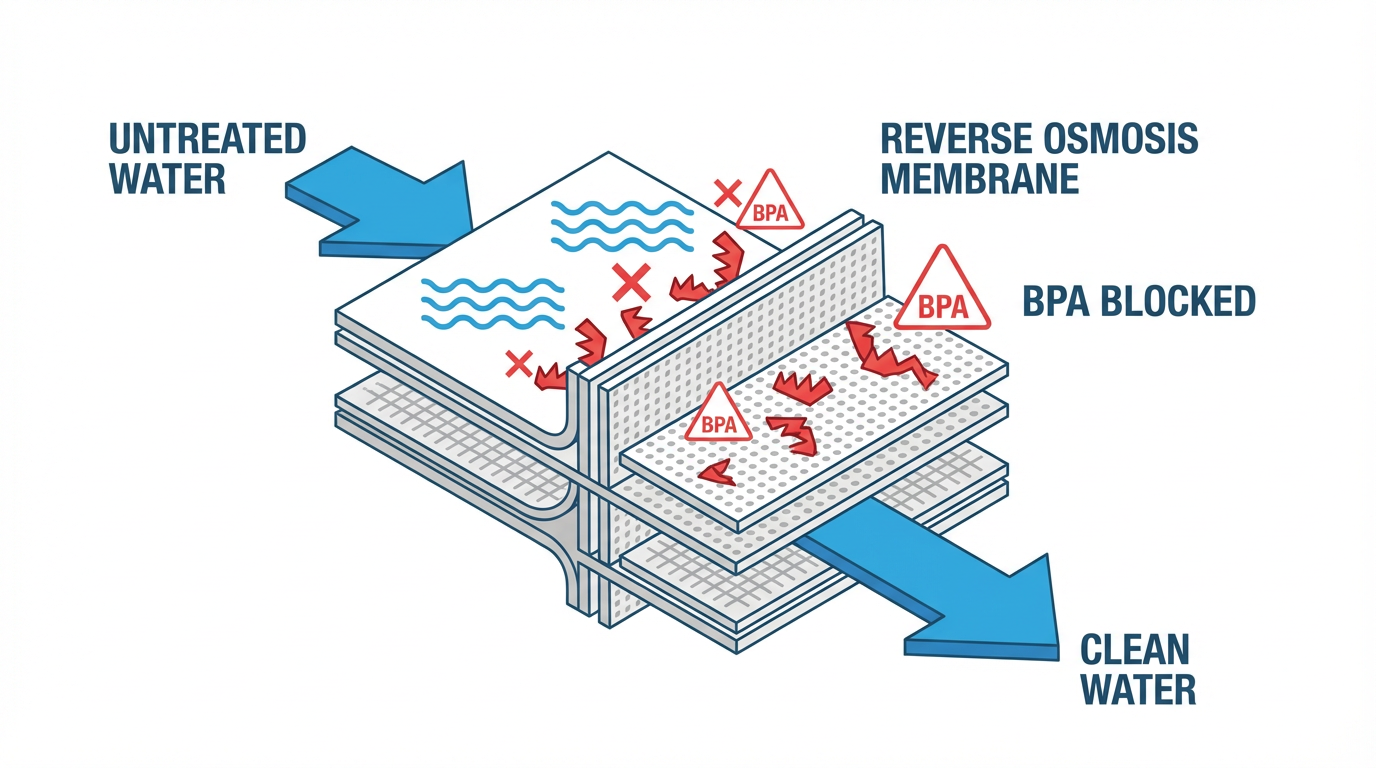
Reverse osmosis membranes are typically thin-film composite structures supported by polymer layers such as polysulfone. Several regulatory analyses of the EU’s new ban highlight a narrow derogation that allows BPA-derived monomers in these polysulfone resins, provided strict conditions are met.
The logic is straightforward but important. RO, along with related pressure-driven membrane processes like microfiltration and ultrafiltration, is central to microbiological safety and desalination. For now, regulators accept that some high-performance membranes rely on chemistries that trace back to bisphenols. Instead of forcing an immediate shift to entirely new polymer families, the EU allows these uses so long as migration of BPA from the finished membrane into water stays below a one microgram per kilogram detection threshold and the membranes are properly cleaned and flushed before use.
From a homeowner or facility perspective, that means the following. A membrane module used in a compliant RO system may contain BPA-derived material in its internal structure, but it is designed so that BPA does not measurably migrate into the permeate water under normal operating conditions. At the same time, the housings, storage tanks, fittings, and dispensers around that membrane increasingly need to be BPA-free to meet European rules.
In my own work reviewing RO installations for clients who operate in both EU and non-EU markets, I have seen this lead to a pattern: membranes are sourced from suppliers with strong compliance documentation, while accessory choices are aggressively shifted toward BPA-free plastics, stainless steel, or glass wherever water can stagnate or be stored.
How Well RO And Other Filters Remove BPA From Water
There are two sides to the BPA story in filtration: materials that might add BPA to water, and processes that can remove BPA that is already there.
A study in Water Science and Technology looked at two treatment processes for BPA in water: an advanced oxidation process combining ultraviolet light with hydrogen peroxide, and reverse osmosis membrane separation. Under the tested conditions, the UV/hydrogen peroxide process removed up to forty-eight percent of BPA at the highest combination of UV dose, oxidant, and BPA concentration. However, partial oxidation created by-products with measurable estrogenic activity, meaning the total hormone-like activity in water could actually increase unless the process conditions were carefully optimized or followed by a polishing step.
The same study evaluated RO membranes and found that they rejected BPA in the range of sixty to eighty-four percent. In water containing ten micrograms per liter of BPA, RO delivered greater reduction than the advanced oxidation conditions tested. The researchers also noted that BPA adsorbed onto the membrane surface, which contributes to apparent removal but raises questions about long-term membrane performance and potential desorption.
Other research on low-pressure reverse osmosis for BPA-containing industrial wastewater reinforces the idea that RO can be an effective barrier. In that work, BPA removal depended on size exclusion through the dense membrane layer, hydrophobic interactions between BPA and membrane surfaces, and electrostatic effects. Process configuration allowed for a purified permeate and a BPA-enriched concentrate, positioning RO as both a treatment and a concentration step for further handling.
On the household side, several manufacturers report strong BPA removal using activated carbon, especially in dense carbon block form. One brand that uses coconut-shell-based carbon blocks reports that its filters remove about ninety-nine percent of BPA from drinking water when maintained properly, and simultaneously reduce other contaminants like chlorine and certain perfluorinated compounds. Coconut-based carbon has very high internal surface area—on the order of thousands of square feet per gram—so organic molecules like BPA can be effectively adsorbed as water passes through.
A comparison table helps clarify how these options relate to each other and to RO accessories.
Treatment step |
How it targets BPA |
Reported performance in cited studies |
Key considerations for RO users |
RO membranes (household/utility) |
Size exclusion and interactions within the membrane’s dense layer |
Around 60–84% BPA rejection in one water-treatment study |
Strong primary barrier; membrane materials must meet BPA rules |
UV/H₂O₂ advanced oxidation |
Hydroxyl radicals oxidize BPA and related organics |
Up to 48% BPA removal in tested conditions |
May form estrogenic by-products; often needs a polishing step |
Activated carbon (block filters) |
Adsorption onto high-surface-area carbon pores |
One manufacturer reports about 99% BPA removal |
Highly effective polishing; requires regular cartridge replacement |
In real-world home systems, RO and activated carbon are often combined.

A typical under-sink RO system may use a carbon prefilter to protect the membrane and a carbon postfilter to polish taste. In that configuration, the membrane handles a large portion of BPA reduction along with salts and many other contaminants, while the carbon stages provide additional adsorption and taste improvement.
Given the rodent-lab evidence that RO-filtered taps had about ten times less BPA than unfiltered taps, and the strong performance of carbon blocks against organics, a well-designed multi-stage RO system with BPA-conscious accessories can be a powerful tool for reducing BPA exposure from water, even if drinking water is only a small slice of total BPA intake.
Practical Guidance For BPA‑Safer RO Accessories And Setups
The science and regulations can feel abstract until you translate them into actual decisions at the kitchen sink or equipment room. Here is how I advise clients who want both regulatory peace of mind and health-focused hydration.
For point-of-use containers and dispensers, prioritize materials that avoid BPA. Glass and stainless steel are the safest bets for bottles and carafes that will hold water for hours at room temperature or warmer. Among plastics, independent sources such as Culligan Quench and APEC Water highlight that items marked with certain recycling codes are more likely to contain BPA, particularly older products labeled with code seven, while codes such as one, two, and four are generally considered lower risk. When you do use plastic accessories, focus on products clearly labeled as BPA-free from reputable manufacturers, and replace any that become cloudy, cracked, or heavily scratched, since damage can increase leaching.
For office and commercial environments, consider moving from large bottle-based coolers to plumbed-in, bottleless dispensers that integrate RO and carbon filtration. Articles from workplace hydration providers point out that this shift not only reduces BPA exposure from big plastic bottles but also cuts down on microplastics, delivery logistics, and long-term cost. In my experience, bottleless systems also make it easier to track filter changes and hygiene, which indirectly affects overall water quality.
Within the RO system itself, ask your supplier for explicit confirmation that housings, sumps, storage tanks, and faucet components are free of BPA and compliant with the strictest relevant standards, especially if you plan to sell or install systems in the EU. The membrane may legitimately rely on BPA-derived polysulfone under the EU exemption as long as migration is non-detectable, but surrounding plastics no longer have that regulatory shelter. When selecting tanks and lined metal components, confirm that any internal coatings are formulated without BPA or other restricted bisphenols where your target market requires it.
Filter maintenance is not just a taste issue when it comes to BPA. Activated carbon cartridges need regular replacement to maintain adsorption capacity. Several environmental and filtration sources recommend changing pitcher filters roughly every few months and plumbed-in cartridges at manufacturer-recommended intervals, often on the order of six to twelve months depending on usage. Neglecting filter changes can shorten the life of an RO membrane and reduce the system’s ability to capture organic contaminants such as BPA.
How you operate the system matters too. The animal facility study that found higher BPA levels in primary, unflushed tap samples suggests a simple habit: when you return from travel or start the day, let the tap run for several seconds before feeding your RO system or filling containers. This flushes out water that has been sitting in pipes and reduces any contribution from epoxy-lined plumbing. Similarly, avoid filling RO storage or serving jugs with very hot water and avoid heating plastic containers in the microwave or dishwasher when they are not designed for it, since high heat is known to increase leaching.
If you are responsible for compliance in a company that manufactures or distributes RO systems, build a documentation chain that would satisfy the EU’s Declaration of Compliance requirements even if you are not yet selling into Europe. That means knowing exactly which polymers, coatings, and adhesives contact water, having migration test results or material declarations for BPA and other bisphenols, and tracking any use of polysulfone membranes that rely on BPA exemptions. Given that other jurisdictions are watching Europe closely, being ahead of the curve lowers your risk of future product redesigns.
Finally, remember that drinking water is usually only a fraction of total BPA exposure. Multiple sources, including EPA-related analyses cited by Aquagear and SpringWell Water, indicate that diet from food packaging and other consumer products is a larger contributor. That perspective can take some pressure off the RO system and shift it toward a broader lifestyle question. A BPA-conscious hydration setup is still worth pursuing because it is a controllable, daily exposure, but it should sit alongside choices such as reducing canned foods, being selective about plastics, and reviewing children’s products for safer materials.
Frequently Asked Questions
Can my RO system add BPA to my drinking water?
Based on the research summarized here, a modern RO system is more likely to reduce BPA in your water than to add it, especially if it uses RO membranes plus activated carbon and is fed by a tap that you briefly flush. However, some older or cheaper accessories, particularly large polycarbonate bottles or BPA-based tank linings, can contribute BPA if they contact stored water. The animal bottle study showing much higher BPA in polycarbonate than in glass is a reminder that your storage vessels matter as much as your filtration technology.
Does RO remove BPA completely?
No single treatment step removes BPA completely in every scenario. The Water Science and Technology study found that RO membranes rejected about sixty to eighty-four percent of BPA under its test conditions, and low-pressure RO research indicates strong but not absolute retention, depending on membrane properties and water chemistry. Activated carbon can bring down residual levels further; one manufacturer reports about ninety-nine percent BPA removal with its coconut-shell carbon block filters. In practice, combining RO with well-designed carbon stages will reduce BPA substantially, but not to literal zero.
If drinking water is a small fraction of my BPA exposure, why focus on RO accessories at all?
It is true that several analyses, including one cited by SpringWell Water, suggest that drinking water accounts for less than a few percent of total BPA ingestion on average, with packaging and other food-contact materials dominating. However, water is something you consume many times a day, and hydration gear is one of the easier categories to upgrade. Replacing a polycarbonate bottle with glass or stainless steel, switching from a bottle-fed cooler to a bottleless RO dispenser, and choosing BPA-conscious RO components are relatively simple, one-time choices that keep paying benefits over the life of the system. They also align naturally with other moves many people make for better hydration, such as drinking more water and relying less on bottled beverages.
Closing Thoughts
BPA regulation is tightening fastest where food and water meet, and RO systems sit right at that intersection. The good news is that the same technologies that protect you from microbes, salts, and industrial pollutants can also help lower BPA, as long as they are paired with thoughtful choices about materials and maintenance. If you treat your RO accessories with the same level of attention you give to your water quality data, you can build a hydration setup that respects both regulatory realities and your own long-term health.
References
- https://pmc.ncbi.nlm.nih.gov/articles/PMC5438920/
- https://www.bcpp.org/resource/bpa-laws-and-regulations/
- https://www.mayoclinic.org/healthy-lifestyle/nutrition-and-healthy-eating/expert-answers/bpa/faq-20058331
- https://www.plasticpollutioncoalition.org/blog/2023/3/23/toxic-free-water-filters-as-a-solution
- https://www.researchgate.net/publication/338848991_Treatment_of_Bisphenol_A_BPA_in_water_using_UVH2O2_and_reverse_osmosis_RO_membranes_assessment_of_estrogenic_activity_and_membrane_adsorption
- https://www.cirs-ck.com/en/comprehensive-analysis-and-latest-developments-on-global-control-of-bisphenol-a-bpa
- https://clearlyfiltered.com/articles/understanding-what-bpa-is-and-its-health-effects
- https://food.ec.europa.eu/food-safety-news-0/commission-adopts-ban-bisphenol-food-contact-materials-2024-12-19_en
- https://www.food-safety.com/articles/10023-eu-officially-adopts-ban-on-bpa-in-all-food-contact-materials
- https://www.healthline.com/nutrition/what-is-bpa

Share:
Understanding the Importance of pH Range for RO Membrane Functionality
Understanding When and Why to Boost RO Pressure Toward 0.6 MPa (About 87 PSI)