

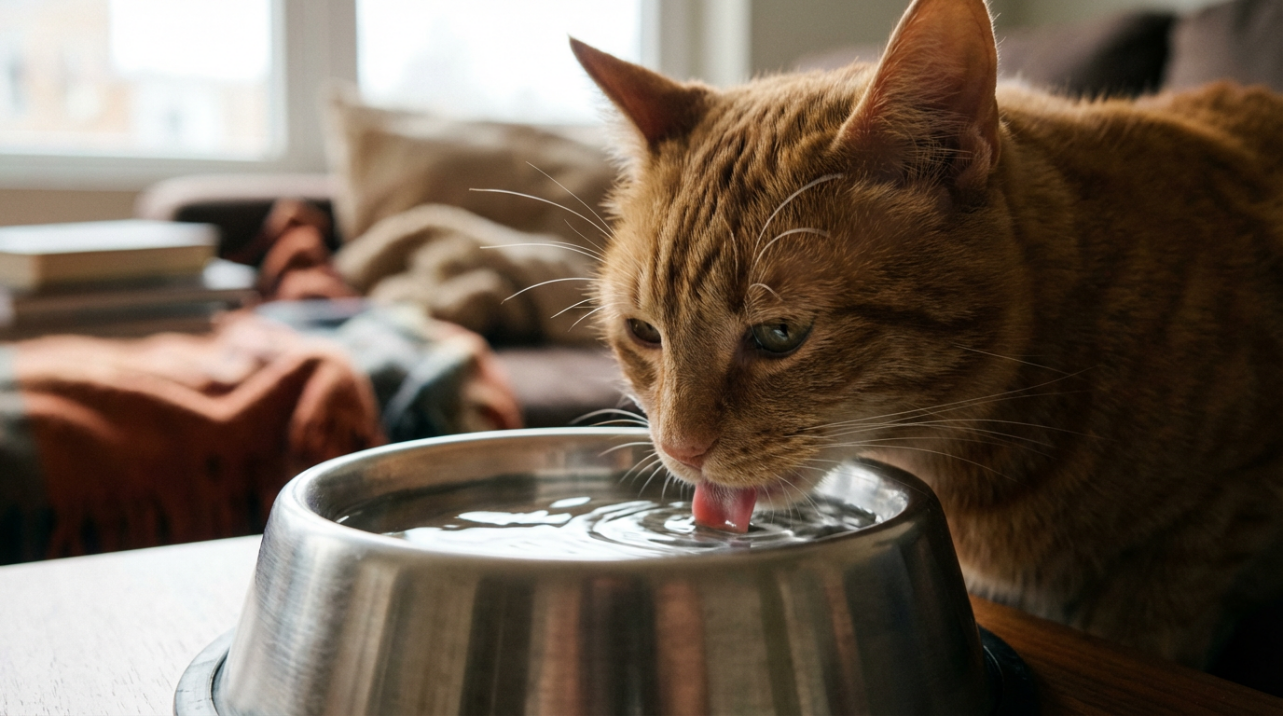
As a Smart Hydration Specialist and water wellness advocate, I spend a lot of time looking at something most cat guardians barely think about: the actual water in the bowl. Not just whether the bowl is full, but what kind of water it contains, how it tastes and smells to a cat, and how the whole setup supports or sabotages long‑term kidney and urinary health.
Veterinary centers such as the Cornell Feline Health Center, FEDIAF (the European pet food federation), and the Merck Veterinary Manual all emphasize the same core truth: hydration is not optional for cats. It drives temperature regulation, digestion, circulation, toxin removal, and joint lubrication. When you combine cats’ naturally low thirst drive with less‑than‑ideal water or bowl setups, you get a quiet recipe for chronic mild dehydration, urinary tract problems, and kidney disease.
This guide will walk you through the key decisions every cat guardian needs to make about drinking water: how much water your cat should actually get, whether tap or filtered water makes more sense in your home, which equipment to use, and how to know the setup is truly working for your cat.
Why Your Cat’s Drinking Water Matters More Than You Think
Domestic cats evolved from desert‑dwelling ancestors that were designed to meet most of their fluid needs by eating prey with very high moisture content. Sources such as Countryside Animal Hospital and Pet Age explain that wild prey typically contains around seventy to seventy‑five percent water, while modern dry kibble often contains only about six to ten percent. Because of that evolutionary background, cats simply are not wired to seek out large quantities of standing water, even when they need it.
Veterinary organizations consistently warn that this low thirst drive, combined with modern diets and indoor lifestyles, puts many cats in a state of chronic mild dehydration. Countryside Animal Hospital and Cornell note that this can contribute to urinary tract infections, crystals and stones, constipation, reduced circulation, and over time, chronic kidney disease. Older cats and those with existing kidney or urinary issues are especially vulnerable, which is why feline‑only clinics such as Taunton Cat Hospital devote entire campaigns like National Pet Hydration Awareness Month to this topic.
In practice, this means the water you choose and how you present it are not cosmetic choices. They directly affect how much your cat drinks, how concentrated their urine becomes, and how hard their kidneys have to work. A ten‑pound indoor cat may look “fine” lapping at a single bowl near the food dish, but if the water is slightly off‑putting in taste, a little stale, or presented in a whisker‑unfriendly bowl, that same cat can quietly fall short of their daily hydration needs every single day.
The good news is that relatively small changes in water quality and setup can have outsized health benefits. Studies summarized by Pet Age and FEDIAF show that when cats get more water through moisture‑rich food and appealing water sources, they produce larger volumes of more dilute urine and see lower risk of urinary problems. That is exactly what you want your cat’s kidneys and bladder to experience throughout their life.
How Much Water Should My Cat Get Each Day?
Before choosing the “right” water, it helps to know how much water your cat’s body is aiming for. Cornell’s Feline Health Center notes that a typical cat needs about four ounces of water per five pounds of lean body weight each day, counting both what they drink and what they get from food. That means an average ten‑pound cat should be taking in roughly eight ounces, or about one cup, of water daily from all sources.
Darwin’s Pet and FEDIAF describe similar ranges in metric form, which translate to roughly 0.7 to 1.0 fluid ounce of water per pound of body weight per day. Hill’s Pet Nutrition arrives at a comparable practical guideline, explaining that most cats will drink somewhere in the range of about five to ten ounces of water per day depending on size, activity level, age, and how much moisture their food provides.
To make those numbers less abstract, here is how the daily target looks for common cat weights. These values are drawn from Darwin’s hydration chart and Cornell’s guidance and expressed in cup equivalents for convenience.
Cat weight (lb) |
Approximate total water per day (cups, from food + drinking) |
Approximate total water per day (fl oz) |
7 |
about 0.5 to 0.8 |
about 4 to 6.4 |
9 |
about 0.7 to 1.0 |
about 5.6 to 8 |
11 |
about 0.9 to 1.4 |
about 7.2 to 11.2 |
13 |
about 1.1 to 1.7 |
about 8.8 to 13.6 |
15 |
about 1.3 to 2.0 |
about 10.4 to 16 |
Here is how this plays out in a real‑world scenario. Imagine a ten‑pound cat whose daily target is roughly one cup of water. A cat eating mostly dry food, which is only a few percent water, may get only a small fraction of that total from meals and has to make up the rest by drinking. If that cat only takes a handful of short drinks each day from an unappealing bowl, they can easily fall a few ounces short on most days.
Contrast that with a ten‑pound cat eating moisture‑rich canned food that is up to eighty percent water, as described by Countryside and Pet Age. That cat may get a large portion of the daily target built into their meals and only needs to drink a modest amount extra. The difference in total fluid intake, urine volume, and urine concentration between those two cats can be dramatic despite them living in the same apartment and sharing the same tap.
The takeaway from Cornell, FEDIAF, and Hill’s is that you do not need to measure every sip, but you do want a rough sense of your cat’s daily intake. If your cat’s drinking and eating habits combined seem unlikely to reach at least around one cup of total water per ten pounds of body weight each day, especially in warm weather or during illness, it is time to optimize both water quality and presentation.
Tap, Filtered, Bottled, or Distilled: Which Water Is Best?
Once you know how much water your cat should get, the next decision is what kind of water to put in the bowl or fountain. Here is where water quality, taste, safety, and practicality intersect.
Tap Water: Often Acceptable, Sometimes Preferred
Several sources highlight that properly treated municipal tap water is generally considered safe for healthy pets. The Uahpet guide notes that tap water from a reliable municipal supply goes through treatment to remove many contaminants before it reaches your kitchen. Priority Pet Hospital even describes a double‑blind study presented at an international veterinary behavior meeting in which cats overwhelmingly chose tap water over filtered water when given a side‑by‑side choice, as well as household observations where cats ignored filtered water in a fountain but happily drank plain tap from another bowl.
This paints a nuanced picture. For many households where people themselves drink their tap water without concern, clean, fresh tap water is a perfectly reasonable starting point for cats and may actually be more appealing than heavily filtered water in terms of taste. As veterinary behaviorists involved in that study concluded, you do not need to invest in filtration for taste reasons alone if your cat already prefers the tap and your local water quality is good.
At the same time, pet health and water quality experts such as Leaf Home and Wired Whisker point out that even tap water meeting regulatory standards can contain chlorine, chloramine, trace levels of heavy metals from aging pipes, and other residual contaminants that may irritate sensitive pets or contribute to urinary tract issues in susceptible animals. If you do not like the taste of your tap water, or you live in an area with very hard water or known plumbing issues, it is reasonable to question whether that same water is ideal for your cat.
Filtered Water: Extra Protection and Better Palatability
Filtered water adds a layer of protection by running tap water through media such as activated carbon or more advanced multi‑stage filters. Family Pet Medical Center defines filtered water as water processed to remove impurities like bacteria, parasites, heavy metals, chemicals, and pesticides while retaining beneficial minerals. Leaf Home and Wired Whisker both present filtered water as the best long‑term household option because it reduces chlorine and many contaminants yet keeps essential minerals that support healthy physiology.
From a hydration‑behavior standpoint, filtration can also improve taste and smell. Wired Whisker notes that cats’ sense of smell is roughly fourteen times stronger than ours, making them much more sensitive to the subtle odors that chlorine and other additives leave in tap water. Removing those off‑putting smells through filtration can make water more inviting, especially for picky or low‑thirst cats, cats with kidney or urinary issues, or cats that have previously turned away from certain water bowls.
Uahpet emphasizes that filtered water is particularly helpful for cats that are sensitive to tap‑water taste or odor, reluctant to drink, or managing specific health conditions. Leaf Home adds that filtration can lower the risk of urinary stones and kidney problems associated with certain minerals and contaminants in hard or highly treated water. Many modern cat fountains now incorporate multi‑stage filters that combine mechanical screens with activated carbon and ion exchange resins, aiming to remove sediment, chlorine, and some metals while circulating and oxygenating the water.
One important nuance, drawn from Priority Pet Hospital’s summary of the Wooding and Mills study, is that filtration should not come at the cost of actual drinking. If your cat clearly prefers the taste of your safe municipal tap over filtered water, hydration wins. The science‑backed compromise is to offer both tap and filtered options for a week or two, see which one your cat naturally chooses, and then pair their favorite with consistent cleanliness and an appropriate bowl or fountain.
Bottled and Distilled Water: Niche Roles Rather Than Everyday Solutions
Hill’s Pet Nutrition explains that most bottled spring water or bottled tap water is safe to share with pets and can be a convenient option when traveling or when your home supply is temporarily compromised. Leaf Home notes, however, that relying on bottled water long term is costly and less environmentally friendly than home filtration. For most households, bottled water makes sense as a backup or travel solution rather than the default option for your cat’s daily hydration.
Distilled water is a different story. Both Hill’s and Leaf Home express caution about using distilled water as a primary source for pets because the distillation process strips out not only contaminants but also essentially all minerals. Some veterinarians cited by Hill’s are skeptical about the long‑term effects of distilled water on urinary and cardiac health. Leaf Home suggests reserving distilled water for short‑term situations, such as during boil‑water advisories, rather than for everyday use. In a smart hydration setup, distilled water is a temporary stopgap, not a lifestyle.

Outdoor, Fish‑Tank, and Ocean Water: Avoid for Drinking
When cats explore, they may be tempted by novelty water sources. Hill’s Pet Nutrition and pet health organizations such as the American Kennel Club warn that ponds, creeks, and rivers can harbor leptospirosis bacteria, algae, and other pathogens in standing water and mud. Fish tanks and ornamental ponds are often treated with chemicals to balance pH and control algae for the benefit of the fish, not for safe mammalian drinking. Ocean water poses its own danger; Hill’s, referencing Tufts University’s Cummings School of Veterinary Medicine, explains that seawater’s high salt content can cause salt poisoning, or hypernatremia, which disrupts normal sodium balance and can trigger neurologic signs.
For indoor cats, the main takeaway is simple: redirect them from aquariums, decorative water features, and any saltwater exposures, and make their own water stations more appealing so they are less tempted by unsafe alternatives.
Putting Water Choices Together
When you blend all of these expert perspectives, a practical hierarchy emerges. In a typical home with safe municipal supply, clean tap water is a perfectly acceptable choice and may be your cat’s favorite. If you already use filtration for your own water or you live in an area with water‑quality concerns, filtered tap water gives your cat an extra margin of safety and often better palatability. Bottled water serves as a backup or travel solution. Distilled water is best reserved for short‑term use when advised, rather than as daily drinking water. Outdoor surface water, fish‑tank water, and ocean water are best treated as off‑limits.
Bowls, Fountains, and Placement: Building a Cat‑Friendly Hydration Station
Water quality is only half the story. Veterinary clinics like Taunton Cat Hospital and hydration guides from Darwin’s Pet, Meowant, and Leaf Home all highlight that cats can be surprisingly particular about how and where their water is presented.
From a materials perspective, Taunton Cat Hospital and Meowant both recommend avoiding plastic bowls because plastic can harbor bacteria in micro‑scratches and may alter the taste of the water. Instead, they prefer stainless steel or ceramic, which are less porous, easier to sanitize, and less likely to impart unwanted flavors. Leaf Home echoes this, highlighting stainless steel and ceramic as the most hygienic, durable options for pets’ water.
Bowl shape and depth matter too. Taunton and Pet Evolution point out that wide, shallow bowls are often more comfortable for cats because they reduce whisker contact with the sides. Many cats find deep, narrow bowls unpleasant and will quietly drink less from them. In my own hydration assessments, one of the most common upgrades that immediately changes a cat’s behavior is switching from a small, deep plastic dish to a wide, shallow stainless steel or ceramic bowl.
Cleanliness and refresh frequency are non‑negotiable. Meowant and Leaf Home advise replacing your cat’s water at least once or twice per day, even with a fountain, because bacteria and debris accumulate quickly in stagnant water. Meowant, Leaf Home, and Darwin’s all recommend washing bowls daily with warm, soapy water and performing regular deeper cleanings to remove biofilm, that slimy bacterial layer that builds up on surfaces in contact with water. For fountains, Darwin’s and Uahpet stress following the manufacturer’s instructions for disassembling and scrubbing hidden crevices, as well as replacing filters on schedule.
Placement is another frequently overlooked factor. FEDIAF and Cornell suggest providing multiple water stations around the home to make drinking convenient and to avoid territorial conflicts that block access. Taunton and Darwin’s recommend placing bowls in rooms your cat naturally frequents, away from litter boxes and strong odor sources, and not always right next to food. Some cats prefer their water slightly apart from food; others love to drink near favorite perches, sleeping spots, or treat stations. A simple real‑world experiment is to place two or three bowls in different quiet, low‑traffic areas and watch where your cat reliably goes.
Pet fountains deserve their own mention. Countryside Animal Hospital, Taunton Cat Hospital, Meowant, Uahpet, Cornell, Leaf Home, and Wired Whisker all point out that many cats prefer moving water because it appears fresher, stays cooler, and is more oxygenated. Fountains also typically incorporate filtration to keep water cleaner between full changes. Meowant’s and Uahpet’s product examples show features that matter in practice: stainless steel construction for hygiene, quiet motors so noise‑sensitive cats are not scared away, cordless or flexible placement, and multi‑stage filters. Darwin’s adds an important safety note for plug‑in fountains: plug them into properly protected outlets and keep electrical components away from splashing.
Whether you use bowls, fountains, or both, think of your hydration setup as a “station” that you calibrate to your cat’s preferences. Start with safe water (tap or filtered), choose non‑plastic, whisker‑friendly bowls or a well‑designed fountain, place them in appealing, low‑stress locations, and keep them very clean. When those basics are right, cats often increase their intake without any coaxing.

Food, Treats, and Flavor Boosters: How Diet Complements Drinking Water
The water that ends up in the bowl is only part of your cat’s hydration story. Several veterinary and nutrition sources, including Countryside Animal Hospital, Pet Age, Darwin’s Pet, Cornell, and FEDIAF, emphasize that water contained in food plays a major role for cats, sometimes even more than what they drink.
Pet Age describes a controlled WALTHAM Centre for Pet Nutrition trial where cats were fed diets with identical nutrient content but different moisture levels, ranging from dry food with a little over six percent water up to wet food with more than seventy percent water. As dietary moisture increased, cats drank less from the bowl but still achieved significantly greater total fluid intake overall, with larger urine volumes and more dilute urine. The lesson is that you cannot rely on the water bowl alone to meet a cat’s hydration needs, especially if they are eating mostly dry food.
Countryside Animal Hospital and Darwin’s point out that canned foods typically contain up to about eighty percent water. Cornell agrees that cats eating wet diets often drink less because they already meet much of their daily requirement through food. Wet or raw diets therefore pull double duty: they provide the necessary nutrients while quietly delivering a steady flow of moisture that supports urinary and kidney health.
This has knock‑on benefits beyond hydration. Pet Age notes that high‑moisture diets are naturally lower in calories per gram, which helps cats feel satisfied on fewer calories and can support healthy weight management. They also report that well‑hydrated stool makes digestive transit smoother and may help reduce constipation and ease hairball passage. In practice, many veterinarians recommend switching cats with urinary issues, constipation tendencies, or early kidney disease to moisture‑rich diets as part of a broader management plan.
You do not necessarily need to switch completely away from dry food overnight. Pet Age and Darwin’s both suggest blending wet and dry foods, such as topping kibble with canned food or high‑moisture purees, as a practical middle ground. Over time, you can gradually increase the proportion of wet food if your cat and your veterinarian agree it is appropriate.
Flavor boosters and water‑rich treats can also help, especially for reluctant drinkers. Countryside, Cornell, and Darwin’s mention using a small splash of tuna water from tuna packed in water (not oil) or a little low‑sodium chicken broth to make water more enticing. Darwin’s also recommends using leftover liquid from canned or raw food as a flavor enhancer. Meowant and Pet Evolution highlight ice cubes and frozen treats made from water mixed with wet food or broth; movement and novelty can attract cats and turn hydration into enrichment.
Whenever you use flavorings, the hygiene rules become even more important. Meowant and Darwin’s caution that flavored water spoils faster, so it should be changed more frequently to prevent bacterial growth. Offer small portions that your cat will consume within a short time, then wash and refill the bowl.
A simple example brings this together. Imagine a twelve‑pound cat whose daily target is roughly a cup and a half of total water. If that cat eats mostly dry food and is not a big drinker, you can increase daily moisture intake by switching half of the calories to canned food, adding a tablespoon or two of warm water to each wet meal, offering a small amount of flavored water once a day as a snack, and introducing a fountain with filtered tap water. None of these changes are extreme on their own, but together they can move that cat from marginal hydration to comfortably meeting their daily needs.
How to Know Your Cat’s Water Choice Is Working (and When to Worry)
Picking the “right” water for your cat is ultimately about outcomes, not equipment. The most important question is whether your cat is actually well hydrated and drinking safely.
Cornell Feline Health Center, FEDIAF, Leaf Home, Meowant, Countryside Animal Hospital, Pet Evolution, and Darwin’s all describe similar signs of possible dehydration. On the behavioral side, you may see lethargy, weakness, or a noticeable drop in playfulness. Appetite may decrease, and groomers often report that dehydrated cats may groom less. Physically, gums and tongue can become dry or tacky instead of moist and slick, saliva can feel thicker, and eyes may appear slightly sunken. Urine may become darker, more concentrated, and stronger‑smelling, and you might notice that the litter box is being used less often.
The skin‑tent test is a simple at‑home check described by Cornell, Darwin’s, and FEDIAF. Gently lift the loose skin over your cat’s shoulders and then release it. In a well‑hydrated cat, the skin snaps back quickly into place. In a dehydrated cat, it may fall back more slowly or remain slightly tented. Cornell notes that this sign is less reliable in older cats whose skin is naturally less elastic, so you should interpret it in context with other signs.
Leaf Home and FEDIAF remind us that dehydration develops faster than most nutrient deficiencies and can quickly affect circulation, electrolyte balance, and temperature regulation. In severe cases, clinical signs can progress to cardiac arrhythmias and neurologic abnormalities. That is why both Cornell and the European pet‑food guidelines advise contacting a veterinarian promptly if you suspect dehydration, especially if it is accompanied by vomiting, diarrhea, or known conditions such as chronic kidney disease, diabetes, or hyperthyroidism.
On the flip side, a well‑tuned hydration setup typically shows itself in small but reassuring ways. Your cat visits their water station regularly without hesitation, prefers their clean bowl or fountain over random drips or tanks, has steady litter box habits with urine that is not overly dark or strong‑smelling, and maintains normal energy and appetite. In older cats, many veterinary teams such as those at Countryside Animal Hospital and Taunton Cat Hospital encourage guardians to monitor water intake and litter box output more consciously because subtle changes here can be early flags for underlying disease.
If you have adjusted water type, bowls, fountain, and diet but your cat still seems under‑hydrated or shows any worrying signs, that is the point where water decisions and veterinary care intersect. Cornell and Leaf Home both emphasize that underlying illnesses can both increase water loss and reduce intake, so professional evaluation and, when needed, fluid therapy are essential.
FAQ: Everyday Decisions About Cat Drinking Water
Should my cat drink the same filtered water that I do?
If you use filtered water for your family because of taste or water‑quality concerns, veterinary sources such as Family Pet Medical Center and Leaf Home suggest offering that same filtered water to your pets. Filtration can reduce chlorine, heavy metals, and other contaminants while retaining beneficial minerals. However, the behavioral research summarized by Priority Pet Hospital shows that some cats actually prefer plain tap water and will drink more of it. A practical, science‑aligned approach is to offer both safe tap and filtered water initially, watch which your cat chooses, and then commit to the option that delivers the best combination of safety, taste, and consistent drinking.
Is hard tap water or well water bad for cats?
Leaf Home notes that hard water containing high levels of minerals such as calcium and magnesium, as well as possible trace metals like lead or copper, may contribute to urinary tract issues and other health problems in susceptible pets. Family Pet Medical Center similarly warns that heavy metals and certain chemicals in water can affect pets’ digestive and nervous systems. If your home has very hard water, older plumbing, or a private well, it is wise to have your water tested and discuss the results with your veterinarian. In many cases, a properly chosen filtration system that targets your specific contaminants gives your cat a safer, more consistent water supply.
Do I really need a cat water fountain, or are bowls enough?
Feline‑focused clinics like Taunton Cat Hospital and educational resources from Cornell and Countryside Animal Hospital emphasize that moving water can entice many cats to drink more, and modern pet fountains often include filtration that helps keep water fresher between changes. However, fountains are not mandatory. A well‑hydrated cat can do perfectly well with still water as long as it is clean, refreshed daily, presented in stainless steel or ceramic bowls, and located in appealing, low‑stress spots. If your cat is not drinking much from bowls, is fascinated by running faucets, or has urinary or kidney issues, a fountain is a tool worth trying, provided you clean it and maintain its filters as recommended.
Is it safe to flavor my cat’s water?
Veterinary hydration guides from Cornell, Countryside Animal Hospital, and Darwin’s Pet describe using small amounts of tuna water (from tuna packed in water, not oil) or low‑sodium chicken broth to encourage drinking in reluctant cats. This can be safe and effective when used sparingly and when your veterinarian agrees it suits your cat’s health profile. The key is to keep portions small, avoid high‑salt products, and change flavored water frequently because it spoils faster and can harbor bacteria. As Meowant and Leaf Home stress, flavored water does not reduce the need for daily washing and frequent refills; it increases that need. Think of flavoring as a short‑term nudge layered on top of a solid foundation of clean, appealing plain water and moisture‑rich food.
Staying ahead of hydration problems starts with simple, deliberate choices: know roughly how much water your cat needs, give them safe and appealing water (tap or filtered) in the right bowls or fountains, and support that effort with moisture‑rich food and attentive observation. When you treat water quality and hydration as core parts of your cat’s wellness plan, you are not just filling a bowl; you are quietly protecting their kidneys, bladder, and comfort for years to come.
References
- https://www.vet.cornell.edu/departments-centers-and-institutes/cornell-feline-health-center/health-information/feline-health-topics/hydration
- https://research.oregonstate.edu/sites/research.oregonstate.edu/files/iacuc/files/animal-care-inspection-guide-2020.pdf
- https://www.shepherd.edu/app/uploads/2018/06/AC_BlueBook_AWA_FINAL_2017_508comp.pdf
- https://ucanr.edu/sites/default/files/2013-04/164790.pdf
- https://stormwater.ucf.edu/toolkit/vol1/Contents/pdfs/Pet%20Waste%20Management/petwaste.pdf
- https://europeanpetfood.org/pet-food-facts/fact-sheets/nutrition/the-importance-of-water-in-your-pets-diet/
- https://www.familypetmedicalcenter.com/reasons-to-give-your-pets-filtered-water/
- https://www.justanswer.com/cat-health/pm2jv-cat-refuses-drink-clear-filtered-water-bowl.html
- https://www.petage.com/cat-hydration-why-water-is-a-key-nutrient-to-lifelong-health-in-felines/
- https://tauntoncathospital.com/news/pet-hydration-awareness-month-cat

Share:
Hydration Strategies for Long-Term Meal Replacement Users
Guidelines for New Parents Choosing an RO System for Baby Formula