

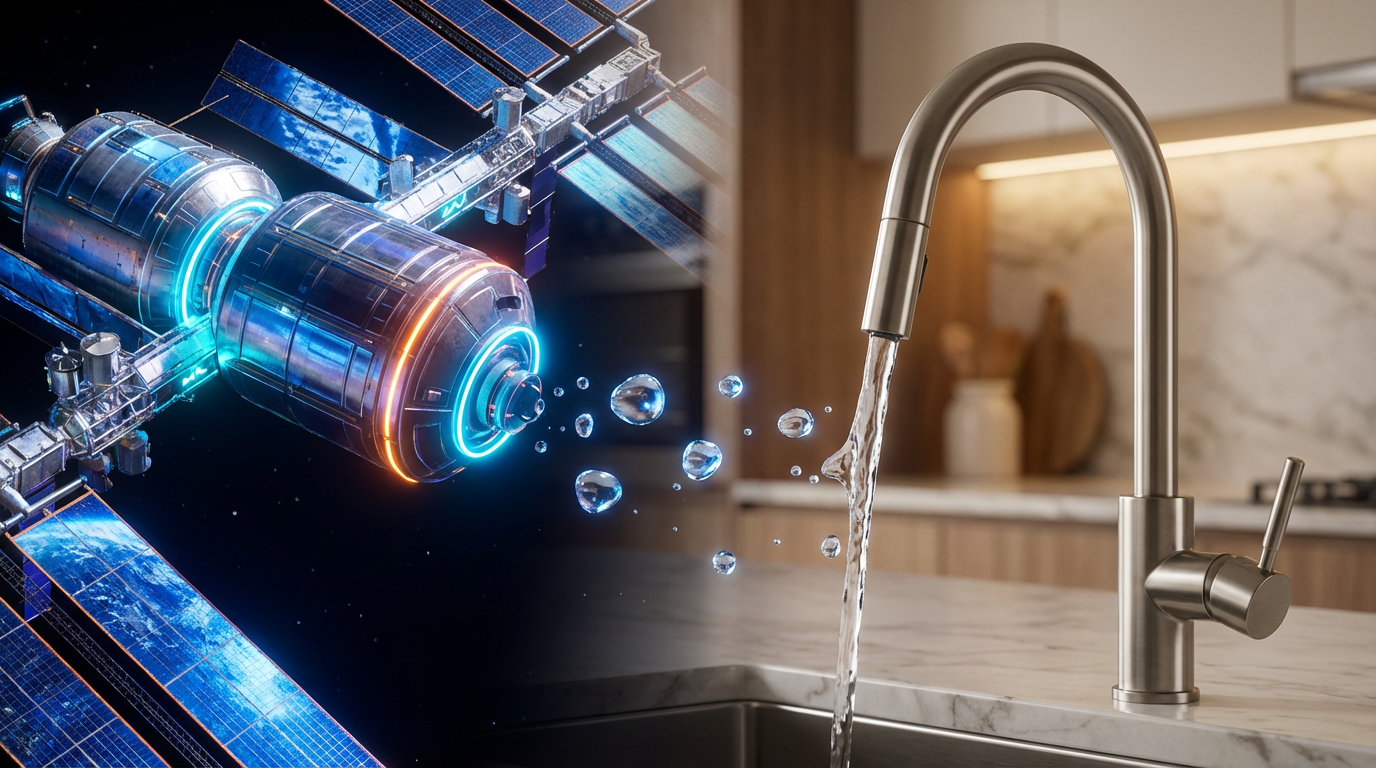
Why Space-Age Filtration Belongs in Your Kitchen
When you hear “NASA water technology,” you probably picture astronauts recycling every drop of moisture on a space station, not your kids filling a glass at the kitchen sink. Yet the gap between those two scenes is much smaller than it looks.
NASA has spent decades perfecting ways to purify water in the harshest environments imaginable: sealed spacecraft, closed-loop habitats, and remote research facilities where a failure is simply not an option. Many of those solutions have quietly migrated into everyday life as commercial “spinoff” technologies, from pool systems and industrial cooling towers to whole-house softeners and under-sink drinking water filters.
At the same time, concerns about tap water quality on Earth are rising. The Safe Drinking Water Act regulates many contaminants, but research summarized by Brio and by national health briefings shows that utilities still struggle with emerging threats such as PFAS “forever chemicals,” pharmaceuticals, and agricultural pollutants like nitrates. Aging pipes can leach lead into water after it leaves the plant, and extreme weather can overwhelm treatment systems, as in recent flooding-related crises.
As a smart hydration specialist, I see more households asking a very practical question: if NASA can safely turn humidity, urine, and wastewater into astronaut-ready drinking water, should I trust NASA-derived filtration in my home? The short answer is that these technologies can be excellent tools, but the NASA label alone is not a guarantee. You still need to match the technology to your water, verify performance, and understand the trade-offs.
This article will walk you through what “NASA water filtration” really means, how it compares with conventional systems, and when it is worth investing in space-age solutions for your everyday hydration.
What “NASA Water Filtration Technology” Actually Means
“NASA technology” is often used in marketing, but in the water world it has a specific meaning. NASA sponsors innovations for spacecraft and research missions, and then works with companies to adapt those inventions for Earth. Agencies such as NASA’s Spinoff program and the Water Resources Research Center describe several families of water technologies with space roots that now show up on the consumer side.
Here are the main categories you are likely to encounter at home.
First, there are advanced adsorption media built from NASA research in activated carbon chemistry. Aquaspace, for example, developed a proprietary compound after working with NASA on spacecraft purification. It blends several carbonaceous materials into a highly porous, thermally or chemically activated structure that offers on the order of two thousand square meters of surface area per gram, which is tens of thousands of square feet of microscopic adsorption sites. The pores are engineered in multiple size ranges so the media can grab both small and large organic and inorganic molecules.

Second, there are silver-ion based bacteriostatic technologies. In the Apollo era, NASA and its contractors created a compact, chlorine-free silver-ion purifier to keep spacecraft water safe without harsh chemicals. That work evolved into copper–silver ionization systems that sanitize pools, fountains, and cooling towers, and later into consumer filtration media where microscopic silver is embedded in the filter bed to inhibit bacterial growth. Puronics SilverShield and Hydronex MicroSilver Bacteriostasis are prime examples of this lineage.
Third, there are multi-stage, closed-loop purification and recycling concepts. On the International Space Station, NASA uses distillation, absorption beds, catalytic oxidation, and chemical conditioning to recover around ninety percent of wastewater, including urine and cabin condensation, for drinking. Related research produced advanced forward osmosis “water walls,” microwave-based decontamination for biofilms, and compact treatment pouches that turn heavily contaminated liquids into fortified drinks. While you do not have an ISS-style recycler in your basement, the same principles underpin many high-end residential systems that combine filtration, disinfection, and sensor-based control.

Finally, NASA-backed nanomaterials and membrane innovations, such as carbon nanotube meshes developed with Seldon Laboratories, show up in portable straw-style purifiers used during emergencies and in remote areas. These devices treat contaminated water at practical flow rates without power, an obvious advantage when the grid is down.
In short, NASA-derived water technologies at home usually fall into one of three roles: they act as smarter adsorption media inside a filter, they stabilize or boost disinfection without heavy chlorine, or they inspire multi-barrier, highly efficient systems that try to do more with less water, power, and maintenance.
How NASA Tech Compares With Conventional Home Filtration
Before you decide whether NASA belongs under your sink, it helps to understand how these systems differ from standard home filters. The unbiased Tap Score guide and public health agencies like the Centers for Disease Control and Prevention describe four major treatment families that dominate the residential market.
Adsorption filters, typically based on activated carbon, grab contaminants on the surface of porous media. They excel at improving taste and odor and can reduce many organic chemicals, some heavy metals, and disinfection byproducts. Membrane filtration, including reverse osmosis, uses semi-permeable barriers to remove increasingly small particles and dissolved substances; reverse osmosis, with extremely fine pores, can reduce parasites, bacteria, viruses, and a wide range of dissolved chemicals such as lead, copper, fluoride, and sodium. Ion exchange swaps harmful ions, such as hardness minerals or certain metals, for benign ones; this includes traditional water softeners and specialized resins for nitrate or arsenic. Disinfection methods such as ultraviolet light and chlorination target microbes but do not remove chemicals.
NASA-derived systems build on these same foundations rather than replacing them. Aquaspace’s compound is still a carbon-based adsorption media, but it is engineered to target a broader spectrum of contaminants with a highly electropositive surface while retaining beneficial minerals like calcium, magnesium, and potassium and maintaining a stable pH. Silver-based bacteriostatic media sit inside conventional softeners or whole-house filters and inhibit bacterial growth in the tank without relying on high chlorine doses. Closed-loop and nanomesh systems still use membranes and adsorption, but they are optimized for extreme reliability and efficiency.
From a performance standpoint, the key distinction is depth and specificity. Many mass-market filters mainly address aesthetic issues such as chlorine taste or discoloration. NASA-derived technologies, at least as described in manufacturer literature and NASA’s own reports, are explicitly engineered to tackle more challenging contaminants—volatile organic compounds, industrial solvents, pharmaceuticals, herbicides, and certain heavy metals—while preserving mineral balance or reducing chemical disinfectant use.
However, independent validation matters more than origin. Consumer testing conducted by organizations such as Tap Score, Water Filter Guru, and Consumer Reports consistently emphasizes third-party certifications under standards from NSF International, the Water Quality Association, and similar bodies. Those labels tell you which contaminants a device actually removes in standardized tests.

A NASA story can explain why a technology is promising, but it does not replace the need to confirm that a specific model meets your goals in your water.
Key NASA-Derived Technologies You Might See At Home
NASA-Influenced Activated Carbon: Aquaspace
Aquaspace is one of the clearest examples of NASA research reshaped into a consumer product line. The company’s core Water Treatment Compound comes from decades of space-agency-backed work and is described as a dense, hard, granular blend of carbonaceous materials with a huge internal surface area and a carefully tuned pore structure. The goal is adsorption rather than simple absorption: contaminants stick to the surface rather than soaking into the material.
This compound is engineered with macro, transitional, and micro pores to target both large organic molecules (such as many industrial chemicals) and small inorganic ions. According to the manufacturer’s descriptions, Aquaspace filters are designed to reduce taste and odor problems, chlorine, herbicides, pesticides, lead, industrial solvents, pharmaceuticals, gases, and dozens of volatile organic compounds, while deliberately retaining essential minerals and avoiding a drop in pH that would make water more acidic.
On top of the base media, Aquaspace offers specialized cartridges. A Fluoride and Heavy Metal Compound targets fluoride, lead, arsenic, mercury, and hexavalent chromium. An Ion Compound raises pH to about nine, lowers oxidation–reduction potential, and adds calcium, potassium, and magnesium so that the filtered water is both purified and “alkalizing” in the sense marketed by many wellness-oriented systems. A Microbial Ceramic Cartridge adds a physical barrier for bacteria, parasites, cysts, viruses, and hard-to-treat organisms like cryptosporidium.
There are also AQUATOMIC hydrating magnets, which the company says “decluster” water molecules to improve hydration. That claim is more speculative and is not the focus of most independent testing, so I typically treat it as an optional add-on rather than a core performance driver when advising clients.
From a real-world standpoint, what stands out is how broadly Aquaspace filters are deployed. NASA’s technology transfer materials and company case studies note that Aquaspace was invited to testify before the U.S. Congress as a successful example of space technology commercialization. Its filters have been used for many years in the White House, selected by the Environmental Protection Agency for a childcare center, and adopted throughout Washington, D.C. public schools when the city set a stringent lead target of one part per billion in drinking fountains and kitchenettes.
For home use, Aquaspace offers countertop, under-sink, portable, and whole-house models. Filters are positioned as lasting about a year and as a health- and budget-friendly alternative to bottled water, which the company points out can itself be contaminated and is often acidic, in addition to generating plastic waste.
In practice, Aquaspace is a compelling option if your lab tests show a mix of organic chemicals, chlorine byproducts, and heavy metals, and you prefer to keep minerals in your water rather than strip them out with reverse osmosis. The main caveat is that you still need to ensure you choose the right combination of base and specialty cartridges for your specific issues and verify any performance claims through certification or independent test data.
Silver-Ion Bacteriostasis: Hydronex and Puronics
The other big NASA heritage story in residential water is silver-ion technology. In the nineteen sixties, NASA’s Manned Space Center and its partners developed a small, chlorine-free silver-ion purifier for Apollo missions. Later, an Electrolytic Silver Ion Cell using copper–silver ionization was adapted for pools, spas, fountains, ponds, and industrial cooling towers under brands such as Carefree Clearwater.
This technology works by sending a low direct current through copper and silver electrodes, releasing ions into the water. Those ions interfere with microbial enzyme systems, causing bacteria and algae to die so they can be removed by filtration.

One advantage, highlighted in NASA Spinoff reports and by the Water Resources Research Center, is that copper and silver ions do not dissipate quickly in heat or sunlight, unlike chlorine. They maintain a stable residual level, sharply reducing the need for high chlorine doses that can create irritating fumes and carcinogenic disinfection byproducts such as trihalomethanes. Independent tests cited by NASA show strong control of pathogens, including E. coli, Pseudomonas, Legionella, Staphylococcus, Streptococcus, and Salmonella.
Residential systems like Hydronex and Puronics SilverShield adapt this concept inside the treatment tank rather than in a pool. Hydronex uses MicroSilver Bacteriostasis, embedding silver ions in HYgene media so the filter bed itself resists bacterial growth. Puronics’ SilverShield media uses microscopic silver particles as a bacteriostat to keep the media cleaner for longer and to reduce the risk of microbial contamination when water sits in the tank. Both systems still rely on other filtration and ion-exchange layers to actually remove hardness minerals and contaminants; the silver is there to stabilize microbiology, not to single-handedly disinfect raw water.
These systems are typically paired with sophisticated control valves. Puronics’ iGen smart valve, for example, tracks household water usage, learns daily patterns, and optimizes regeneration cycles. Company literature reports up to fifty percent reductions in both salt consumption and water used for regeneration, which is significant in regions with high water and sewer costs. NuWater Technologies, a Utah installer, emphasizes that these NASA-inspired systems are particularly valuable in hard-water regions, where they deliver softer water, better-tasting drinking water, and longer life for water heaters and other appliances.
Hydronex marketing focused on cities such as Albuquerque underscores that water issues are not just about taste; municipalities may face complex contamination profiles, and households with young children, older adults, or people with health conditions are especially sensitive to waterborne risks. For those families, the promise of “space-mission-grade” bacteriostasis can be reassuring when layered into a well-designed whole-house treatment train.
Closed-Loop Concepts and Emergency Uses
Beyond permanent home systems, NASA’s work on closed-loop water recovery and portable purification has direct implications for resilience. On the International Space Station, the Environmental Control and Life Support System collects moisture from cabin air, hygiene water, and urine, and processes it through stages of filtration, distillation, and catalytic oxidation to produce potable water. Educational materials from NASA’s STEMonstrations program describe recoveries on the order of ninety percent of wastewater, drastically reducing the need to launch water from Earth.
Related terrestrial technologies include forward osmosis “water wall” modules, which double as structural and radiation shielding elements while treating wastewater, and a two-step “urine cell” pouch that turns contaminated liquids into fortified drinks using activated carbon pretreatment and engineered salinity gradients. There is also a microwave-based decontamination system that can eradicate biofilms and waterborne bacteria in filtration systems within seconds, according to NASA technology descriptions.
Through small-business research awards, NASA supported the development of carbon nanotube nanomesh filters, commercialized as handheld straw-style purifiers such as the WaterStick. These devices treat contaminated water without electricity and at practical flow rates, enabling safe drinking water in remote or disaster-stricken areas.
For a homeowner, these technologies matter less for daily kitchen use and more for emergency preparedness and off-grid living.

A portable, NASA-derived straw or a compact emergency system based on space shuttle iodine disinfection, which NASA-backed sources estimate can deliver treated water at well under a cent per gallon compared with dollars per gallon for bottled water, can be a powerful part of a resilience plan when extreme weather disrupts municipal supply.
NASA Ionization at the Pool, Not the Tap
NASA’s copper–silver ionization is also widely used for pools, spas, fountains, and cooling towers. Systems such as Carefree Clearwater’s commercial ionizers treat tens of thousands of gallons, reduce chlorine requirements, and are installed at facilities ranging from YMCA pools and university aquatics centers to decorative fountains at high-profile sites.
While pool water is not drinking water, the same basic principle—stable, low-chemical microbial control—has appeal for homeowners who want gentler water for skin, eyes, and hair. If you are evaluating “NASA pool systems,” it is worth recognizing that these are legitimate spinoffs with strong track records for recreational water, but they do not replace the need for proper drinking water treatment indoors.
Health and Safety: What Really Matters Beyond the NASA Label
NASA-related branding can easily overshadow the fundamentals: what contaminants are in your water and which technologies reliably remove them. The Tap Score guide stresses that the “best” filter is the one that matches your specific water quality and preferences, and in some cases a lab report will reveal that you do not need treatment at all.
Several themes emerge from public health and expert sources. First, national drinking water regulations are important but incomplete. The Safe Drinking Water Act sets standards for over one hundred contaminants, yet studies and expert interviews summarized by Brio and by major health briefings note that treatment plants were not originally designed for many modern pollutants such as pharmaceuticals and PFAS. PFAS in particular are linked by toxicologists and epidemiologists to cancer, liver damage, and fertility problems, and they are detected in the blood of almost all Americans according to environmental groups such as the Environmental Working Group. Agricultural pollution is another major driver, with farm runoff identified as a leading source of river and stream contamination.
Second, distribution systems and home plumbing can introduce problems that plant-level testing misses. Lead is a classic example. Public data typically come from samples near the treatment plant, while lead often leaches from aging service lines, solder, or fixtures between the street and your glass. That is one reason D.C. schools decided to push for an aggressive one part per billion lead target at the tap and chose Aquaspace filters that could meet that goal in independent testing.
Third, different technologies handle different contaminants. The Centers for Disease Control and Prevention notes that reverse osmosis can remove a wide spectrum of dissolved chemicals and microbes, whereas basic microfiltration or simple carbon may only modestly reduce some bacteria or certain chemicals. Ion exchange can address hardness and some metals or nitrates, but it does nothing for microbes. Ultraviolet disinfection can inactivate many parasites, bacteria, and viruses, yet it does not remove chemical pollutants. No single method removes everything.
PFAS are a good case study. The Environmental Protection Agency’s guidance on filters certified to reduce PFAS points to three effective point-of-use technologies when correctly used and maintained: granular activated carbon, ion exchange resins, and reverse osmosis. Certified devices in these categories can greatly reduce PFAS levels, though regulators emphasize that existing standards as of spring 2024 may not guarantee reductions all the way down to new federal drinking water limits. Certifications under NSF or ANSI standards, such as Standard 53 for PFAS reduction or Standard 58 for reverse osmosis, are key indicators that the device has been tested for specific compounds.
Experts interviewed in national health reporting also remind us that filters themselves can become contamination sources if neglected. When water stagnates in faucet or under-sink housings, additional lead and bacteria can accumulate. Flushing for at least several seconds before drinking and replacing cartridges on schedule are simple steps that keep even high-end systems performing as intended.
In short, NASA-origin technology can be a powerful ally, but the nonnegotiables remain the same: test your water, match treatment to contaminants, insist on credible third-party certification, and respect maintenance schedules.

A Practical Framework for Evaluating NASA-Based Systems at Home
When clients ask whether a NASA-derived filter is worth it, I walk them through a sequence that applies to any advanced system.
The first step is always to get reliable data on your water. For city water, mail-in laboratory tests such as those described in the Tap Score guide measure hardness, pH, heavy metals, volatile organic compounds, and disinfection byproducts. For private wells, comprehensive panels add minerals, nitrates, coliform bacteria, and sometimes radioactivity, pesticides, and other contaminants. Over-the-counter test strips can give a rough sense of chlorine or pH, but they are inadequate for critical pollutants like lead, arsenic, PFAS, and disinfection byproducts. Free “tests” offered by filtration salespeople tend to double as marketing tools, so I treat them as supplemental at best, never as the basis for a multi-thousand-dollar decision.
Once you know what you are dealing with, the second step is to clarify what you really want to change. Some homeowners care primarily about taste and odor, such as getting rid of a chlorine smell or sulfurous notes from a well. Others are focused on health-related contaminants such as lead, PFAS, or disinfection byproducts. Still others are most concerned about protecting plumbing and appliances from scale and corrosion, or about having an emergency backup when the grid goes down. NASA-derived technologies can play different roles in each scenario: Aquaspace for broad-spectrum chemical reduction with mineral retention, Hydronex or Puronics for whole-house softening plus bacteriostasis, or nanomesh straws and iodine-based shuttle technologies for emergency resilience.
The third step is to decide where the treatment should live: point-of-entry or point-of-use. Point-of-entry systems treat water as it enters the home and feed all taps and appliances. They are ideal for hardness, chlorine, and many whole-home issues, and NASA-influenced softeners and filters live here. However, the Tap Score guide warns that point-of-entry is often not the best option for lead, which frequently originates inside the home’s own plumbing. For that, dedicated point-of-use solutions such as under-sink filters, countertop reverse osmosis units, or even high-performance pitchers may be safer. Your housing situation matters as well; renters usually gravitate toward portable or non-plumbed systems.
The final step is to scrutinize certifications, independently reported performance, and lifecycle cost. This is where many NASA-branded offerings either shine or need more evidence. Some systems, including non-NASA options like AquaTru countertop reverse osmosis or certain Brondell countertop filters, hold extensive certifications to NSF, IAPMO, or WQA standards and have publicly available lab data. Others rely heavily on their NASA heritage without providing detailed contaminant-by-contaminant test results. My rule of thumb is simple: if you are paying a premium to get space-age technology, you should ask for Earth-based verification.
Pros and Cons of NASA-Derived Water Filtration in the Home
When you put all of this together, the advantages of NASA-derived systems cluster around a few themes. They often target a broader array of contaminants than simple aesthetic filters, using engineered carbon compounds or multi-layer media stacks modeled after spacecraft systems. They typically aim to preserve beneficial minerals or stabilize pH, which many people prefer to the very flat taste of demineralized water. Silver-ion bacteriostatic media can keep tanks cleaner and reduce reliance on heavy chlorine, which is appealing for skin, hair, and indoor air quality. NASA’s focus on reliability under extreme constraints means these technologies are designed with long-term performance and low consumable use in mind, and real-world deployments in settings like the White House, EPA facilities, and school districts provide additional confidence.
On the other hand, there are real limitations and trade-offs. NASA branding can overshadow the basic questions of certification and fit. Not every “NASA-based” product will have independent testing for the specific contaminants you care about, especially emerging ones like PFAS. Bacteriostatic silver media are excellent at inhibiting microbial growth inside the tank but are not full-spectrum disinfectants for heavily contaminated raw water. Whole-house systems with smart valves and multi-layer beds are more complex to install and maintain than a simple pitcher or under-sink cartridge; professional installation is usually required, and ignoring salt or media replacement schedules will erode their benefits.
Cost is another factor. While some NASA spinoff technologies, such as the shuttle-derived iodine disinfection cartridges described by the Water Resources Research Center, can produce treated water at very low per-gallon costs, fully installed residential systems with smart controls and multi-layer media can be expensive. That said, the cost should be weighed against bottled water spending and long-term benefits like reduced appliance wear and fewer plumbing repairs.
Finally, some features bundled with NASA-derived systems venture into wellness marketing more than established science. Claims about magnet-based “hydration enhancement” or extremely high pH levels need to be separated from the well-supported performance of the underlying filtration media. A clear-eyed, data-first evaluation helps you capture the genuine advantages of space-age technology without paying extra for unproven extras.
When NASA Technology Makes Particular Sense
There are a few scenarios where I find NASA-derived water solutions especially worth considering. If your lab report shows a complex mix of industrial chemicals, disinfection byproducts, and metals, and you prefer mineral-rich water, an Aquaspace system configured with the appropriate specialty cartridges can provide unusually broad chemical reduction without turning your tap into a reverse osmosis system.
If you live in a hard-water region and want both softer water throughout the house and stable microbial conditions inside your treatment tank, a Hydronex or Puronics system that combines ion-exchange softening with NASA-inspired MicroSilver or SilverShield bacteriostasis and smart, water-saving regeneration control can be compelling. These systems are particularly attractive for households with vulnerable members who will benefit from both gentler water and reliable, low-chemical treatment.
For emergency preparedness or off-grid living, NASA-derived nanomesh straws, iodine-based shuttle disinfection devices, and similar compact systems offer portable, no-power ways to turn questionable water into something far safer for short-term use. They can sit alongside gravity-fed systems, bottled reserves, and other measures as part of a layered resilience strategy.
In all of these cases, NASA’s role is not to replace good water stewardship, but to expand the toolbox available when conventional solutions fall short.
FAQ
Do NASA water filters make my tap water “as pure as astronaut water”?
Not exactly, and that is generally a good thing. On the International Space Station, water is part of a tightly controlled, closed-loop system designed for microgravity and extreme resource constraints. It relies on distillation, adsorption beds, catalytic oxidation, and chemical conditioning to recycle wastewater, including urine, into safe drinking water. NASA-derived residential systems borrow media and design ideas from that work, but they are adapted for Earth conditions and for integration with municipal treatment, not meant to reproduce the entire space station process in your kitchen.
Are silver-ion water systems safe to drink from?
NASA’s copper–silver ionization technology was explicitly developed to avoid the drawbacks of heavy chlorine use, and NASA Spinoff materials report that the ion levels used in those systems pose no known health risk when properly designed and operated. In home systems, silver is usually embedded in media as a bacteriostat rather than dosed freely into the water at high levels. As with any treatment, it is important to use systems designed for potable water, follow manufacturer instructions, and consult your healthcare team if you have specific medical concerns such as metal sensitivities.
Are NASA-derived filters always better than regular certified filters?
Not always. Some NASA-influenced systems are excellent and have strong use cases, but conventional filters can also deliver outstanding performance. For example, independent reviews and lab tests from groups like Water Filter Guru and Consumer Reports highlight non-NASA products such as advanced countertop and under-sink reverse osmosis units that completely removed all health-related contaminants detected in test samples and hold extensive certifications across many standards. The deciding factors should be your water’s contaminant profile, certified performance for those specific contaminants, your budget, and your installation constraints, not the origin story alone.
Closing Thoughts
Space-age water technology has come a long way from keeping a handful of astronauts alive in orbit. Today, NASA-derived media, silver-ion bacteriostasis, and closed-loop design ideas quietly support healthier, more resilient drinking water in homes, schools, and businesses across the country. If you pair those technologies with solid testing, credible certification, and consistent maintenance, they can be a powerful way to upgrade your home hydration from “good enough” to confidently excellent.
References
- https://wrrc.arizona.edu/innovative-technologies
- https://www.epa.gov/water-research/identifying-drinking-water-filters-certified-reduce-pfas
- https://spinoff.nasa.gov/Spinoff2004/er_1.html
- https://www.cdc.gov/drinking-water/about/about-home-water-treatment-systems.html
- https://www.ewg.org/research/ewgs-2024-guide-countertop-water-filters
- https://www.consumerreports.org/home-garden/water-filters/best-under-sink-water-filters-from-consumer-reports-tests-a8948313333/
- https://www.thespruceeats.com/best-countertop-water-filters-4178851
- https://4neighborhood.com/top-6-advantages-of-advanced-water-filtration-systems/
- https://aquaspace.com/pages/technology
- https://cgchomeservices.com/five-key-benefits-of-an-advanced-water-filtration-system/

Share:
Understanding the Impact of Alkaline Water on Blood pH Levels
Understanding Why Bartenders Prioritize Water Quality Over Alcohol