

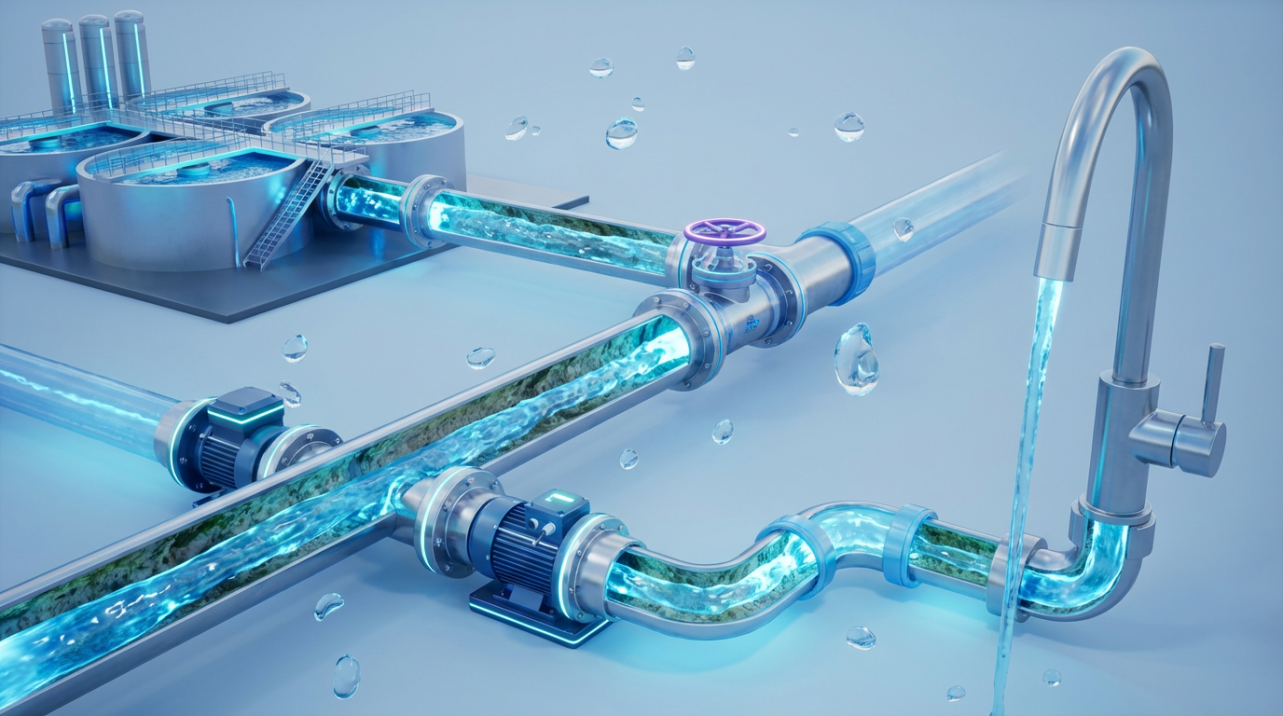
As a smart hydration specialist, I spend a lot of time at kitchen sinks with people who are puzzled. Their city says the water is safe. The utility publishes reassuring test reports. Yet the water sometimes smells odd, looks cloudy after the tap has been off for a while, or leaves a strange film on glasses or skin.
The missing piece in that story is the “last mile”: your plumbing, fittings, and fixtures. Once water leaves the treatment plant, it passes through miles of pipe, down your street, through your foundation, into your water heater, and finally through small fittings in faucets, filters, ice makers, and showerheads. Each material it touches can change what comes out of the tap.
In this article, I will walk you through what current research says about how pipes and fittings affect water quality, where smart filtration and home hydration systems fit in, and how to make practical choices that support both safety and great-tasting water.
From Treatment Plant To Tap: Why The Journey Matters
Municipal water usually begins its life in a lake, river, or groundwater well. It is clarified, filtered, disinfected, stored, and then pushed through distribution mains under pressure. For private wells, the path is shorter but similar: water is pumped from an underground aquifer through your plumbing to each fixture.
Studies summarized by water-quality and plumbing experts show a consistent pattern. Even when the utility does an excellent job, the plumbing network can either preserve that quality or degrade it. Corroded metal, aging joints, and poorly chosen fixtures can leach metals or plastic residues, strip out disinfectant, or allow germs to enter through tiny leaks or cross-connections.
One analysis of U.S. infrastructure cited in homeowner resources notes that water main breaks waste billions of gallons of treated water every day and give soil, septic, or industrial contaminants new pathways into the distribution system. By the time water reaches your shutoff valve, its history already matters.

Once water passes that valve and enters your “premise plumbing” (the pipes, heaters, fixtures, and devices inside your building), responsibility shifts even more onto the property owner. Guidance from the Minnesota Department of Health stresses that even fully compliant public water can change inside a building because of low use, aging metals, stagnant dead ends, or poorly maintained equipment. That is where your choices as a homeowner or building manager begin to matter a great deal.
The Microbial World In Your Pipes
When people think about tap water risks, they usually imagine a sudden contamination event at the treatment plant. In reality, many problems are quieter and closer to home.
Biofilms: The Slimy Neighborhoods Inside Pipes
Microbiology research on drinking water distribution systems has made one thing very clear: most bacteria in these systems do not float freely in the water. They live as biofilms, which are slimy communities attached to pipe walls and fittings.
A controlled long-term study of cast iron and cement pipe coupons in a full-scale distribution system found that these biofilms are shaped strongly by pipe material. Rough, corroded cast iron supported very diverse microbial communities, while smoother cement surfaces hosted somewhat less diverse but different communities. Importantly, some opportunistic pathogens behaved differently on each surface. Under the chloraminated conditions studied, cement coupons tended to harbor higher relative levels of Mycobacterium species, while cast iron surfaces tended to have higher relative levels of Legionella.
These results matter because the U.S. Centers for Disease Control and Prevention (CDC) notes that many serious waterborne illnesses are linked to biofilm-associated germs such as non-tuberculous mycobacteria, Pseudomonas, and Legionella. These organisms can be present even when the bulk water meets regulatory standards.

Why Stagnant Water Is A Problem At Home
The CDC emphasizes that tap water delivered by public systems is treated to meet safety standards, but it is not sterile. Low levels of environmental germs are expected and usually safe to swallow. Risk rises when water sits, disinfectant levels fall, and biofilms get comfortable.
Germs can enter or grow in home plumbing when water flow is disrupted by main breaks or utility work, when water remains unused in pipes for long periods, or when disinfectant residuals drop too low. Inside pipes, heaters, filters, or humidifiers, bacteria, fungi, and amoebas can form biofilms that shield them from disinfectants and allow gradual growth.
People are more likely to get sick from these germs when water becomes a mist or touches vulnerable body sites such as lungs, open wounds, eyes, or the inside of the nose. That is why CDC risk guidance focuses on showers, humidifiers, nasal rinsing devices, and medical equipment such as CPAP machines, especially for people over about fifty, infants, those with lung disease, or anyone with a weakened immune system.
Practical guidance from CDC is straightforward and very actionable. If a faucet or shower has not been used for about a week, they recommend flushing cold water fully for a couple of minutes, then running hot water until it is hot. After power outages or pressure drops, they advise flushing each faucet and shower until the water runs clear and hot, and contacting the utility if brown or discolored water persists.
They also stress cleaning or replacing showerheads and faucet aerators when buildup is visible, and maintaining devices such as humidifiers and CPAP systems according to manufacturer instructions so they do not become germ reservoirs. None of this requires a lab coat; it just requires awareness and simple habits.

Smart Fittings, Sensors, And Flushing Cycles
Modern non-touch or sensor faucets are increasingly common in homes and public spaces. A study in BMC Infectious Diseases examined eight identical sensor-operated fittings supplied by municipal water and equipped with programmable cold-rinse flush cycles. The researchers varied usage frequency, the length of connecting pipes, valve block material, and the duration of automated pre- and post-use flushes. Over twenty weeks they collected weekly cold-water samples, measured total bacterial counts and Pseudomonas aeruginosa, and used rigorous statistical methods to understand how these operational settings influenced bacterial water quality.
While the study’s detailed results are specific to its test fittings, what matters for homeowners is the principle: patterns of use, stagnation volumes in pipes, and automated flushing settings can significantly change the microbial profile of the water sitting right at your tap. Non-touch technology by itself is not a guarantee of “cleaner” water. It is one piece in a broader puzzle that includes how often water moves and how your entire plumbing system is designed.

When The Plumbing Itself Becomes The Contaminant
Microbial risks are only half of the plumbing story. The other half is chemistry: metals, plastics, and other compounds dissolving into your water.
Lead, Copper, And Other Metals From Aging Pipes
Homes built before 1986 in the United States and Canada are more likely to contain lead pipes, lead-containing fixtures, or lead solder. Resources for homeowners note that many U.S. homes still use aging plumbing, and an estimated 9.2 million lead service lines continue to deliver water nationwide. Corroding iron or steel pipes can also produce rust that discolors water, alters taste, and shelters bacteria.
The U.S. Environmental Protection Agency (EPA) and CDC agree on a critical point: there is no known safe level of lead in a child’s blood. EPA’s health-based goal for lead in drinking water, called the maximum contaminant level goal, is set at zero. Lead is persistent and accumulates in the body over time. In children, even low levels are associated with learning and behavior problems, shorter stature, impaired hearing, and blood disorders.
EPA estimates that drinking water can make up about one fifth or more of a person’s overall lead exposure, and for infants who rely mostly on mixed formula, water can contribute roughly forty to sixty percent of total lead exposure. That is why EPA and CDC emphasize looking at all sources of lead together: paint, dust, soil, food, air, and water.
Lead in tap water does not usually come from the treatment plant. It typically enters as water contacts lead service lines, lead-containing fixtures, or plumbing solder. Corrosion is the mechanism: a chemical reaction between water and metal that is influenced by water chemistry, temperature, how long water sits in pipes, and whether protective scales or coatings are present. The Safe Drinking Water Act now defines “lead-free” plumbing as having no more than a weighted average of 0.25 percent lead across wetted surfaces of pipes and fittings, and no more than 0.2 percent in solder and flux, but many older installations predate these requirements.
EPA’s practical advice for homeowners is grounded and specific. Community water systems must provide an annual Consumer Confidence Report that explains local water quality. If you are concerned about lead at your tap, EPA advises testing through a certified laboratory, which typically costs tens of dollars, not thousands. They also highlight simple steps that reduce lead exposure from plumbing, such as using only cold water for drinking, cooking, and making baby formula, flushing stagnant water before use, regularly cleaning faucet aerators where particles can collect, and using filters certified to remove lead, installed and maintained according to instructions.
From a hydration perspective, this means you should never rely on taste, smell, or clarity as indicators of safety. Lead is invisible and tasteless in water. Testing and smart fixture choices are nonnegotiable if your home or building has older plumbing.

Corrosion, Rust, And Sediment
Corrosion is not just a lead story. Old iron and galvanized steel pipes corrode over time, producing rust that can turn water yellow, brown, or orange and give it a metallic taste. According to plumbing-focused guidance, this rust can harbor bacteria and narrow pipes, reducing flow and pressure.
Tiny pinhole leaks in copper pipes are another red flag. These small perforations signal advanced pipe decay and can act as one-way gates: when pressure drops, contaminated soil water carrying fertilizers, solvents, or microbes can be drawn into the line. Loose connectors, cracked underground segments, and failing seals can create similar intrusion paths, especially during pressure disturbances or ground vibration.
Sediment and mineral buildup, particularly in hard water areas, collects in pipes, fixtures, and water heaters. This buildup not only reduces flow and energy efficiency, it provides extra surface area for biofilms to grow. Expert recommendations consistently call for flushing water heaters and plumbing lines on a routine basis to control sediment and support both water quality and equipment longevity.
Plastic Pipes, Taste, Odor, And Leaching
Plastic, or polymer, plumbing has become popular in “green” and conventional buildings because it is lighter, easier to install, and often cheaper than copper. However, research has revealed that not all plastics behave alike in contact with drinking water.
Professor Andrea Dietrich at Virginia Tech has long argued that pipes should be treated like food packaging. Her team uses trained sensory panels, similar to wine tasters, to evaluate how different plumbing materials affect the taste and odor of water. In one National Science Foundation–funded study, purified water with common disinfectants was stored in various polymer pipes for several days, then assessed. Chlorinated polyvinyl chloride (cPVC) performed best among the tested plastics, releasing fewer organic compounds, consuming less disinfectant, and generating no noticeable odors. Even so, cPVC produced a slight plastic aftertaste initially, which typically dissipated after a couple of months of regular use as the system was flushed. Copper pipes, by contrast, consumed nearly all residual disinfectant during the tests, which can have implications for biofilm control and taste.
A separate research effort, also backed by the National Science Foundation, examined PEX plumbing in a high-efficiency building and in laboratory tests. In a new PEX system, investigators detected eleven PEX-related contaminants in tap water, including toluene and several unregulated compounds linked to antioxidants and manufacturing processes. Laboratory experiments on six PEX brands over thirty days found that all produced odors above the EPA’s secondary (aesthetic) standard for drinking water odor. For one PEX type, the presence of chlorine actually intensified odors early on.
The team also measured a manufacturing byproduct called ethyl-tert-butyl ether (ETBE). In the first days of pipe use, ETBE levels in test water reached well above the most stringent health-based limit adopted by one U.S. state, and remained above that state’s limit after a month, even though no federal standard exists for ETBE in drinking water. A separate case study of a high-value home with PEX plumbing documented “gasoline-like” tap water odors attributed to toluene and ETBE at concentrations above odor thresholds but below health-based levels.
These studies do not mean that all PEX is unsafe.

They do mean that specific brands and formulations vary substantially, that new plastic plumbing can temporarily contribute to off-odors, and that cleaning procedures permitted by some codes can unintentionally increase chemical release. They confirm what many homeowners already sense: when water suddenly smells or tastes wrong after a plumbing change, it is not “just in your head,” even if basic compliance tests show no immediate health violation.
To pull these findings together, it helps to see common pipe and fitting materials side by side.
Material or component |
Water-quality strengths |
Water-quality concerns seen in research |
Notes from studies and guidance |
Stainless steel fittings (304, 316 grades) |
Strong, highly durable, resistant to rust and many corrosive conditions, do not impart taste or odor when properly selected |
Some grades contain nickel, which may matter for people with nickel allergies; improper cleaning or neglect can allow localized corrosion or residue-related issues |
Articles on stainless fittings conclude they are safe and reliable for drinking water when compliant grades are chosen, installed correctly, and maintained |
Copper pipes and fittings |
Durable and widely used, and in some contexts less prone to biofilm than certain plastics |
Can leach copper in more aggressive water, causing metallic taste and elevated copper levels; in one sensory study, copper consumed most disinfectant, potentially changing microbial control |
Homeowner resources highlight pinhole leaks as a serious integrity and contamination concern |
Legacy metals (lead, galvanized steel, cast iron) |
Historically common, still present in many older neighborhoods |
Lead is toxic at any level, especially for children; galvanized and iron pipes corrode, releasing rust, metals, and fostering biofilms; leaks and breaks allow external contaminants in |
EPA and multiple homeowner guides stress replacing these materials where feasible and using filtration and flushing as interim measures |
cPVC and similar “better-performing” polymers |
Good corrosion resistance; in sensory tests, cPVC produced the fewest organics and no noticeable odors; slight plastic aftertaste tended to fade with months of use |
Still consumed some disinfectant; initial taste issues possible; quality depends on formulation and installation products such as glues |
Research suggests cPVC can perform well but must still be evaluated as a system including fittings and adhesives |
PEX and other flexible plastics |
Light, easy to install, less expensive than copper; compatible with quick-connect fittings and smart systems |
Lab and field work have shown leaching of compounds like toluene and ETBE, strong odors early in use, variability between brands, and conditions that encourage bacterial growth; some plastics can interact with disinfectants |
Researchers call for more rigorous evaluation of PEX brands, better plumbing codes, and early monitoring of new installations |
Fittings, Connectors, And Fixtures: Small Parts With Big Impact
When most people picture “plumbing,” they imagine big pipes in walls or under streets. Yet many of the most critical water-quality decisions happen at the scale of fittings: the small connectors that attach tubing to filters, faucets, toilets, ice makers, and hydration systems.
Stainless Steel, Brass, And Plastic Fittings
Stainless steel fittings are widely used in drinking water systems because of their mechanical strength and corrosion resistance. Their key feature is a thin chromium oxide layer that protects against rust, even in chlorinated municipal water. Articles reviewing stainless fittings emphasize that stainless does not leach harmful chemicals and does not add odor or taste when proper grades, such as 304 or 316, are used. Nickel content is a potential concern for highly sensitive individuals, but overall risk from plumbing fittings is considered low, and nickel-free grades are available.
Brass fittings are common in general-purpose air and fluid systems. However, resources focused on air fittings caution that brass exposed to water, especially mineral-rich or contaminated water, can corrode over time. This not only shortens the life of the fitting, it can release particles and metals into the water stream. Plastic fittings are lightweight and naturally resistant to many forms of corrosion, but they are more limited in pressure and temperature and can interact with certain chemicals.
Across these materials, the common denominator for safe use is correct specification and certification for potable water. Building codes and manufacturer documents specify which fittings are intended for contact with drinking water, and modern guidance encourages selecting components that are independently certified to relevant standards rather than improvising with general-purpose hardware.

Quick-Connect Fittings In Home Hydration Systems
Quick-connect or push-to-connect fittings have transformed water treatment and home hydration systems since they entered the water industry in the late nineteen seventies and early nineteen eighties. Instead of needing specialized tools and careful crimping, these connectors let you insert tubing by hand until it seats with a click.
A typical quick-connect fitting has three main elements: a body, a collet, and an O-ring. Tubing slides through the collet and O-ring into the body. As pressure inside rises or someone pulls on the tube, internal grooves push the collet into a position that causes its teeth to bite into the tube. The O-ring seals the gap between tube and body, creating a watertight joint. Manufacturers and installers value these fittings because they are fast, forgiving of tight spaces, and easy to inspect visually.
Fresh-water system specialists note that the most common cause of leaks in quick-connect fittings is simple: the tubing was not pushed in all the way, especially past the O-ring. Diagonally cut tubing, sharp edges that nick the O-ring, excessive side load from bent tubing, or repeated connect and disconnect cycles that gouge the tube surface can also cause slow drips or sudden failures. In high-vibration settings such as boats or equipment with pumps, locking clips that hold the collet in place can reduce the risk of tubes working loose over time.
Quick-connect couplings are used widely in under-sink reverse osmosis systems, refrigerator and ice maker connections, and many point-of-use filters. They are also found in pneumatic and industrial equipment, often built into original equipment to simplify installation. However, there is an important distinction between quick-connect and quick-disconnect fittings. Quick-connects are designed to hold more like semi-permanent joints; removing tubing requires pressing the collet while pulling the tube. Quick-disconnect fittings, by contrast, are made for frequent disconnection and are often better suited to components like filters that are routinely removed and replaced.
Push-To-Connect PEX Fittings: Reliability And Water Chemistry
Where entire piping runs are made of PEX, push-to-connect PEX fittings play a similar role at a larger scale. Laboratory and field data summarized by manufacturers show that certified PEX push fittings can provide leak-free performance comparable to traditional crimp systems when installed correctly. Test programs simulating decades of service, including more than ten thousand pressure cycles and thermal cycling up to around 180°F, have shown that these fittings can meet or exceed performance standards such as ASTM F1960 and F877, with material safety confirmed under standards like NSF and IAPMO protocols.
In side-by-side monitoring of several thousand real-world installations over roughly eight to ten years, researchers found very similar overall failure rates for push and crimp fittings, with the majority of failures in both categories traced to installation error rather than hardware defects. For less experienced installers or retrofit situations where access is limited, push fittings often perform better initially, in part because they reduce the chance of under-crimping or missing connections.
From a water-wellness standpoint, two findings from this research are particularly important. First, the lifespan of elastomeric O-rings inside push fittings is highly sensitive to water chemistry. Lower chlorine levels, under about one part per million, support much longer O-ring life than higher residuals above about two parts per million. Water with pH far outside the neutral range also accelerates degradation of both metals and elastomers. Second, operating temperature matters. Systems that routinely run at higher hot-water temperatures see shorter expected lifespans for these components, even if they remain within manufacturer ratings.
This means that maintaining moderate disinfectant levels, stable pH, and reasonable hot-water temperatures is not only good for taste and skin comfort, it is also good for the mechanical health of your fittings. Whole-home water treatment that stabilizes pH or moderates disinfectant levels, when needed and properly designed, can extend the life of both plumbing and filters.
Do Not Treat Air Fittings As Drinking-Water Hardware
In some workshops and garages, it is tempting to repurpose general-purpose air fittings for water. Articles aimed at industrial users are clear on this point: you can run water through certain fittings that are explicitly rated for liquid service, but you cannot assume that an air fitting is automatically safe or reliable for water.
Several problems arise when fittings designed purely for air are used with water. Brass fittings exposed long-term to water may corrode more quickly than intended. Sealing mechanisms optimized for compressible gases may not perform the same way with liquids, increasing the risk of leaks. Water’s higher viscosity compared with air changes flow and pressure drop in ways that can exceed the fitting’s liquid pressure rating. Internal corrosion or seal degradation can release particles into the water stream, which is especially concerning in food, beverage, or medical applications.
Recommended practice is simple: verify that any fitting in contact with water is specified and documented by the manufacturer as compatible with liquids and with drinking water if that is the intended use. Preference is typically given to stainless steel or specially coated brass that are dual-rated for air and water, with seals designed for liquid contact.
Fixtures As Mini-Reservoirs
Finally, remember that fittings and fixtures are more than mechanical connectors; they can also be biological habitats. Plumbing experts point out that aging faucets and showerheads can harbor bacteria or leach metals. This is why they recommend replacing older fixtures with modern, “lead-free” designs made from stainless steel or certified plastics, and regularly cleaning or changing aerators and showerheads.
CDC guidance reinforces this: the small screens on faucet tips and the nozzles of showerheads collect sediment and particles where germs can grow. Cleaning, soaking, or replacing these parts when buildup is visible is a simple but powerful water-wellness habit.

Smart Filtration And Home Hydration Systems: Powerful, But Not Magic
Filtration and softening are central tools in any smart hydration strategy, but they work best as part of an integrated system rather than as a bandage over failing pipes.
Homeowner resources from multiple plumbing and filtration companies recommend point-of-entry systems (treating all water entering the home) or point-of-use systems (treating water at specific taps) to remove particles, some metals, chlorine byproducts, and taste- or odor-causing compounds. One manufacturer of whole-home systems describes their products as capable of removing lead, rust, bacteria, and other contaminants to provide cleaner water from every tap, regardless of the age of the plumbing.
These promises come with important caveats. First, filters and softeners have their own risks if neglected. Plumbing and public health guidance warns that poorly maintained filters, from small pitchers to whole-home units, can become bacterial reservoirs. Some whole-home filters remove chlorine or other disinfectants, which can improve taste but also reduce the protection that disinfectants normally provide within pipes and fixtures. Manufacturers and CDC both emphasize following replacement schedules carefully, using cartridges certified for the contaminant of concern, and never running hot water through filters that are not designed for it.
Second, softeners that exchange hardness minerals for sodium or potassium can increase these ions in drinking water. Resources aimed at people on low-sodium diets highlight that this may be a consideration for certain households.
Third, filtration does not fix underlying lead service lines or heavily corroded interior plumbing. Guidance from EPA and plumbing professionals treats filtration as an important layer of defense, but not a substitute for replacing high-risk materials, especially where young children, pregnant women, or vulnerable adults are present.
A Practical Roadmap To Healthier Water At Home
Turning all of this science into a practical plan is where my work as a water wellness advocate really starts. In home after home, the most successful strategies share the same sequence.
Begin by understanding your plumbing story. If your building was constructed before 1986, assume there is at least some chance of lead-containing materials unless you know they were replaced. Look at visible pipes where they enter your home, under sinks, and near the water heater. Note whether you see copper, galvanized steel, plastic, or a mix. If you live in an older neighborhood, consider asking your utility or a licensed plumber whether your service line is made of lead and, if so, what options exist for replacement.
Next, get objective data on your water. Read the annual Consumer Confidence Report from your community water system to understand the source water, treatment processes, and overall quality profile. If you use a private well, check with your state or local health department to learn which contaminants are of concern in your area. For household-level insight, EPA recommends testing through certified laboratories, typically at a cost between about twenty and one hundred dollars depending on the panel. For older homes, this often includes lead and copper, as well as basic chemistry such as pH and hardness.
Then, address clear hazards and integrity problems. If testing or plumbing inspection reveals lead service lines, lead solder, or severely corroded iron or galvanized pipes, work with qualified professionals to plan replacement. For many families, this is a staged process over years, supported by interim measures like certified point-of-use filters for drinking and cooking taps. Fix pinhole leaks, deteriorated connectors, and chronic low-pressure issues that may signal hidden failures. Regularly flush water heaters and consider inspections of hot-water recirculation loops if present.
After that, match filtration and softening to your actual needs. For households with confirmed lead in plumbing, choose filters certified for lead reduction and locate them at taps used for drinking and formula preparation. For homes with aesthetic issues such as odor or taste linked to plastic plumbing, work with a water professional who understands both local water chemistry and the specific materials in your system, including PEX or cPVC. If hardness or sediment are issues, point-of-entry treatment may protect appliances and fixtures while point-of-use filters fine-tune taste for drinking.
Finally, maintain movement and hygiene throughout your hydration system. Adopt the CDC habit of flushing taps and showers that have sat unused for about a week, and always after plumbing work or noticeable pressure drops. Keep water heater temperatures in a range around 130–140°F to discourage Legionella and similar germs, while using thermostatic mixing valves at taps to prevent scalding, especially for children and older adults. Clean or replace aerators and showerheads when mineral deposits or slime appear. Empty and dry portable humidifiers daily and maintain CPAP humidifier chambers according to instructions, using distilled or appropriately treated water where recommended. Replace filter cartridges on schedule and do not try to stretch their life; an overused filter is not a frugal filter, it is a potential contamination source.
Taken together, these steps create a virtuous cycle where good plumbing, well-chosen fittings, smart filtration, and simple habits reinforce each other.

FAQ: Plumbing, Fittings, And Home Hydration
If my city water meets standards, do I really need extra filtration at home?
Meeting regulatory standards means your utility is doing its job at the plant and in the distribution system it controls. It does not account for what happens in your specific building. Research and public health guidance show that aging pipes, lead fixtures, corrosion, and biofilms inside premise plumbing can all affect your water between the meter and your sink. Filtration is not mandatory in every situation, but it is often a smart layer of protection at key taps, especially in older homes, buildings with complex plumbing, or households with infants, pregnant women, or people with weakened immune systems.
Are stainless steel fittings always the best choice for drinking water?
Stainless steel fittings offer excellent corrosion resistance, mechanical strength, and generally do not add taste or odor to water when appropriate grades are used. Research and manufacturer guidance describe them as a safe and reliable choice for drinking water systems when they meet applicable standards and are installed correctly. However, “best” still depends on context. People with severe nickel allergies may prefer nickel-free grades or other materials. In some situations, high-quality polymer fittings certified for potable use are entirely appropriate. The key is to avoid non-certified hardware, make sure any fitting touching drinking water is designed and rated for that purpose, and match the material to the chemistry and operating conditions of your system.
How long should push-to-connect and quick-connect fittings last in my home?
Laboratory and field studies of certified push-to-connect PEX fittings show that, under typical residential pressures and temperatures and with moderate disinfectant levels, these fittings can perform for decades, with overall system lifespans on the order of thirty to fifty years. In a large field sample, their failure rates were similar to traditional crimp fittings, and most problems in both groups were traced to installation errors rather than inherent defects. Industrial guidance for harsh, high-pressure fluid systems sometimes calls for replacing push-connect fittings every year or so, but those environments are more extreme than normal home plumbing. For home hydration systems, a better approach is to combine good initial installation, stable water chemistry, reasonable hot-water temperatures, and periodic inspection of accessible fittings for moisture, corrosion deposits, or damage. If you see discoloration, cracks, or persistent damp spots around a fitting, replacement is warranted regardless of age.
Clean, safe, and great-tasting water is not an accident; it is the result of thoughtful choices at every step from the street main to your glass. When you understand how pipes, fittings, and filtration interact, you can turn your home into a genuinely smart hydration environment—one where every sip supports your health with confidence.
References
- https://www.epa.gov/ground-water-and-drinking-water/basic-information-about-lead-drinking-water
- https://www.cdc.gov/drinking-water/prevention/preventing-waterborne-germs-at-home.html
- https://pmc.ncbi.nlm.nih.gov/articles/PMC8724538/
- https://news.vt.edu/articles/2009/01/2009-4.html
- https://www.purdue.edu/newsroom/releases/2014/Q4/drinking-water-odors,-chemicals-above-health-standards-caused-by-green-building-plumbing.html
- https://www.cavityeye.com/influence-from-fittings-and-connectors-on-your-mould-cooling-behaviour
- https://www.cedarparkplumbing.com/the-impact-of-plumbing-on-water-quality-what-you-need-to-know/
- https://www.hosemanufacture.com/blog/how-does-quick-fitting-affect-the-overall-system-performance-1228258.html
- https://idealbelltechnology.com/are-stainless-steel-fittings-safe-for-drinking-water/
- https://ifanpro.com/push-to-connect-pex-fittings-reliable-long-term/

Share:
Why 304 Stainless Steel Faucets Cost More Than Copper Faucets
Carbon Fiber Filters vs. Traditional Activated Carbon: Which Is Better For Your Home Water?