

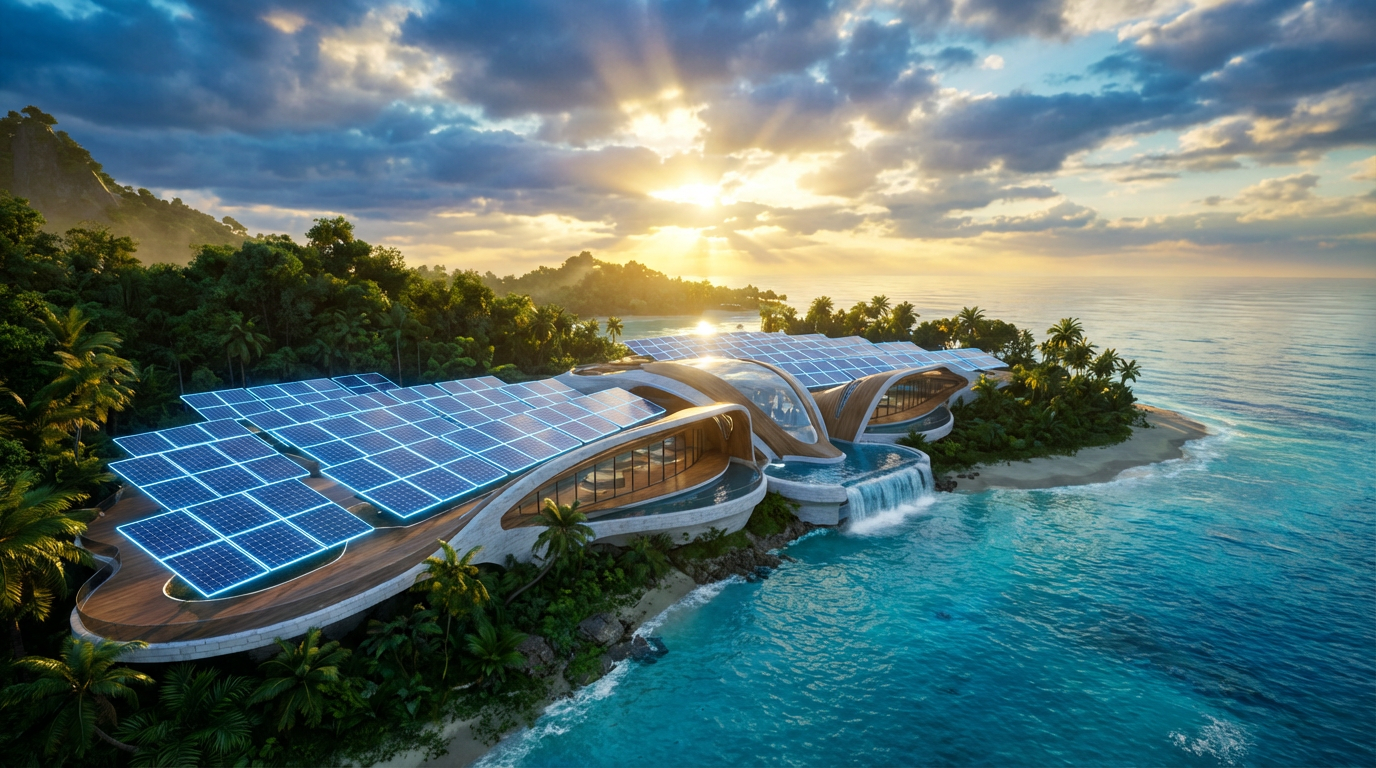
Tropical islands live with a paradox. They are surrounded by water yet often struggle to provide every family with safe, affordable drinking water year-round. As a Smart Hydration Specialist and Water Wellness Advocate, I have seen again and again that the weakest link is not the filtration technology itself but the energy system behind it. If the power fails during a storm or fuel deliveries are delayed, pumps stop, desalination plants shut down, and taps run dry just when clean water is most essential.
Across the Caribbean and the Pacific, that picture is beginning to change. Island communities are pairing solar power with batteries, smart controls, and seawater desalination to create reliable “water security hubs” that can ride out hurricanes, fuel price spikes, and long shipping delays. Research and field programs from organizations such as Rocky Mountain Institute, RTI International, the Global Center on Adaptation, and 8MSolar show that these systems are no longer experimental. They are working today in places like Puerto Rico, the Bahamas, Fiji, Vanuatu, and small Philippine islands.
This article walks through how to design innovative solar and seawater reverse osmosis (RO) systems for tropical islands in a way that is science-backed, storm-ready, and centered on long-term hydration health.
Why Solar-Powered Water Systems Matter So Much on Islands
Island nations face some of the toughest energy and water challenges on the planet. Studies compiled by 8MSolar and Rocky Mountain Institute show that electricity generation on many islands can cost up to ten times more than on large mainland grids. Most small island developing states still rely on imported diesel and other fossil fuels for power. Every gallon of fuel has to arrive by ship, at prices that can be two to three times higher than in continental markets, as the Caribbean planning work from Rocky Mountain Institute highlights.
These fragile energy systems sit directly in the path of more frequent and intense tropical storms. After Hurricane Maria, Puerto Rico needed about eleven months to fully restore its grid. Similar stories play out across SIDS whenever major hurricanes or cyclones hit. Grid infrastructure often uses overhead lines because they are cheaper to build, but the Global Center on Adaptation notes that these lines are especially vulnerable to high winds and flying debris, leading to long outages.
When power is lost, water systems fail quickly. Chlorination pumps, intake pumps, and desalination plants are all electrically driven. A 2019 initiative in Vanuatu, referenced by the Global Center on Adaptation, installed solar-powered water pumping systems precisely because prolonged outages during cyclones had been cutting communities off from safe drinking water. Once those solar pumps were in place, water quality and access improved even during droughts and storms.
At the same time, islands are moving aggressively toward net-zero targets. Renewable capacity across small island developing states has more than doubled in less than a decade, rising from about 3.7 gigawatts in 2014 to 8.76 gigawatts in 2023, according to 8MSolar’s synthesis. Solar alone jumped from roughly 0.1 to 4.2 gigawatts in that period, a more than forty-fold increase. Many Pacific islands, including Fiji, Vanuatu, and the Solomon Islands, have formal targets to reach 100 percent renewable electricity in the 2030s.
For water planners, that growth is not just an energy story.

It is an opportunity to design desalination and filtration systems that are powered by local sunshine and wind instead of vulnerable fuel shipments. Done well, that shift can lock in lower long-term costs for drinking water, strengthen public health resilience, and reduce greenhouse gas emissions at the same time.
The Energy Backbone: How Much Power Does Your Water Really Need?
Before thinking about membranes and piping, it helps to design the energy backbone that will keep water flowing twenty-four hours a day. Water systems are “critical loads,” which in resilience planning means they must stay powered even when everything else goes dark. RTI International defines energy sector resilience as the ability to withstand and recover quickly from shocks while maintaining access to essential services like water pumping, sanitation, health care, and communications.
Case studies from RTI International’s work in the Philippines illustrate what this means in practice. On Isla Verde, a thirty-two kilowatt solar mini-grid now supplies power to more than three hundred households and local businesses. Average households save about $274.00 per year on electricity compared with their previous arrangements. Across the whole community, that adds up to more than $80,000.00 in annual savings that can be redirected to food, education, or maintaining critical infrastructure like water systems.
A similar logic applies to desalination. If a community-scale seawater RO plant is one of the top priority loads, your solar and storage system should be sized so that the plant can run through cloudy days and during grid outages. On the Caribbean island of Montserrat, a one point one megawatt solar array with a matching battery system already meets around forty percent of total electricity demand on sunny days and cuts fuel costs by roughly 12 to 14 percent each year, according to the Global Center on Adaptation. A plant of that scale, targeted specifically at critical loads, can easily carry essential water infrastructure on a small island.
In other words, when you design the energy backbone for an RO plant, you are not just buying kilowatt-hours.

You are buying hydration security for the next hurricane season and for the next generation.
Solar, Storage, and Hybrid Systems for Stable Desalination Power
Desalination and advanced filtration thrive on stable power. Pumps, high-pressure RO skids, and control systems all perform best when voltage and frequency do not fluctuate wildly. That is where modern solar-plus-storage and hybrid renewable systems shine.
Solar photovoltaic systems have become the leading renewable resource on many islands. Hawaii, for example, has mandated 100 percent renewable electricity by 2045. Solar is its largest renewable resource, and on Kauai the local utility reached about 60 percent renewable energy in 2023 with regular periods operating entirely on renewables, as reported by 8MSolar. Fiji is implementing similar solar-based solutions through its rural electrification fund, replacing thousands of diesel village generators and powering islands like Vio, where forty-seven households now rely on a solar microgrid.
Batteries transform these solar installations from daytime-only assets into all-day power plants. In Tonga, utility-scale battery storage is being deployed to stabilize the main grid and enable much higher penetration of renewables without compromising reliability. The Caribbean regional scenario studied by Rocky Mountain Institute concludes that solar with storage, wind with storage, and geothermal with storage all become least-cost options compared with diesel and natural gas by around 2027, when considered over long-term operating horizons.
Wind complements solar particularly well in tropical island climates. Tamesol’s work on hybrid solar-wind systems for islands highlights that trade winds often strengthen at night or during cloudy periods, just when solar output is low. By pairing photovoltaic arrays with appropriately sized wind turbines and storage, islands can smooth out variability and maintain a more even power supply for loads like RO plants. Ta’u in American Samoa is one notable example, where a solar-and-battery microgrid supplemented with wind has drastically reduced reliance on diesel generators and delivered a cleaner, more reliable power supply for the island.
To visualize the decision, it can help to compare the roles of different energy options for a desalination-focused system.
Energy option |
Best role for water systems |
Key strengths grounded in island experience |
Main risks or limits for RO loads |
Diesel generators |
Backup or transitional power for existing plants |
Familiar technology, can be dispatched on demand, already installed in many islands |
High and volatile fuel costs, dependence on shipping, emissions, noise |
Central grid powered by fossil fuels |
Legacy supply where renewables are not yet scaled |
Can serve many loads from centralized plants |
Vulnerable to storms, long restoration times, little control at the plant level |
Solar PV plus batteries |
Primary supply for modern RO and pumping stations |
Uses local sunshine, works during fuel disruptions, supports island “islanding” capability |
Needs upfront capital and good design, depends on weather forecasting |
High-resilience supply where land and wind resource allow it |
Solar and wind complement each other, smoothing output as shown in Tamesol case studies |
Added mechanical complexity, requires careful control integration |
|
Rooftop or floating community solar |
Decentralized supply for smaller treatment and distribution |
Uses underutilized rooftops or water surfaces, avoids land conflict, can be community owned |
Requires corrosion control and tailored design near the coast |
For seawater RO, the combination that most often delivers stable, low-cost water over the full life of the system is solar PV plus battery storage, supplemented by wind or small backup generators where appropriate. When designed with modern energy management systems and forecasting, this backbone can keep pumps and membranes running smoothly without constantly worrying about tanker schedules or fuel price spikes.

Designing Hurricane-Resilient Solar for Coastal RO Plants
Tropical islands do not have the luxury of designing purely for average weather. In the Atlantic and Caribbean, the 2017 hurricane season, with storms like Harvey, Irma, and Maria, exposed how fragile conventional power infrastructure can be. Rocky Mountain Institute’s Solar Under Storm series examined why some solar plants were shredded while others were back online the next morning.
The lesson from those field investigations is reassuring in one sense. Solar arrays can survive Category 4 and even Category 5 hurricanes when they are designed and built correctly. The Ragged Island microgrid in the Bahamas, for example, is a roughly three hundred ninety kilowatt solar-plus-battery system engineered to withstand winds around one hundred eighty miles per hour. It now provides about 93 percent of the island’s energy needs and serves as a resilient backbone for essential services, including water and sanitation, as described in Trellis and Eco-Business reporting.
On nearby Highbourne Cay and Chub Cay, similar microgrids were built to Category 5 standards, again following Solar Under Storm best practices. Highbourne Cay’s one point one megawatt system powers residents and resort guests while avoiding more than 1,650 tons of carbon dioxide emissions each year, with expected fuel savings paying back the investment in roughly five to six years. Chub Cay’s four megawatt system aims to cover about 90 percent of the island’s energy demand. On both islands, the extra cost of building for Category 5 winds amounted to only about 5 to 7 percent of total project cost, according to Trellis and Rocky Mountain Institute.
For a one megawatt ground-mounted project in the Eastern Caribbean, Solar Under Storm estimates that adopting hurricane-resilient design adds around $90,000.00 to engineering, procurement, and construction costs. That is a modest premium compared with the cost of completely rebuilding a system after a major storm, not to mention the public health risks of losing drinking water for weeks.
From a practical design standpoint, hurricane-resilient PV for desalination should include features like robust racking and foundations, through-bolted modules instead of weaker top clamps, properly sized and torqued bolts with locking solutions, strong lateral bracing, and foundations designed for site-specific wind and soil conditions. Terrasmart describes how, in the Bahamas, some sites needed ground screws capable of more than 5,700 pounds of tension capacity driven into hard limestone and ancient coral to resist hurricane forces while supporting fixed-tilt racking.
Just as importantly, quality control and collaboration across the supply chain matter as much as hardware choice. Solar Under Storm emphasizes reviewing structural engineer calculations, wind tunnel reports where appropriate, and detailed installation checklists. Regional organizations, including the Organization of Eastern Caribbean States and the Caribbean Development Bank, have begun embedding these resilience standards into codes and underwriting criteria. For an island RO plant, aligning the solar design with these specifications means the energy source for your drinking water is engineered not just to produce power, but to keep doing so under the worst plausible storm.
Using Every Square Foot: Rooftops, Rugged Ground-Mounts, and Floating Solar
Coastal desalination and water treatment plants sit where land is often scarce and expensive. On dense islands, it can be unrealistic to set aside large flat parcels solely for solar. That is why so many island projects have become laboratories for creative siting.
In the Mediterranean, Malta and Cyprus face land and space constraints similar to those on many tropical islands. Malta’s rooftop PV capacity grew by nearly 17 percent in a single year, and domestic rooftops now account for just over half of total PV capacity, according to 8MSolar’s summary of government data. Malta is also experimenting with floating solar installations and reusing underutilized spaces like old quarries and parking areas. For a coastal RO plant, the implication is clear. Before you clear new land, look up to see if you can put solar on rooftops, parking canopies, or even adjacent water surfaces.
The Bahamas offers a striking example of this mindset. At Nassau’s National Stadium, the government and Rocky Mountain Institute collaborated on a solar parking canopy designed to survive Category 5 hurricanes. The same partnership implemented Ragged Island’s resilient microgrid and is now working on microgrids for critical facilities in Abaco after Hurricane Dorian. For a seawater RO system co-located with a water utility depot or port facility, solar canopies over parking or storage areas can serve both as shade and as the main power source.
Ground-mounted solar remains attractive where land is available, but tropical islands rarely offer easy soils. Terrasmart describes projects on Chub Cay and Cat Cay where the subsurface is solid oolitic limestone. Traditional driven steel piles would have required expensive predrilling and concrete. Instead, engineers used heavy-duty ground screws, which can penetrate hard substrates and provide the necessary uplift and lateral resistance with less concrete and faster installation. Their GLIDE racking system was configured for high slopes and wind speeds up to about 210 miles per hour, with customized galvanization to resist marine corrosion. These solutions are directly relevant when you want to place solar near a coastal RO plant on rocky or uneven terrain.
Where land is simply not available, floating solar becomes a powerful tool. Leadvent Group’s analysis of coastal floating solar notes that saltwater corrosion, wave action, and tides pose serious engineering challenges, but these are increasingly manageable with corrosion-resistant metals, reinforced polymers, advanced coatings, flexible mooring systems, and wave-absorbing barriers. Floating arrays have a hidden advantage for water-intensive applications: the cooling effect of water can improve panel efficiency by about 10 to 15 percent compared with similar land-based systems, according to 8MSolar’s cited studies. For a desalination plant operating many hours per day, that extra energy yield translates directly into more gallons of fresh water per square foot of panel area.
The key is not to treat siting as an afterthought. For each island, you need an integrated plan that balances rooftop, ground, and floating solar options while considering corrosion, wave forces, and sea level rise. When done thoughtfully, the result is a compact, efficient solar footprint tightly coupled to your water assets.
Integrated Energy–Water Hubs: Real-World Examples
Around the world, island communities are already operating energy–water hubs that show what is possible when solar, storage, and water systems are designed together.
In Puerto Rico, community-led microgrids have become a symbol of resilience. After Hurricane Maria revealed just how vulnerable centralized infrastructure was, the Adjuntas community, supported by Casa Pueblo, deployed a solar microgrid with batteries that kept key businesses powered through Hurricane Fiona’s island-wide blackout. Separately, about one hundred twenty solar microgrids installed at schools across more than eighty municipalities are now providing shelter, food, drinking water, and medical care during outages, as documented by 8MSolar and Eco-Business. In many cases, those schools stand in as neighborhood hydration hubs, keeping filtration and pump systems running when the surrounding community is dark.
Dominica offers a smaller but instructive example. Two schools there now host solar PV and battery storage microgrids that cover more than sixty percent of each school’s annual energy needs, while ensuring continued power during outages, according to the Global Center on Adaptation. The same resilience approach can be applied to a combined school and water treatment compound, turning it into a reliable center for safe water distribution during and after storms.
In Southeast Asia, RTI International’s work on Calutcot and Gilutongan Islands in the Philippines is directly aligned with water. Through the Energy Secure Philippines program, a solar-powered shared services facility is being deployed to provide cold storage, ice production, desalinated water, and drying services for fish and seaweed. That facility generates revenue by selling water, ice, and preserved products, which in turn helps maintain the energy system. This is a practical proof of concept for small solar-RO clusters that serve both community hydration needs and local livelihoods.
Vanuatu’s solar-powered water pumping initiative shows another angle. Instead of desalination, these systems focus on lifting and distributing freshwater while improving water quality and management capacity. During droughts and cyclones, having independent, solar-driven pumps prevents communities from falling back on unsafe surface sources. For a health-focused designer, these systems are a reminder that seawater RO is one piece of a broader hydration puzzle that also includes springs, shallow wells, and rainwater.
Viewed together, these projects show that innovative solar and water systems are not just about hardware. They are about intentionally pairing clean energy with the specific hydration and livelihood needs of each island.
A Practical Roadmap for a Solar–Seawater RO Project
Translating all this into a practical design path means walking through a set of clear, human-centered steps.
The first step is to define your critical water objectives and loads. How many gallons per day of potable water does the system need to produce for drinking, hygiene, and basic cooking, even during an extended outage? Are you also serving small businesses like guesthouses, fish processors, or clinics, or only households? RTI International’s guidance on mini-grid planning emphasizes that accurately characterizing critical services is essential for right-sizing both generation and storage.
The second step is to determine the level of resilience you truly need. Some islands aim for systems that can run completely independent of the main grid for days or weeks at a time, a mode often called “islanding.” Others want the ability to ride through shorter interruptions. Rocky Mountain Institute distinguishes between infrastructural resilience, which is the physical robustness of assets like solar arrays and batteries, and systems-level resilience, which is the ability of the overall community to continue functioning. For water, that usually means you design the RO plant and its solar-battery supply to function autonomously for at least several days, with hurricane-rated components and protected pump houses.
The third step is to design the energy mix and layout based on your specific island conditions. In regions with strong trade winds and limited land, hybrid solar-wind systems like those described by Tamesol can provide a steadier power profile for RO. In humid tropical climates, Sunpal’s experience shows that high temperatures and moisture can degrade batteries and electronics, so you site storage in well-ventilated, shaded enclosures, use corrosion-resistant materials, and keep electrical gear high above flood levels. In land-scarce coastal zones, you take advantage of rooftops, parking canopies, and carefully engineered floating solar, following the corrosion and wave management principles described by Leadvent Group and the Malta pilots.
The fourth step is to plan ownership, tariffs, and financing to keep water affordable and systems maintainable. Barbados’ CloudSolar model, as summarized by 8MSolar, shows how community or digital ownership of solar assets can channel investment from residents who do not have suitable roofs into shared renewable projects while delivering eight to ten percent returns. Fiji’s rural electrification fund uses a revolving mechanism: community tariff payments plus donor grants go into a trust that finances additional systems, including solar microgrids. For an RO plant, you can adapt these frameworks by treating water sales as a revenue stream that covers ongoing operation, maintenance, and eventual battery replacement, without exposing households to sudden price shocks.
The fifth step is to invest in local skills and long-term maintenance culture. Seaside Sustainability notes that modern coastal energy projects increasingly rely on advanced modeling, three-dimensional mapping, and even artificial intelligence for predictive maintenance. But none of that replaces people who know how to clean panels, replace filters, and diagnose a strange pump noise. Solar Under Storm and Trellis both emphasize the importance of installation quality and routine inspection. Sunpal recommends simple but regular maintenance routines: checking for corrosion and loose wiring, cleaning modules gently every few months, and scheduling work in the cooler hours of early morning or late afternoon to avoid thermal stress.
If you approach the project in this sequence, you end up with something much stronger than a desalination plant with some panels beside it. You build an integrated hydration system whose energy, hardware, finance, and human elements are aligned.
Short FAQ: Smart Hydration and Island Solar–RO Systems
Is solar-powered seawater RO really viable for small tropical islands today?
Evidence from multiple islands suggests that it is not only viable but often economically preferable over the system life. Rocky Mountain Institute’s Caribbean scenario work finds that solar with storage becomes a least-cost option compared with diesel and natural gas within a few years when you consider fuel price volatility and long-term maintenance. At the same time, RTI International’s mini-grid examples in the Philippines, and solar-powered shared facilities that include desalinated water, show that relatively modest systems can reliably serve hundreds of households and businesses. When you combine falling solar and battery costs with the extremely high and unstable prices of imported fuel, powering RO with solar-based microgrids becomes a pragmatic solution rather than a luxury.
How do hurricanes and cyclones affect the design of a solar-RO plant?
Storms change the design question from “What is cheapest today?” to “What still works the day after a Category 4 or 5 landfall?” The Solar Under Storm research by Rocky Mountain Institute shows that PV systems designed with robust racking, proper bolting, and site-specific engineering can survive very high winds with only minor damage. In the Bahamas, Ragged Island’s Category 5–rated microgrid now supplies nearly all of the island’s power. For a solar-RO plant, this means investing in hurricane-rated panels, racking, and enclosures, elevating sensitive equipment above flood levels, and considering protected siting such as behind dunes or in reinforced buildings. The added cost is typically a small percentage of the project but dramatically reduces the risk of losing safe drinking water when it is needed most.
What scale of system makes sense for a village or small town?
Real-world projects suggest that there is no single “correct” size, but there are useful reference points. On Isla Verde, a thirty-two kilowatt solar mini-grid serves more than three hundred households and small businesses with substantial bill savings. On Montserrat, a one point one megawatt solar-plus-storage system covers around forty percent of the island’s total demand. In Fiji, microgrids on islands like Vio serve a few dozen households. A coastal village RO plant that primarily supplies drinking water might only need a fraction of the capacity of a town-wide microgrid. A practical path is to start by sizing the RO and water distribution loads carefully, then working backward to a solar and storage configuration, using these existing projects as benchmarks for what has been proven in similar conditions.
Closing Reflection
Designing innovative solar and seawater RO systems for tropical islands is ultimately about hydration resilience. When you treat clean water as the anchor service and build an energy system around it—using proven solar, storage, and hybrid technologies, hurricane-ready hardware, and community-centered finance—you turn every gallon produced into a long-term investment in health. For island communities on the front lines of climate change, that combination of reliable power and reliable water is what transforms vulnerability into water wellness.
References
- https://www.doi.gov/sites/doi.gov/files/facildsgnguidefortropislands2022.pdf
- https://tethys.pnnl.gov/sites/default/files/publications/Challenges-opportunities-for-marine-energy-transistion-Canada-UBC-Working-Paper-2022-02.pdf
- https://gca.org/the-energy-sector-in-sids-is-incorporating-adaptation-solutions-to-tackle-an-uncertain-climate/
- https://rmi.org/powering-a-unified-caribbean-charting-the-path-to-100-renewable-energy/
- https://www.rti.org/insights/renewable-energy-solutions-for-island-nations-builds-energy-sector-resilience
- https://www.seasidesustainability.org/post/empowering-coastal-communities-with-environmentally-friendly-energy-solutions
- https://www.blueclimateinitiative.org/sites/default/files/2021-01/ocean-energy-in-islands-and-remote-coastal-areas.pdf
- https://www.irena.org/-/media/Files/IRENA/Agency/Publication/2016/IRENA_Path_to_Prosperity_Islands_2016.pdf
- https://www.weforum.org/stories/2024/05/small-island-states-making-big-strides-towards-net-zero/
- https://trellis.net/article/these-best-practices-create-hurricane-resilient-solar-power/

Share:
Effective Pre-Treatment Solutions for Oil-Contaminated Water RO Systems
Effective Solutions for Low Water Pressure Areas Under 0.2 MPa