

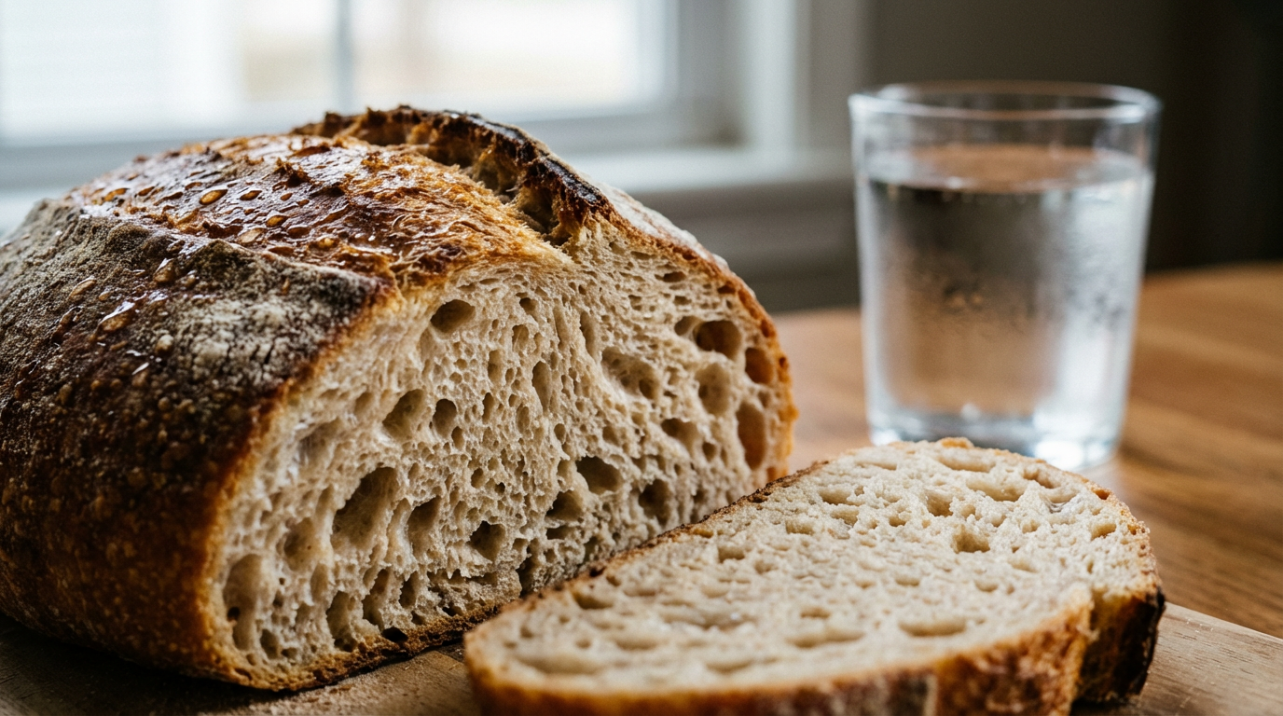
When a loaf rises high, bakes evenly, and slices with a tender, well-aerated crumb, we tend to credit the recipe, the flour, or the starter. In my work as a smart hydration specialist, though, I regularly see something less glamorous make or break fermentation: the water coming out of the tap.
Water typically makes up around forty percent or more of bread dough by weight, and research from baking institutes and technical journals consistently shows that its chemistry shapes yeast activity, gluten development, flavor, and even shelf life. If your bread sometimes overproofs, underproofs, or behaves inconsistently even when your technique is steady, water quality is often part of the story.
In this article, we will walk through how water hardness, pH, disinfectants, and filtration influence bread fermentation success rates, and how you can tune your home water and recipes to support strong, reliable fermentation.
Why Water Is A Fermentation Control Knob, Not Just A Wet Ingredient
From a fermentation standpoint, water is not just there to moisten flour. It is the medium where every critical reaction in dough happens.
When you mix flour with water, the proteins glutenin and gliadin hydrate and combine into gluten. This network traps the carbon dioxide produced by yeast, which is what makes dough rise and bread crumb airy. At the same time, starch granules in the flour swell in the presence of water, giving dough its balance of stretch and resistance that bakers describe as viscoelastic.
Water also dissolves salt, sugars, and any preferments. That solution bathes yeast cells and flour enzymes. Enzymes such as amylases break down starch into simpler sugars that yeast can metabolize, while proteases gently modify proteins and affect dough extensibility. Without the right amount and chemistry of water, yeast cannot access fuel efficiently, enzymes do not run at the proper rate, and gluten either becomes too weak or overly tight.
Technical guides from King Arthur Baking and the Agriculture Institute both emphasize that even when flour and yeast stay constant, changing water source can alter dough mixing time, fermentation rate, and loaf volume. It is why professional bakeries often test and sometimes treat water to standardize it across locations.
In short, fermentation success rates are not only about how much water you use, but also about what is dissolved in that water and the environment it creates for yeast and enzymes.

The Big Three: Hardness, pH, And Disinfectants
Several characteristics of water influence fermentation, but three are especially important in day-to-day baking: mineral content or hardness, acidity or alkalinity measured as pH, and disinfectants such as chlorine or chloramine.
Mineral Content And Water Hardness
Water hardness is essentially the concentration of calcium and magnesium ions, usually expressed in parts per million. These minerals are double-edged. They are yeast nutrients and gluten strengtheners at moderate levels, but they can slow or destabilize fermentation at the extremes.
Baking science sources commonly classify hardness roughly as follows, even though exact cutoffs vary a bit between references:
Water type |
Typical hardness range (ppm) |
Fermentation effect |
Dough and bread characteristics |
Very soft water |
About 10–50 ppm |
Yeast gets fewer mineral nutrients; fermentation can be weak or erratic |
Dough often sticky and slack, weaker gluten, poorer volume and texture |
Moderately hard or medium water |
Roughly 50–150 ppm depending on source |
Generally supports steady, robust fermentation |
Gluten strengthened without becoming overly tough, good volume and crumb |
Hard to very hard water |
Around 150–200+ ppm |
Fermentation may speed up or slow down depending on formulation; yeast can be stressed |
Dough can become tight and less extensible, harder to mix and shape |
Several technical baking references, including professional briefs cited by MyTapScore and Baking Business, point to a practical “sweet spot” around 100–150 ppm for bread doughs, while others such as The Brot Box and some water treatment guides suggest that 50–100 ppm also works very well. The common thread is that moderate mineral content is helpful, and extremes on either end are where problems show up.

Moderately hard water strengthens gluten. Calcium ions in particular help proteins form stronger bonds, which is why bakers working with medium-hard water often report doughs that hold shape well and loaves with good volume. These same minerals also act as micronutrients for yeast, supporting active, predictable fermentation.
Very soft water behaves differently. Because there are few dissolved minerals, flour proteins absorb water more readily, and doughs often feel wetter and stickier at the same hydration level compared to doughs mixed with harder water. The gluten network may develop quickly but end up weaker, resulting in slack doughs that spread out instead of rising tall. Research summaries from baking and water-testing organizations repeatedly link soft water to loose dough and reduced texture quality.
On the other side, very hard water can over-tighten gluten and interfere with hydration. Some technical articles describe fermentation slowing down because proteins struggle to absorb water and enzymes cannot work optimally, while others observe that high mineral levels may initially speed fermentation but still limit final volume and make dough tougher. Either way, excessive hardness tends to reduce your margin of error: fermentation becomes less forgiving, and dough is more likely to overproof in spots and underperform in others.
pH, Alkalinity, And The Fermentation Environment
pH describes how acidic or alkaline water is. Household tap water can span a surprisingly wide range, roughly from 4.5 up to around 10, depending on source and treatment, although many municipal systems target between 6.5 and 8.5.
For bread fermentation, several independent references converge on a similar message. Yeast and flour enzymes prefer a slightly acidic environment, and water that is neutral or gently acidic tends to work best. Studies and baking guides report that:
- Yeast activity in dough is strongest in an environment that ends up around the mid-acid range. Bread dough naturally moves toward that zone as organic acids form during fermentation, which is one reason sourdoughs often have particularly strong structure and flavor.
- Baking science articles aimed at professionals recommend water pH just below neutral, often described as slightly under 7, as a good starting point. The Brot Box, for example, notes that a pH around 6.0–7.0 supports yeast and enzyme performance.
- Technical water-quality briefs emphasize that heavily alkaline water can suppress the natural acidity produced during fermentation, leading to overly tough gluten and less nuanced flavor, even if it is marketed as “extra healthy” for drinking.
Academic work on breadmaking with different waters also highlights the role of pH. One study on regional waters found that medium-hard water close to neutral, slightly on the alkaline side for one tested brand, produced some of the best bread quality, while more strongly alkaline samples harmed gluten and slowed fermentation. The nuance here is that mildly alkaline water near neutral may still work well in the context of fermenting dough, but strongly alkaline water that resists acidification is problematic.
From a fermentation success standpoint, this means that both extremes in alkalinity and extremes in acidity can throw yeast and enzymes off their comfort zone.

Slightly acidic to near-neutral water gives dough room to develop the gentle acidity that strengthens gluten and promotes balanced fermentation.
Chlorine, Chloramine, And Yeast Health
Most municipal water in the United States is disinfected with chlorine or chloramine. These compounds protect public health, but they are also antimicrobial, so bakers often worry about whether they harm yeast or sourdough cultures.
Here the evidence is reassuring for most home bakers. Tap chlorination levels for drinking water are commonly held below about 4 parts per million, and multiple baking-focused sources, including MyTapScore and trade articles summarized by BakeMag, note that yeast performance only starts to suffer around 10 parts per million or higher. A widely shared series of tests from King Arthur Baking and the research team behind Modernist Bread compared breads and sourdough starters made with different water types, including typical chlorinated tap water, and reported no meaningful differences in fermentation performance or loaf quality at normal municipal levels.
A bread-machine focused discussion summarized those findings and echoed a long-standing toxicology principle: the dose makes the poison. In other words, the chlorine concentrations in ordinary tap water are far below what would be required to seriously inhibit commercial yeast in typical doughs.
There are two important caveats. First, long-fermented cultures such as sourdough starters can be more sensitive than a straight dough that ferments for a few hours. Water-quality articles aimed at sourdough bakers caution that residual disinfectants might, over time, slow or destabilize starters in some systems. Second, chloramine, a more stable disinfectant used by some utilities, does not dissipate readily just by leaving water out overnight, and may require filtration such as an activated carbon filter designed for chloramine.
Practical guidance from baking and water-testing organizations is clear. If your tap water smells strongly of chlorine, or if sourdough starters repeatedly struggle without another obvious cause, it is reasonable to switch to filtered water or let water sit uncovered to vent chlorine before mixing. But for most bakers using standard tap water, hardness and pH are more likely to affect fermentation success than disinfectant levels.

Other Water Quality Factors That Touch Fermentation
Beyond hardness, pH, and disinfectants, several other aspects of water quality can influence bread fermentation, either directly or indirectly.
Off-Flavors, Sulfur, Iron, And Taste
Taste may seem like a flavor issue rather than a fermentation issue, but in practice they are intertwined. Water-quality experts note that sulfur odors, metallic tastes, or high iron levels can pass directly into the flavor of bread and baked goods. Even when yeast fermentation proceeds normally, the final loaf can taste off if the water tastes off.
Articles from water-testing services and baking equipment makers point out that strong chlorine, sulfur, or metallic notes are often good reasons to filter water before baking, both to improve bread aroma and to remove contaminants that might stress yeast in higher concentrations. A clean, neutral taste is one hallmark of water that supports both enjoyable drinking and appealing bread.

Trace Elements, Safety, And Nutritional Impacts
At the research level, there is growing interest in how trace minerals in water contribute to the nutritional and sensory profile of bread. A study published in an applied sciences journal compared breads made with deionized water, tap water, and bottled natural mineral water. It found that breads made with natural mineral waters had significantly higher levels of essential minerals such as potassium, magnesium, iron, zinc, copper, and manganese compared to bread made with deionized water, while still keeping potentially toxic elements such as nickel, arsenic, aluminum, and lead well below safety thresholds.
Interestingly, the formulation made with carbonated bottled mineral water produced a noticeably softer crumb. The authors linked this reduced hardness to increased air retention, likely due to the carbonated nature of the water. While this experiment focused more on nutrition and texture than on fermentation speed per se, the findings underscore a broader point: the mineral profile of water shapes both the nutritional value and physical characteristics of bread without requiring any changes to the flour or yeast.
At the same time, that study and others stress that only potable water should be used for breadmaking.

Water that fails basic drinking-water standards in terms of contaminants or heavy metals should be treated for health reasons long before fermentation is considered.
Water Temperature: A Quiet Lever For Fermentation Rate
Although temperature is not a chemical property of water, it is a practical part of water use that heavily influences fermentation success rates.
Professional baking references consistently teach that water temperature is the easiest way to control final dough temperature. Warmer water makes warmer dough, which speeds yeast activity and shortens fermentation times. Cooler water produces cooler dough, slowing fermentation and giving more time for flavor development.
Many everyday bread recipes assume room-temperature water around 70°F. Community discussions and professional references agree that very hot water can kill yeast, while cold water simply slows it down. The gases from fermentation still form; they just do so more gradually, often creating more complex flavors.
For mixer and bread-machine users, one detail often overlooked is mechanical heat. Tests shared among bakers suggest that some mixers and bread machines can raise dough temperature by roughly two dozen degrees Fahrenheit through friction alone, depending on batch size and mixing intensity. That means starting with cooler water may be wise in a warm kitchen, especially if a machine is doing vigorous kneading.

Otherwise, fermentation can race ahead, and dough may overproof or even collapse in the oven.
From a water quality perspective, this does not change hardness or pH, but it reminds us that how we use water — including its temperature — is part of managing fermentation, not just the water’s composition.
How Water Quality Translates Into Fermentation Outcomes
To connect all of this science back to the question home bakers care most about, it helps to think through what happens to fermentation when water characteristics are out of balance.
When water is very soft with little mineral content, yeast is undernourished and gluten is under-supported. You may notice doughs that feel stickier at the same hydration, struggle to hold shape, and sometimes ferment sluggishly even though the dough seems very wet. Bread quality articles describe these doughs as slack, with weaker structure and a tendency toward lower volume and a less satisfying crumb. Fermentation still happens, but its “success rate” in terms of consistent, predictable performance drops.
When water is moderately hard within that broad 50–150 ppm window, fermentation tends to be more reliable. Minerals fuel yeast, gluten develops with enough strength to trap gas, and dough handles comfortably. This is the band where many bakery formulas are designed to work. If you have been baking in one city for years without thinking about water and your bread has been consistently good, there is a fair chance your tap water sits somewhere in this moderate zone.
With very hard water at or above roughly 200 ppm, fermentation becomes more temperamental. In some formulas the yeast may ferment very quickly initially but struggle to give good oven spring, while in others fermentation may feel slower and dough may resist stretching. The gluten network can tighten, and dough temperature management becomes more critical. Trade publications aimed at commercial bakeries describe a suite of corrections for very hard water, such as increasing yeast, adjusting yeast foods, and adding acids, precisely because fermentation can otherwise become inconsistent.
If water is strongly alkaline, especially when combined with high hardness, dough may not develop the natural acidity that supports enzymes and flavor. Fermentation might technically complete, but the loaf can taste flat and the crumb can feel tougher. Technical water articles caution that aggressively alkaline drinking waters marketed as wellness products do not improve baking performance and can actually work against the needs of dough.
Strong disinfectant flavors or contaminants add another layer. When water brings heavy chlorine, metallic, or sulfur notes into the mix, yeast may still ferment, but the bread’s sensory quality drops. In lean breads with few ingredients besides flour, water, salt, and yeast — such as a classic French loaf — water flavor becomes especially noticeable. Experienced bakers in community groups often advise choosing water that tastes good to you for these styles, because fermentation cannot hide unpleasant flavors.
Finally, when water is extremely purified, as with distilled or uncompensated reverse osmosis water, there are so few dissolved minerals that yeast and gluten lose some of their support system. Several baking and water-quality sources note that distilled water can yield doughs that absorb readily but lack strength, and they generally advise against using it as the sole water source for yeast breads unless minerals are deliberately reintroduced.
Practical Ways To Improve Fermentation Success With Better Water
Understanding the science is useful, but what matters in your kitchen is what you can actually change. Fortunately, you do not need a full laboratory to tune your water to help your dough.
Get A Basic Picture Of Your Water
If your bread has become inconsistent after a move, or if you suspect water issues, start with simple information. Municipal customers can usually access an annual water quality report, which often lists hardness and pH. For private wells or more detailed checks, inexpensive test strips for hardness, pH, and chlorine give you a quick snapshot.
In my field work with both homeowners and small bakeries, I often begin with these simple tests. They are not exhaustive, but they show whether you are dealing with very soft water, very hard water, or anything unusual about pH that could influence fermentation.
At the same time, trust your senses. If your tap water smells strongly of chlorine, sulfur, or metal, that alone is reason enough to consider filtration for both baking and drinking.
Match Water To Bread Style And Fermentation Schedule
Not all breads demand the same water profile. High-hydration artisan loaves, long-fermented sourdoughs, and lean baguettes tend to be more sensitive to water chemistry than quick sandwich loaves or heavily enriched doughs.
Research and technical guides on dough hydration explain that wetter doughs ferment faster and rely heavily on strong gluten to hold gas. In those formulas, very soft water can make dough too slack, while very hard water can make it overly rigid. Sourdough, with its reliance on wild yeast and bacteria, is more vulnerable to pH and disinfectants than a straight dough with commercial yeast, which is why water-choice discussions are particularly lively in sourdough circles.
If you bake mainly lean, long-fermented breads and you discover that your water is both very soft and somewhat alkaline, you can expect fermentation to need more attention than in a kitchen blessed with medium-hard, near-neutral water. Knowing that in advance lets you monitor dough more closely and adjust as needed.
Adjust Recipes When You Cannot Change The Water
Sometimes it is not practical to install filtration or switch water sources immediately. In those cases, recipe-level adjustments can improve fermentation success rates.
For very soft water, baking and water-quality references suggest reducing overall hydration slightly and relying on salt and mineral-rich ingredients to strengthen gluten. In practice, that might mean holding back a little water at the mix, adding a touch more salt within reasonable limits for taste and health, or incorporating flours that bring more minerals, such as whole wheat. Some professional bakers also use mineral yeast foods specifically developed to support doughs made with soft water.
For very hard water, several technical articles recommend almost the opposite strategy. You may need to increase yeast slightly, reduce added yeast foods or sugar that could overdrive fermentation, and introduce a small amount of acid, such as a mild vinegar or preferment, to bring pH back toward the optimal range. In industrial settings, phosphates or other buffering agents are sometimes used under professional guidance to stabilize pH.
If your water is strongly alkaline, incorporating preferments or sourdough methods that generate more acidity can help reclaim the dough environment that yeast and enzymes prefer. The goal is not to fight your water blindly, but to understand how it behaves and give fermentation the support it needs.
When To Consider Filtration Or Water Treatment
As someone focused on smart home hydration systems, I always remind people that any treatment you pursue for baking should also make sense for overall health and household use.
Activated carbon filtration is a common starting point. It is well suited for reducing chlorine, many organic compounds, and some off-odors. Water-quality articles for bakers frequently recommend carbon filters for tap water that tastes strongly of chlorine or sulfur, both to protect sourdough cultures and to clean up bread flavor.
For very hard water, some households install softeners or more advanced treatment such as reverse osmosis. These systems can bring hardness levels into a more baker-friendly range, but they also have trade-offs. Softeners often exchange calcium and magnesium for sodium, which might not be desirable at high levels. Reverse osmosis strips many contaminants but also removes beneficial minerals, and industry articles note concerns about water waste and the need to remineralize for optimal baking performance.
In the bakery sector, some specialized systems are designed to filter, disinfect, soften, and descale while preserving a controlled mineral profile. They aim to reproduce “ideal” baking water from place to place without wasting much water. For home bakers, a simpler but often effective approach is to pair a good carbon filter with recipe adjustments, and, where hardness is extreme, to blend filtered tap water with a suitable bottled spring water that has moderate mineral content.
Whatever route you choose, the aim is the same: provide clean, great-tasting water with moderate hardness and a near-neutral pH so that yeast, enzymes, and gluten can perform consistently.

Common Questions About Water And Bread Fermentation
Is my tap water probably okay for bread?
If your tap water is safe to drink and does not have strong off-flavors, it is probably acceptable for most yeast breads. Multiple baking references emphasize that potable water in many regions already falls near the moderate hardness and near-neutral pH range that works well for dough. Where problems arise is at the extremes: very soft water, very hard water, aggressive alkalinity, or pronounced chlorine, sulfur, or metallic tastes. If your bread has always behaved well, your water may already be in the sweet spot.
Is distilled or reverse osmosis water good for fermentation?
Very pure waters such as distilled or unmodified reverse osmosis water are not ideal as the sole water source for yeast doughs. They lack the calcium, magnesium, and other minerals that help yeast and strengthen gluten. Baking and water-quality articles note that such waters can lead to doughs with poorer structure and weaker fermentation performance unless minerals are deliberately added back. These waters can still play a role when blended with mineral-containing water or when paired with remineralization stages in a filtration system, but they should not replace all minerals entirely in breadmaking.
Should I worry more about chlorine or hardness for sourdough?
For most home sourdough bakers, hardness and pH deserve more routine attention than chlorine. Typical municipal chlorine levels are below those that harm yeast in straightforward doughs, and even many sourdough starters thrive on normal tap water. However, if your starter repeatedly fails and your water smells strongly chlorinated, switching to filtered water or letting water sit uncovered to let chlorine dissipate is a reasonable experiment. At the same time, testing or checking hardness and pH will tell you whether soft, hard, or alkaline water is quietly making fermentation more fragile than it needs to be.
In the end, water quality is one of the most powerful and underused levers for improving bread fermentation success. When you combine sound hydration science, simple testing, and, where needed, thoughtful filtration, you give your yeast a stable home, your gluten the support it needs, and your bread a better chance at rising beautifully every time. As a water wellness advocate, I see the same principle play out across the home: the more intentionally we treat the water we drink and bake with, the more consistently our bodies and our breads can thrive.
References
- https://www.academia.edu/63186236/The_Influence_of_the_Waters_of_Our_Country_in_Breadmaking
- https://openprairie.sdstate.edu/cgi/viewcontent.cgi?article=1013&context=plant_faculty_pubs
- https://openscholar.uga.edu/record/7890/files/yi_jinhee_200805_phd.pdf
- https://www.triangularwave.com/BakeryEffects.htm
- https://www.bakemag.com/articles/11985-the-importance-of-water-quality-in-baking
- https://www.bakingbusiness.com/articles/55733-pro-tip-understand-waters-functionality-in-a-dough
- https://www.ciafoodies.com/best-water-for-bread-making/
- https://jupiterhadley.com/the-impact-of-water-quality-on-baking-results/
- https://newyorkwatermaker.com/water-quality-in-baking-tips-to-maintain-it/
- https://www.swissbake.in/blog/master-dough-hydration

Share:
Understanding the Adhesion Phenomenon in Milk Powder Solutions
Using Purified Water for Aquarium Water Changes Safely