

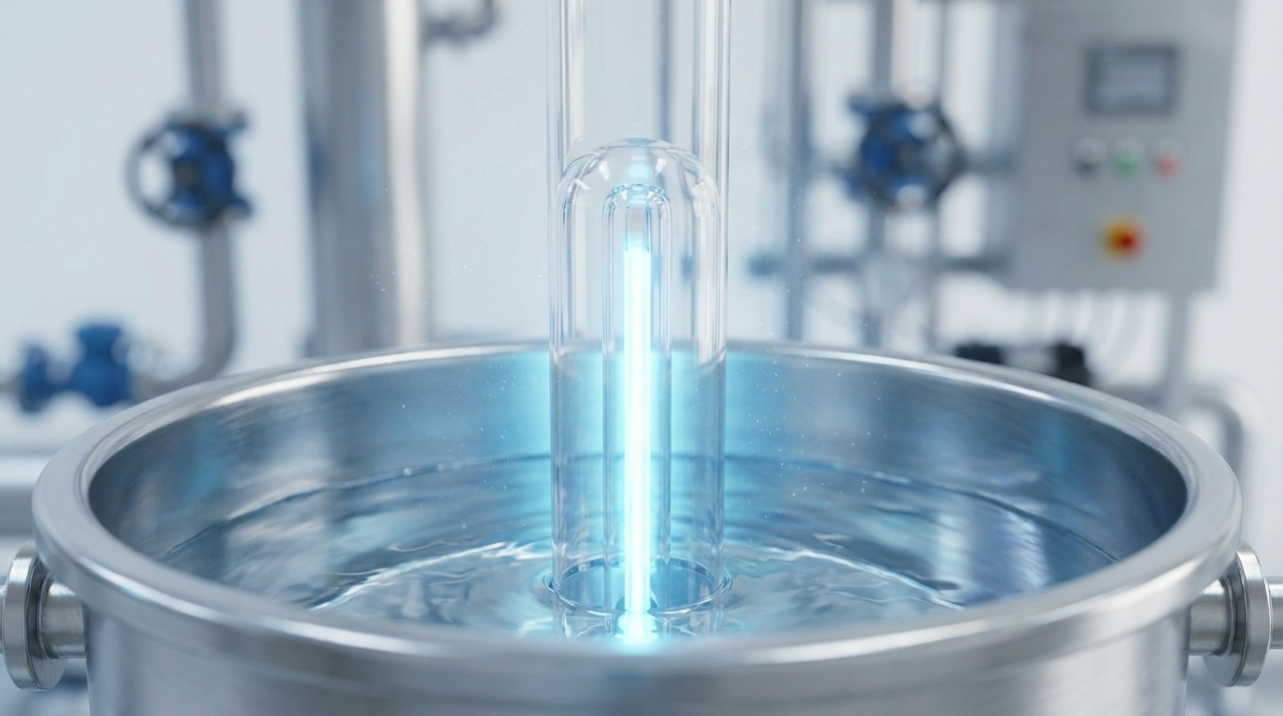
As a smart hydration specialist, I see UV systems as one of the most powerful final barriers between your family and waterborne illness. Yet in real-world service calls, the number one reason a UV system underperforms is surprisingly simple: a dirty or damaged quartz sleeve around the lamp.
This article walks you through science-backed, manufacturer-aligned methods for cleaning and caring for UV reactor quartz tubing, so your system can deliver the protection it was designed for.
Why Quartz Sleeves Matter for Safe Home Hydration
In a UV water treatment system, the reactor chamber houses one or more UV lamps that emit germicidal UV-C light. Those lamps are not in direct contact with your water. Instead, each lamp sits inside a transparent tube called a quartz sleeve or quartz tubing. According to guides from Light Spectrum Enterprises, Fresh Water Systems, and UV Water Systems New Zealand, this sleeve is made from high-purity quartz glass that transmits UV light while keeping the lamp dry and isolated from minerals, salts, and debris.
Without that sleeve, minerals and salts in the water would deposit directly on the lamp surface, quickly reducing its ability to emit the correct wavelength for disinfection. With the sleeve in place, the lamp is protected, but the downside is that the sleeve itself becomes the surface where scale, iron, manganese, and biofilm build up over time. Fresh Water Systems notes that this fouling gradually clouds the sleeve and blocks UV-C light, which means less germicidal energy reaches the water.
That matters for health. A report summarized by University of Georgia Cooperative Extension highlights that microbial contamination in drinking water can cause illnesses quickly, and that in a two-year period the Centers for Disease Control and Prevention documented dozens of drinking-water outbreaks in the United States with hundreds of illnesses and multiple deaths. UV is widely used because it can inactivate bacteria and many viruses without adding chemicals, and it is especially helpful against some microorganisms that are more resistant to chlorine. But it only works if enough UV light actually passes through the quartz and into the water.
A simple example illustrates this. Imagine a whole-home UV system on a private well. The lamp is still glowing blue, so the homeowner assumes the system is working. Over a couple of years, hard water deposits, iron staining, and film slowly coat the quartz tubing. No one notices because the reactor is stainless steel and opaque. Eventually, a routine lab test shows coliform bacteria in the home’s water, even though the UV lamp is on and not yet at the end of its one-year rated life. The problem is not the lamp electronics; it is the “invisible” barrier of fouling on the quartz sleeve that is starving the water of UV light.
How Dirty Quartz Sleeves Undermine UV Disinfection
Manufacturers and service providers consistently warn that contaminant buildup on quartz sleeves reduces UV transmission and, in turn, disinfection performance. Light Spectrum Enterprises explains that mineral and salt deposits will accumulate and, if not cleaned, will “affect the UV transmission and disinfection of water over time.” ELC Lamps Online echoes this, describing how deposits of dirt, hardness minerals, and biological growth gradually lower transmission and make the system less efficient. Fresh Water Systems connects this directly to health outcomes by noting that if the sleeve is not cleaned on schedule, bacteria and viruses may pass through the system, increasing the risk of illness.
This is also about overall system design. University of Georgia Cooperative Extension emphasizes that UV devices do not provide any residual protection in the plumbing; they treat water only at the point where the lamp shines on it. Pathogens introduced downstream are not inactivated, and the same source cautions that UV is not recommended if the raw water is heavily contaminated. When you combine that with a fouled sleeve, you can see why performance margins shrink quickly.
Think of the quartz sleeve as the “window” through which your UV lamp does its job. If that window is cloudy or scratched, fewer UV photons reach the organisms you care about. In practice, that means disinfection safety margins decrease just as variability in water quality increases, which is the opposite of what you want in a resilient home hydration setup.
A real-world scenario helps make this concrete. A cottage UV system draws lake water through a sediment filter and then into the reactor. At the start of the season, the sleeve is clear and the system passes a bacteria test. By late summer, warmer water and higher biological activity in the lake cause biofilm and mineral film to develop more quickly on the quartz. If the sleeve has not been cleaned since spring, the effective UV dose at the end of the season may be much lower than what the system was certified to deliver, even though nothing “looks wrong” from the outside.
How Often Should You Clean and Replace UV Quartz Sleeves?
Different manufacturers quote slightly different intervals, but the pattern across Fresh Water Systems, Light Spectrum Enterprises, UV Water Systems New Zealand, Luminor UV support, and ELC Lamps Online is consistent: regular cleaning and periodic replacement are essential.
Fresh Water Systems recommends cleaning the quartz sleeve at least once every twelve months, commonly at the same time you replace the UV lamp, and as often as every three to six months in hard water or fouling-prone conditions. They advise replacing the sleeve every two to three years, because after that time it often cannot be restored to full transparency.
Light Spectrum Enterprises suggests cleaning every few months or whenever the UV lamp is replaced, and also recommends replacing the sleeve every two to three years. UV Water Systems New Zealand frames it slightly differently: they recommend cleaning the sleeve and replacing the seals annually, and replacing the sleeve itself about every three to five years, sooner if water is high in minerals or if the sleeve shows cloudiness or scratches. Luminor Blackcomb guidance calls for cleaning at least once a year, with more frequent cleaning when water quality demands it. ELC Lamps Online recommends creating a scheduled cleaning program based on how quickly deposits form in your specific system.
You can think of the intervals this way. In a typical home with reasonably pretreated water, you might coordinate cleaning with your annual lamp change. If you then follow the two to three year replacement guidance from Fresh Water Systems and Light Spectrum Enterprises, that might mean three cleanings and one new sleeve over a three-year period. In a home with very hard, high-iron water where deposits form quickly, you may find that aligning with the more aggressive three to six month cleaning interval suggested by Fresh Water Systems is necessary. Over three years, that could mean up to twelve cleanings and at least one replacement, which is still a modest amount of maintenance relative to the health protection it preserves.
To make these ranges easier to visualize, here is a comparison based on the published recommendations.
Water conditions and care |
Typical cleaning frequency |
Typical sleeve replacement interval |
Sources mentioning this pattern |
Moderately treated, low to medium minerals |
About once per year, often with lamp replacement |
Around 2–3 years |
Fresh Water Systems; Light Spectrum Enterprises |
Hard or high-iron water, prone to fouling |
About every 3–6 months, plus at each lamp replacement |
Around 2–3 years, sometimes sooner if stained |
Fresh Water Systems |
Well pretreated, low-mineral water |
At least annually, sometimes stretched if very clean |
Around 3–5 years, based on condition |
UV Water Systems New Zealand |
Industrial or critical applications |
At least annually, often under a documented schedule |
Replacement based on inspection and performance |
ELC Lamps Online; Luminor support; UV Water Systems New Zealand |
Seals deserve their own note. UV Water Systems New Zealand emphasizes that sleeve seals should be replaced annually, typically at the same time as the lamp, because lamp heat can make seals brittle and leaks can develop. Many service guides, including Luminor’s, treat fresh O-rings as standard practice whenever the sleeve is removed.
From a decision-making standpoint, the key questions are how hard and iron-rich your water is, how well it is pretreated, and whether your system is mission-critical, such as for a home on a private well with immunocompromised occupants. Those factors determine whether you follow the annual baseline or move toward the more frequent end of the range.
Step-by-Step: Safe Cleaning Method for UV Quartz Sleeves
Manufacturer instructions differ slightly in the details, but the overall method described by Fresh Water Systems, Light Spectrum Enterprises, Luminor, Luminor Rack documentation, Luminor Blackcomb support, U.S. Water Systems, UV Water Systems New Zealand, and ELC Lamps Online is very consistent. The safest way to maintain your quartz sleeve is to follow the sequence of preparation, careful disassembly, gentle cleaning, inspection, and deliberate reassembly.
Preparation: Shut Down and Depressurize Safely
Before touching any part of a UV system, multiple sources emphasize safety preparation. Fresh Water Systems, Luminor, and Water eStore’s Luminor Rack guide all stress the importance of disconnecting electrical power, shutting off water flow, and releasing system pressure.
In practical terms, preparation usually looks like this. You shut off the water supply feeding the UV unit or engage the bypass if your system has one. Then you open a downstream faucet to relieve pressure in the plumbing, just as U.S. Water Systems describes for their Defender line. Many UV reactors, including Luminor rack systems and some Defender units, also have a drain plug; removing this after relieving pressure lets residual water drain so you are not wrestling with a full chamber.
At the same time, you turn off or unplug the UV controller. Fresh Water Systems notes that you should silence any alarm and allow the lamp and chamber to cool for about ten to fifteen minutes, because UV lamps run hot and should not be handled immediately. Luminor and Luminor Blackcomb instructions likewise caution that the lamp may be hot when first powered down.
While the system is cooling, you gather tools and protective equipment. Across Fresh Water Systems, Luminor, UV Water Systems New Zealand, and ELC Lamps Online, the essentials are a soft, non-abrasive cloth or lint-free towel, an appropriate cleaning liquid such as vinegar or a manufacturer-recommended scale remover, and clean gloves. Luminor suggests cotton gloves, and Fresh Water Systems recommends new protective gloves such as latex; in all cases, the idea is to avoid skin oils and grime on the glass.

A quick example here: if you align cleaning with annual lamp replacement, the preparation time is relatively small. While the lamp cools for those ten to fifteen minutes, you can stage your cloths, cleaning solution, new O-rings, and any replacement sleeve so that the rest of the work proceeds smoothly and your system is offline for as short a time as possible.
Disassembly: Accessing the Quartz Sleeve
Once the system is cool and depressurized, the next goal is to expose the quartz sleeve without stressing the lamp or seals. Detailed instructions from Light Spectrum Enterprises, Fresh Water Systems, and Luminor Rack systems all follow a similar pattern.
You begin at the top of the reactor by removing the safety cap or protective cover. On many residential units, the cap releases when you squeeze tabs on the sides, as described by Light Spectrum Enterprises and Fresh Water Systems. Under that cap sits the lamp connector. Luminor’s LUMI-Loc connector, for example, is disengaged by pushing it inward and turning it about a quarter turn counterclockwise before pulling it away. For other brands, you may simply pull the plug straight off the lamp pins, taking care, as Light Spectrum Enterprises notes, to let strain relief wires stay connected so they are not put under tension.
Next, you carefully withdraw the lamp. Luminor recommends handling the lamp only by its ceramic ends, both to avoid burns and to keep fingerprints off the lamp surface, which can also affect performance. If your reactor uses a gland nut, such as in the Blackcomb and Luminor rack designs, you unscrew this nut from the chamber to expose the top of the quartz sleeve and its O-ring seal. Luminor’s instructions advise gently twisting and pulling the sleeve and O-ring assembly out of the reactor. In some models, an internal spring that centers the lamp remains inside the sleeve; the manufacturer notes that this spring must stay in place and must be reinstalled if removed.
Defender systems from U.S. Water Systems add an extra nuance: if there is no outlet shut-off valve, you should expect water to drain back through the system once you open it, and if the UV is fed from a reservoir tank, you must close the supply valve from that tank so gravity-fed water does not shoot through the UV chamber during service.
In real-world terms, this means disassembly is less about force and more about sequence. When homeowners rush, they tend to fight against trapped pressure or forget a valve, which leads to surprise splashes or stressed fittings. Following the manufacturer’s order step by step keeps the process calm and controlled.
Cleaning: Choosing the Right Technique for Your Deposits
With the quartz sleeve removed, you can see what you are up against. Different sources recommend slightly different cleaning liquids, but they all agree on two principles: keep it gentle and avoid abrasives.
Both Light Spectrum Enterprises and Fresh Water Systems recommend a weak acid, such as common vinegar, applied with a soft, non-abrasive cloth. This dissolves mineral scale and many forms of fouling without scratching the quartz. UV Water Systems New Zealand prefers mild soap and water for routine cleaning and emphasizes avoiding abrasive materials. Luminor and Water eStore’s Luminor Rack guide recommend using a commercial scale cleaner such as CLR or LIME-A-WAY in combination with a soft, lint-free cloth, especially when dealing with stubborn scale. ELC Lamps Online adds that dedicated UV or quartz sleeve cleaning agents can also be used and stresses that harsh or abrasive chemicals and tools should not be used because they can scratch or chemically damage the quartz.
Another key point from Luminor Blackcomb and ELC is to keep liquids out of the inside of the sleeve. You are cleaning the outside surface that faces the water, not flooding the interior where the lamp sits. They advise cleaning with a soft cloth, then thoroughly rinsing with clean water if a stronger cleaner has been used, and finally drying the sleeve with a separate lint-free cloth so no moisture is left to enter the UV system.
Suppose your water is moderately hard and the sleeve shows a light white film but no thick scale. In that case, a vinegar-soaked cloth, as recommended by Fresh Water Systems and Light Spectrum Enterprises, is usually enough. If your water is very hard and you see thick crusted scale, following Luminor’s guidance and using a commercial scale remover may be more effective, provided your system’s manual allows it. In either case, patience and gentle wiping are more important than scrubbing aggressively.
Inspection: Deciding Whether to Clean or Replace
While the sleeve is clean and dry, this is the moment to decide whether to put it back into service or replace it. Fresh Water Systems advises inspecting the sleeve for cracks, chips, or significant scratches and states that any damaged sleeve should be discarded and replaced immediately, because damage can reduce disinfection and potentially harm the UV system. UV Water Systems New Zealand adds that visible cloudiness, persistent fouling that will not clean off, or noticeable scratches are signs the sleeve should be replaced sooner than the standard three to five year interval.
Because quartz sleeves are fragile, both Fresh Water Systems and UV Water Systems New Zealand recommend handling them carefully and even keeping a spare sleeve on hand, so that a breakage during maintenance does not force the UV system and, in many homes, the water supply itself to be shut down while waiting for a replacement.
Imagine a homeowner who cleans the sleeve after two years of operation and finds that, although the surface is free of loose scale, a brownish iron stain remains and the glass looks permanently hazy. That is a classic case where cleaning alone is not enough, and replacing the sleeve now rather than waiting another year aligns with the two to three year replacement guidance from Fresh Water Systems and Light Spectrum Enterprises.

Reassembly and Restart: Bringing the System Back Online
Reassembly is essentially the reverse of disassembly, but manufacturers highlight several small details that make a big difference.
Luminor’s instructions for Blackcomb and rack systems advise gently sliding the quartz sleeve back into the reactor until it contacts the opposite end, then centering it along the reactor’s length and engaging any internal centering springs. The O-ring is slid into place so it seats firmly against the reactor, and the gland nut is then hand-tightened only, without tools, to avoid over-compressing the seal. Luminor repeatedly warns never to install a UV lamp without the stainless steel compression spring in place if the design uses one, because the spring ensures proper lamp alignment.
Once the sleeve is secure, you insert the lamp into the sleeve, again handling it by its ceramic ends. The lamp connector is plugged back onto the lamp pins, then pushed into the gland nut and turned clockwise to lock it, as in the LUMI-Loc design. If the system uses a grounding screw, such as in some Luminor models, that screw is reinstalled on the chamber.
On the plumbing side, you close any drain plugs and slowly open the water supply while venting air from the system through a downstream faucet, just as described in the Luminor Rack maintenance guide. Water eStore recommends using the supplied filter wrench to snug filter housings and then carefully checking all joints and housings for leaks once the system has filled. Only after confirming that the reactor and any filters are leak-free do you restore power to the UV controller. If a new lamp was installed, Luminor Blackcomb support notes that you may need to reset the lamp timer according to the control panel instructions.
In a well-prepared service call, this reassembly and restart phase is where patience pays off. Opening valves slowly, watching for drips, and confirming that alarms clear and timers reset properly avoid the need to shut everything down and start over.
Cleaning Chemistry and Tools: Pros and Cons
Because different sources mention different cleaning agents, it is helpful to compare them side by side. The table below summarizes the main options described by Light Spectrum Enterprises, Fresh Water Systems, UV Water Systems New Zealand, Luminor, and ELC Lamps Online.
Cleaning option |
Best uses and advantages |
Sources mentioning it |
Key cautions |
Vinegar or other weak acid |
Dissolving typical mineral and scale deposits with a simple, inexpensive household acid |
Light Spectrum Enterprises; Fresh Water Systems |
Do not use abrasive cloths; avoid getting liquid inside the sleeve; rinse and dry thoroughly |
Mild dish soap and water |
Removing light dirt and film on systems with modest scaling |
UV Water Systems New Zealand |
Avoid strong detergents or anything abrasive; keep the open end of the sleeve dry during cleaning |
Commercial scale removers (CLR, LIME-A-WAY) |
Breaking down heavier limescale and mineral buildup when recommended by the manufacturer |
Luminor Blackcomb; Luminor Rack guides; ELC Lamps Online |
Follow label directions; keep chemicals out of the sleeve interior; rinse and dry completely |
Dedicated UV/quartz sleeve cleaners |
Targeted cleaning of quartz while protecting optical clarity |
ELC Lamps Online |
Use only products approved by the UV system manufacturer; avoid contact with other system materials |
Any abrasive pads or harsh chemicals |
None; they scratch and damage quartz and reduce UV transmission |
Fresh Water Systems; ELC Lamps Online |
Do not use scouring pads, abrasive powders, or harsh solvents; they can permanently damage the sleeve |
If you also own quartz countertops, you may notice an apparent contradiction in advice. Countertop care guides, such as the one from Fynes Designs, warn against acidic cleaners like vinegar and against abrasive products because engineered quartz counters contain resins that can be etched or dulled. UV sleeves, by contrast, are made from high-purity quartz glass without those resins, as ELC Lamps Online explains, and UV equipment guides from Light Spectrum Enterprises and Fresh Water Systems explicitly recommend weak acids such as vinegar for sleeve cleaning. The common ground between both worlds is the strict avoidance of abrasives; on UV sleeves, gentle chemistry plus a soft cloth is the winning combination.
Water Quality, Pre-Treatment, and Keeping Sleeves Cleaner for Longer
One of the smartest ways to reduce how often you need to deep-clean or replace a quartz sleeve is to reduce the amount of fouling your water can cause before it ever reaches the UV reactor.
Fresh Water Systems emphasizes two pre-treatment strategies. First, they recommend a sediment prefilter of about five microns upstream of the UV unit. This removes particulate matter that could otherwise “shadow” microorganisms from UV exposure and also reduces the amount of debris that can deposit on the sleeve. Second, they recommend an ion-exchange water softener and iron reduction if needed when dealing with hard water or high iron. This protects not only the UV system but also household appliances such as water heaters, showerheads, and dishwashers from scale and orange staining.
ELC Lamps Online describes how routine cleaning and maintenance of quartz sleeves prevent system inefficiencies and potential failures and extend overall system lifespan. UV Water Systems New Zealand notes that in high-mineral water, sleeves may need to be replaced more often than the three to five year baseline because scaling accelerates wear.
Consider two scenarios over a three-year span. A homeowner with moderately hard water but no softener might decide to follow the Fresh Water Systems recommendation and clean the sleeve every six months, replacing it after about two and a half years when cloudiness persists. That could add up to five or six cleanings and one replacement in three years. Another homeowner with a sediment prefilter, softener, and iron reduction in place might find that annual cleaning is sufficient and that the sleeve remains clear for closer to four or even five years, as UV Water Systems New Zealand suggests can be possible in favorable conditions. The second homeowner is spending less time on maintenance not because they care less, but because they invested in upstream water conditioning.
University of Georgia Cooperative Extension also reminds us that UV is not recommended for very heavily contaminated water sources without appropriate pre-treatment, and that for some protozoa, filtration or distillation is required. Thinking holistically about your treatment train—sediment removal, hardness management, iron reduction, disinfection, and ongoing testing—keeps both the quartz sleeve and your overall water safety in a healthier operating range.
When to Replace Instead of Just Cleaning
Cleaning can restore performance only up to a point. Multiple sources outline clear signs that it is time to replace the quartz sleeve rather than keep polishing it.
Fresh Water Systems advises replacing sleeves every two to three years and immediately replacing any sleeve that has cracks, chips, or significant scratches, because these defects can compromise disinfection and potentially damage the system. Light Spectrum Enterprises aligns with the two to three year replacement interval, noting that sleeves can generally be cleaned and reused over that period before replacement is needed. UV Water Systems New Zealand suggests a slightly longer baseline of three to five years for sleeve replacement, but clearly states that visible cloudiness, persistent fouling, or scratches are reasons to replace earlier.
The seals that surround the sleeve also age. UV Water Systems New Zealand recommends replacing sleeve seals annually, typically aligned with lamp replacement, because the heat from the lamp can make them brittle. If seals fail, leaks can develop around the sleeve penetration, which can be both a nuisance and a risk for lamp damage.
A practical way to decide is to combine time in service with visual inspection. If your sleeve is within the first two years of operation, cleans to full clarity with recommended cleaners, and shows no defects, continued use is usually reasonable within the ranges described by Fresh Water Systems and Light Spectrum Enterprises. If the sleeve is approaching three or more years and shows haze that will not wash away, or if you see any chips or cracks, replacing it now aligns with the replacement windows described by all three major guidance sources.
Keeping a spare sleeve on hand, as Fresh Water Systems suggests, can turn a potential multi-day outage while waiting for parts into a single maintenance session, which matters if your UV system is your main barrier against microbes in a private well or surface water supply.
Safety Considerations and Common Pitfalls
The technical steps for cleaning a quartz sleeve are straightforward, but several safety considerations emerge consistently across Luminor, Fresh Water Systems, Luminor Blackcomb support, Luminor Rack instructions, U.S. Water Systems, UV Water Systems New Zealand, and ELC Lamps Online.
Power and water must be shut off and the system depressurized before you open any part of the reactor. Luminor and Water eStore repeatedly emphasize disconnecting power and releasing pressure through a faucet and drain plug. U.S. Water Systems warns that if outlet valves are not closed or reservoir tank valves left open, gravity and head pressure can cause water to shoot through the UV chamber when seals are opened, creating a mess and a safety hazard.
Skin contact with hot lamps or glass is another risk. Fresh Water Systems points out that UV lamps run hot and need ten to fifteen minutes to cool before handling. Luminor recommends handling lamps by the ceramic ends only. All of the cleaning guides emphasize wearing clean gloves, both to protect your skin from cleaning agents and to keep oils off the quartz.
Chemical handling deserves attention too. ELC Lamps Online advises wearing gloves and eye protection when working with cleaning solutions and warns against harsh or abrasive chemicals because they can damage quartz. When using commercial scale removers, Luminor and Water eStore recommend following the product label closely and keeping liquids out of the sleeve interior.
Common pitfalls include skipping depressurization, using abrasive pads to “speed up” cleaning and thereby scratching the sleeve, reassembling the reactor without verifying that O-rings are correctly seated, and installing a lamp without the internal spring or centering features in place. The various manufacturer instructions and support articles point to these mistakes not as rare anomalies but as issues they see often, which is why they repeat those cautions.
From a practical standpoint, the safest approach is to treat the reactor like a pressure vessel and the quartz sleeve like a precision optical part. That mindset naturally leads to careful depressurization, gentle handling, and respect for the manufacturer’s torque and assembly guidance.
FAQ
Can I use the same cleaner on my UV quartz sleeve that I use on my quartz countertops?
Care instructions for engineered quartz countertops and UV quartz sleeves are not interchangeable. Fynes Designs explains that quartz countertops are engineered stone bound with resins, and that acidic or abrasive cleaners can dull or damage the surface, so vinegar and similar products are discouraged there. UV quartz sleeves, on the other hand, are made of high-purity quartz glass without those resins, as described by ELC Lamps Online. UV equipment guides from Fresh Water Systems and Light Spectrum Enterprises specifically recommend weak acids such as vinegar for cleaning sleeves, and Luminor recommends commercial scale removers like CLR or LIME-A-WAY in some cases. The common rule is to avoid abrasives in both contexts, but for sleeves, following the UV manufacturer’s cleaning recommendations is more important than countertop guidance.
What if my quartz sleeve is cracked but the water still looks clear?
Water clarity is not a reliable indicator of disinfection. Fresh Water Systems notes that any sleeve with cracks, chips, or significant scratches should be discarded and replaced immediately because damage can reduce UV transmission and potentially harm the system. A cracked sleeve can also allow water to approach areas that were designed to stay dry, which risks lamp failure. Even if your water looks clear at the tap, running a UV system with a damaged sleeve undermines the very barrier you installed it for, so replacement rather than continued use is the appropriate response.
Is a clean UV quartz sleeve enough to guarantee safe water on its own?
A clean, intact quartz sleeve is necessary for your UV system to work as designed, but it is not the entire safety picture. University of Georgia Cooperative Extension explains that UV disinfection is highly effective against many bacteria and viruses and is particularly valuable against some chlorine-resistant organisms, yet it does not inactivate all protozoa and provides no residual disinfectant in the plumbing. The same source notes that UV is not recommended when raw water is heavily contaminated. Fresh Water Systems also emphasizes the importance of prefiltration and water softening when needed. In practice, this means that a clean sleeve, proper lamp maintenance, appropriate pre-treatment, and periodic water testing together give you a much stronger level of protection than relying on UV alone.
Closing Thoughts
Thoughtful care of your UV reactor’s quartz tubing is one of the simplest, highest-impact steps you can take for healthier water at every tap. By pairing manufacturer-backed cleaning methods with smart pre-treatment and realistic replacement intervals, you turn a fragile glass tube into a reliable guardian of your home hydration.
References
- http://onsite.tennessee.edu/disinfection.pdf
- https://engineering.purdue.edu/~jafvert/GEP_EEE/guide_lt2_uvguidance.pdf
- https://fieldreport.caes.uga.edu/publications/B1487/water-disinfection-methods-and-devices/
- https://actat.wvu.edu/files/d/061cdab1-839e-4624-ae1f-cab3f59e64ae/uv-disinfection-technical.pdf
- https://macro.lsu.edu/HowTo/MALVERN/PDF/MALVERN_FAQ_OTHER/Cuvette%20handling%20and%20cleaning.pdf
- https://www.ultimatereef.net/threads/calcification-on-quartz-sleeve.709707/
- https://www.elclampsonline.com/how-to-clean-a-uv-quartz-sleeve/
- https://www.fynesdesigns.com/easy-cleaning-how-to-remove-stains-from-quartz-countertops/
- https://ultraviolet.com/3-methods-clean-quartz-sleeves/
- https://uvwatersystems.co.nz/blogs/news/quartz-sleeves-and-seals-for-water-systems-how-to-care-for-them?srsltid=AfmBOooZ8PpSqbYD4BoVn4NRbPyq0PSNfM-vHp61EcdcmFW_cO8rachT

Share:
Understanding Why Your RO System Sometimes Refuses to Operate
Understanding Why Your Pump Starts But Lacks Pressure