

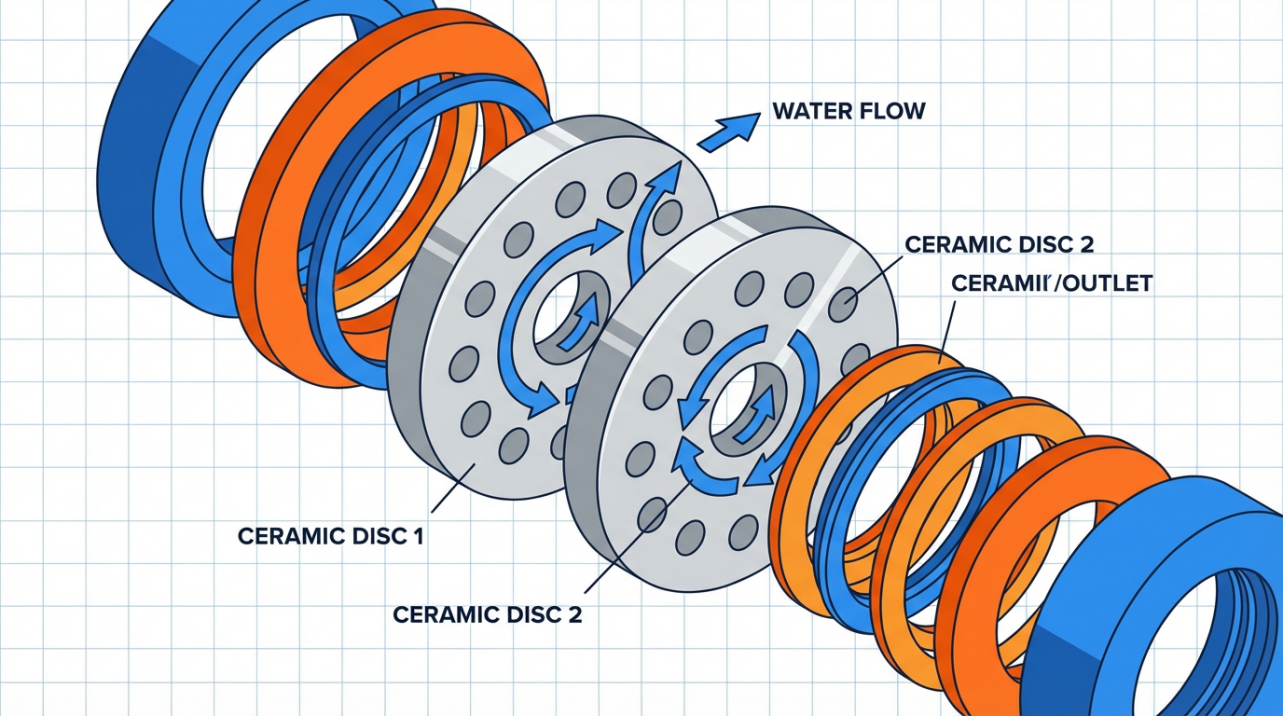
Ceramic faucet cartridges are the quiet heroes of a modern hydration-focused home. They sit out of sight inside your kitchen or bathroom faucet, yet they decide whether you get a smooth, precise stream of water or a sputtering, dripping annoyance. From a smart hydration perspective, their condition shapes not only your daily comfort but also how much water you waste and how consistently safe your drinking water remains.
Public health guidance from organizations such as the World Health Organization and plumbing experts at Purdue University makes it clear that plumbing is a health barrier, not just hardware. Cartridges, seals, and check valves help keep clean water separate from contamination and carry wastewater away safely. Understanding what helps ceramic cartridges last – and what quietly wears them out – is one of the easiest ways to protect both your faucets and your home hydration system.
What Ceramic Cartridges Actually Do
Inside most modern single-handle and many dual-handle faucets, a ceramic disc cartridge is the main control mechanism. Instead of relying on older rubber washers that you tighten down to stop the flow, ceramic cartridges use two extremely hard, polished ceramic discs. One disc stays fixed, while the other rotates as you move the handle.
As described in a plumbing forum discussion and by several faucet manufacturers, each disc has precisely shaped openings. When the openings align, water flows through; when they misalign, the flow stops. Because ceramics are very hard and wear-resistant, this design allows for the familiar “quarter-turn” feel: you can go from fully off to fully on in about a quarter of a turn, with very smooth motion and accurate control of temperature and flow.
Modern bathroom and kitchen faucet guides describe ceramic disc cartridges as the “brains” of the faucet. They mix hot and cold water, regulate flow, and, when they work properly, create an almost watertight seal that keeps your faucet drip-free for years.
How Long Ceramic Cartridges Are Designed To Last
Several sources converge on similar lifespan ranges for ceramic cartridges, with important caveats.
A ceramic cartridge manufacturer reports lab testing up to about 500,000 on–off cycles, with cartridges still operating smoothly. Under real household conditions, that translates to roughly 5 to 10 years for typical residential use, and premium models in good water quality can reach around 10 to 20 years. The same source notes that “economy” cartridges may last closer to 3 to 5 years, especially in harder service.
Other plumbing and faucet repair resources put most faucet cartridges, including ceramic types, in the 5 to 10 year range under normal conditions, while emphasizing that build quality, water quality, and maintenance habits are what turn those ranges into reality. One plumbing repair guide notes that ceramic disc cartridges can outlast older compression styles by many years, often reaching 15 to 20 years compared with roughly 3 to 5 years for compression cartridges.
Some faucet brands talk openly about longevity in their specifications. A luxury faucet manufacturer with all-brass bodies and ceramic disc cartridges, for example, rates its cartridges for over 500,000 cycles and backs many models with long-term warranties. That kind of rating is a signal that the manufacturer expects the ceramic internals to last for many years in everyday use.
To put ceramic cartridges in context alongside other cartridge types, the following table summarizes lifespan ranges reported by cartridge and faucet manufacturers.
Cartridge type |
Typical service life (real-world guidance) |
Notes on performance and durability |
Compression (rubber washer) |
About 1–3 years |
Older, low-cost, more leak-prone; frequent tightening and drips |
Economy ceramic cartridge |
About 3–5 years |
Lower-cost, often plastic-bodied; more sensitive to conditions |
Standard residential ceramic |
About 5–10 years |
Common in modern homes; lifespan highly dependent on water quality |
Premium brass ceramic |
About 10–20 years |
Brass-bodied, high-grade seals; used in high-end and heavy-use setups |
These ranges are not guarantees.

They are best-case expectations based on testing and field experience, and the factors below determine where your faucets actually land within those ranges.
Water Quality, Hardness, And Scale
If there is one factor that consistently shortens ceramic cartridge life, it is water quality – especially hardness and sediment.
Multiple plumbing and faucet-care articles point to hard water as a primary cause of premature wear. Hard water carries dissolved minerals that precipitate out as limescale on internal faucet parts, especially on cartridge surfaces, O-rings, and aerators. Over time, those deposits roughen the carefully polished ceramic and sealing surfaces that make the cartridge drip-tight. They also restrict flow, forcing users to apply more handle force, which further stresses the cartridge.
A commercial plumbing article describes how limescale accumulates not only on drains and visible faucet surfaces but also inside cartridges themselves, eventually requiring full component replacement. Household maintenance guides echo this, explaining that mineral deposits often start by clogging the aerator, then extend deeper into the valve if not addressed.
Manufacturers of both faucet cartridges and water filters recommend several protective strategies, especially in hard-water areas. These include installing a whole-home water softener to reduce mineral content, adding pre-filtration when water has visible sediment or sand, and following manufacturer guidance on pressure limits and replacement intervals. A water filtration manufacturer, for example, emphasizes pre-filters and proper pressure management as key ways to extend filter life. Those same principles apply to ceramic cartridges: the less grit and scale they see, the longer they retain their smooth, low-friction sealing surfaces.
A cartridge maker that sells anti-scale ceramic cartridges reports a case from a Nordic hotel where standard cartridges needed replacement about every three years due to hard water. After switching to anti-scale versions, cartridge service life extended to over eight years, dramatically cutting replacement cycles and complaints. That example underscores how water quality and cartridge design interact.

Sediment, Debris, And System Cleanliness
Beyond dissolved minerals, simple dirt also shortens cartridge life. A faucet and plumbing guide notes that dirt and debris can enter household water lines during storms, street work, or building renovations. Once those particles move into your plumbing, they travel through pipes and can accumulate inside cartridges and aerators.
If debris lodges between ceramic discs, it can scratch or chip the polished surfaces. A cartridge repair guide lists mineral buildup, scratched valves, and internal corrosion as leading causes of leaks. If damage progresses far enough, water starts to bypass the “off” position, causing constant dripping or leaks around the handle.
Water filtration experts recommend cleaning filter housings at every cartridge change to remove biofilm and residual contaminants. The same concept holds at the faucet level. Several faucet care articles encourage regular removal and cleaning of aerators by soaking them in diluted vinegar and brushing off deposits. One manufacturer recommends monthly aerator cleaning in hard-water areas to keep debris from reaching the cartridge at all.
Plumbing maintenance advice also suggests flushing new or newly repaired lines before installing a faucet so that construction debris does not get trapped in the cartridge on day one. A faucet maintenance article explicitly recommends flushing dirt out of pipes before installation for this reason.
Usage Intensity And Mechanical Stress
Two households with identical faucets and water quality can still see different cartridge lifespans based on how intensively those faucets are used and how they are handled.
The ceramic cartridge manufacturer that describes economy, standard, and premium grades highlights “daily usage intensity” as a major variable. A quiet guest bathroom that sees a few uses per day will impose far fewer cycles on a cartridge than a busy kitchen sink that runs dozens of times per day. In hotels, schools, or public restrooms, usage can be many times higher than in a typical home.
Several faucet maintenance articles also stress handle behavior. Recommendations include avoiding excessive operating force, not slamming the handle open or closed, and staying within the faucet’s design pressure. High pressure, combined with aggressive handle movement, accelerates wear on internal seals and can even deform plastic-bodied cartridges over time.
Where daily use is heavy or where users are less careful, such as in rental properties or commercial spaces, the choice of cartridge grade becomes more important. Brass-bodied ceramic cartridges are repeatedly recommended for high-usage environments because they have higher mechanical strength and better heat and pressure resistance. Plastic-bodied cartridges, by contrast, are described as lighter and cheaper but more prone to long-term deformation and shorter lifespans of about 3 to 8 years.
Cartridge Design, Materials, And Manufacturing Quality
Not all ceramic cartridges are created equal, even though they share the same basic operating principle.
A faucet value guide points out that premium faucets use ceramic cartridges rated for roughly 300,000 to 500,000 open–close cycles, which dramatically lowers leakage risk over time. Low-end cartridges that rely on copper or plastic sealing components, or have less precise surfaces, are more prone to wear and early failure.
The dedicated ceramic cartridge article deepens that picture. It distinguishes between brass-bodied and plastic-bodied ceramic cartridges and associates brass with higher strength, better pressure and temperature resistance, and longer life, particularly in high-use settings like hotels or public restrooms. Plastic cartridges are positioned as suitable for cost-sensitive, low-usage residential applications where earlier replacement is acceptable.
One faucet brand that emphasizes longevity notes that it uses all-brass bodies, superior finishes, and ceramic disc cartridges rated over 500,000 cycles. This pairing of robust valve bodies with high-spec ceramic cartridges is designed to keep both leak risk and maintenance frequency low.
Cartridge design also matters beyond materials. Cartridge makers and plumbers warn that there is no truly universal cartridge. Different brands and models have distinct stem lengths, thread patterns, and sealing surfaces. Using an almost-right cartridge, or one that fits only with force, can cause leaks, stiff handle motion, or even permanent damage to the valve body. That is why both plumbers and manufacturers recommend matching brand and model carefully and, when in doubt, physically comparing the old and new cartridges.
Installation Quality, Compatibility, And Plumbing Design
Proper installation is a quiet but powerful factor in cartridge longevity.
Several faucet care articles emphasize hiring experienced professionals for installation, avoiding impacts that could damage the faucet body, and removing cement or glue residue from surfaces. Just as importantly, they recommend flushing pipes before installation so that debris does not immediately contaminate the new cartridge.
Cartridge replacement guides explain that the basic swap can be within reach for a careful homeowner, but they also caution about alignment and seating. If the cartridge is misaligned, overtightened, or installed with damaged O-rings, it can place uneven stress on the ceramic discs and seals. That stress can show up as stiffness, grinding noises, or immediate leaks, all of which shorten service life.
Broad plumbing design also intersects with cartridge longevity and water wellness. The World Health Organization and plumbing experts at Purdue University define cross-connection (any potential link between clean drinking water and a source of contamination) and backflow (reverse flow due to back-pressure or back-siphonage) as major health risks. They highlight certified backflow prevention devices and simple air gaps as primary defenses.
A practical example appears in a forum explanation of modern mixer taps. There, the ceramic cartridge provides flow and mixing control, while check valves prevent water from flowing backward, especially when hoses or hand showers are attached. Double check valves are often used where potentially contaminated water could otherwise be drawn back into the system if mains pressure drops. In other words, the cartridge and its surrounding valves form a system. If that system is poorly installed or maintained, both health risks and mechanical stress increase.
Water Pressure, Flow, And Thermal Conditions
Cartridges are designed to operate within certain pressure ranges. A cartridge and shower valve guide notes that typical sink cartridges handle about 30 to 50 pounds per square inch (PSI), while shower cartridges are built for 60 to 80 PSI and incorporate features such as pressure balancing to prevent sudden hot or cold spikes.
When pressure regularly exceeds design limits, internal seals experience more stress and can wear prematurely. A water filtration manufacturer likewise warns that excessive pressure can damage housings and internal components, shortening cartridge life. While that guidance is aimed at filter cartridges, the same physics apply to ceramic faucet cartridges.
Some faucet maintenance resources also connect irregular flow or heater shutdowns to blockages in faucet screens or internal passages. If pressure is normal at the supply but low at the faucet, the cause may be a clogged aerator or cartridge rather than a system-wide issue. Leaving such restrictions unresolved often leads to more aggressive handle use and higher pressure spikes, which in turn accelerate wear.
Temperature plays a smaller role than pressure but still matters. Ceramic cartridges are generally tolerant of hot water, but their seals and surrounding materials must be compatible with the faucet’s intended temperature range. Shower cartridges see more thermal stress than many sink cartridges, another reason they are built more robustly.
Maintenance Habits And Response To Leaks
The difference between a ceramic cartridge that serves quietly for a decade and one that fails in a few years often comes down to maintenance habits and how quickly small issues are addressed.
Multiple faucet maintenance guides converge on a simple message: clean and inspect regularly, and treat leaks as urgent. Recommendations include wiping faucet surfaces with a soft cloth after use to prevent deposits, deep cleaning every month or two with a gentle vinegar solution, and avoiding abrasive cleaners that damage finishes.
At the internal level, articles from faucet manufacturers and maintenance experts suggest inspecting seals and gaskets annually, lubricating moving parts with silicone-based grease, and replacing worn parts every few years before catastrophic leaks occur. Aerator cleaning appears in almost every guide, typically by soaking in vinegar and gently brushing to clear mineral buildup.
A cartridge repair guide recommends proactively replacing faucet cartridges every 5 to 10 years, even if issues are not yet obvious, to prevent emergency leaks and long-term water damage. It also lists key signs of a failing cartridge: constant drip, leaks around the handle base, inconsistent temperatures, grinding noises, and handles that feel either stiff or loose.
The cost of ignoring these early warnings is not just mechanical. According to EPA WaterSense information cited in a cartridge repair guide, a faucet dripping at just one drip per second can waste more than 3,000 gallons of water per year, often adding around $35 to $50 to annual water bills from that single leak. Over multiple faucets and years, that waste multiplies. From a hydration and sustainability perspective, stopping drips early is one of the simplest water conservation steps you can take.
Home maintenance articles also warn that persistent leaks can damage cabinetry, promote mold growth, and corrode internal faucet parts. Once valve seats and internal threads are badly eroded, even a new cartridge may not seal properly, pushing you toward a full faucet or valve replacement rather than a simple cartridge swap.
Strategies To Maximize Ceramic Cartridge Life In A Hydration-Focused Home
With the main risk factors in mind, you can approach ceramic cartridge care as part of a broader, smart hydration strategy rather than a one-off repair. The goal is to pair the right hardware with the right environment and habits so the cartridge quietly supports healthy water use over the long term.
Start With The Right Faucet And Cartridge
Choosing the right cartridge begins when you select the faucet. Cartridge guides recommend using compression cartridges only when budgets are very tight or when you are maintaining vintage fixtures where frequent replacement is acceptable. For most modern homes that prioritize long-term reliability and low leakage, ceramic disc cartridges are the preferred choice.
Within ceramic cartridges, manufacturers differentiate between economy, standard, and premium brass-bodied designs. The ceramic cartridge article suggests reserving plastic-bodied cartridges for light-use, cost-sensitive applications and specifying brass-bodied ceramic cartridges wherever durability, brand reputation, and heavy usage are important, such as busy kitchens, rental properties, hotels, or commercial restrooms.
Faucet value and maintenance guides also advise choosing faucets with solid brass bodies, high-quality finishes, and OEM cartridges rated for many hundreds of thousands of cycles. That combination reduces both the frequency of repairs and the likelihood of catastrophic leaks that damage surrounding cabinetry and surfaces.
Protect Your Cartridge With Cleaner Water
The same water quality improvements that make drinking water taste better and feel better for skin also protect your ceramic cartridges.
Manufacturers of water filters and faucet cartridges recommend pre-filtration where water has high sediment loads or visible particles. A simple sediment pre-filter can intercept coarse debris before it reaches the finer passages of ceramic cartridges and aerators, significantly reducing mechanical wear. In hard-water areas, installing a water softener is repeatedly highlighted as a way to slow mineral buildup, extend fixture life, and improve overall water quality.
Filter manufacturers stress following official installation and maintenance guidelines, staying within specified pressure ranges, and replacing filter cartridges on time. Cleaning filter housings with warm soapy water and sanitizing them at each change helps prevent biofilm and mineral scale from seeding downstream components like faucet cartridges.
For faucet-level care, multiple sources recommend cleaning aerators several times per year, soaking them in vinegar to dissolve limescale, and replacing them if they are severely clogged. Because aerators are the first line of defense, keeping them clean is one of the simplest ways to keep debris away from the cartridge and maintain strong, even flow.
Build A Simple Annual Service Ritual
Instead of waiting for something to break, adopting a basic annual (or semiannual) faucet and cartridge check can dramatically extend component life.
Faucet maintenance guides suggest a routine that includes visually inspecting faucets for corrosion, cracks, or worn finishes; checking under sinks for hidden moisture; listening for small drips; and testing handles for stiffness or looseness. When issues are found, they recommend promptly replacing seals, O-rings, and cartridges as needed rather than deferring repairs.
Internal inspection can include removing handles to check cartridge condition, inspecting O-rings for flattening or cracks, and applying a thin layer of silicone-based plumber’s grease to moving parts to maintain smooth operation. Aerators can be removed and cleaned at the same time. Supply hoses are worth a quick check as well, particularly in older installations, looking for bulges, cracks, or corrosion.
Homeowners with basic tools can often handle these tasks themselves by following manufacturer instructions. Several guides emphasize that if the process seems confusing, parts do not fit as expected, or leaks persist after DIY repairs, consulting a licensed plumber is the safer choice to avoid hidden damage.
Know When To Replace The Faucet, Not Just The Cartridge
While cartridges are designed to be replaceable, there comes a point when replacing the entire faucet or valve is the better move.
A faucet manufacturer focused on bathroom fixtures suggests that full faucet replacement is often appropriate when the faucet is 15 to 20 years old, when multiple internal components are failing, or when the cost of cartridge repair approaches about 30 percent of the price of a new faucet. Visible signs such as heavy rust, severe mineral buildup, cracks in the faucet body, or peeling finishes also point toward replacement.
Faucet problem checklists list recurring dripping despite multiple repairs, leaks from multiple points on the faucet, uncomfortable stiffness or looseness in handles, and persistent low pressure that is not solved by cleaning the aerator as clues that deeper internal deterioration is present.
In showers, a cartridge and valve guide notes that repeated short-lived cartridge replacements, visible damage to valve seats, heavy corrosion, or difficulty finding compatible parts are indicators that full shower valve replacement is more economical in the long term. Typical shower valve replacement costs, including materials and labor, are higher than a simple cartridge swap but can restore proper operation and reduce the risk of hidden leaks behind walls.
From a water wellness standpoint, upgrading older faucets also brings benefits in efficiency. Modern faucets typically use significantly lower flow rates than older models, which can reduce water waste while still delivering a comfortable stream, especially when combined with water-saving cartridges and aerators designed to maintain perceived pressure.
Integrate Cartridge Care With Your Hydration System
If you use under-sink or whole-home filtration, your faucet cartridge sits at the end of a carefully designed chain. Water filter experts emphasize that each system is engineered with specific pressure limits, flow rates, and replacement intervals, and that ignoring those guidelines shortens component life and can compromise water quality.
By aligning filter maintenance, pressure management, and faucet care, you create a coherent hydration system. That means replacing filter cartridges on time, cleaning housings to remove biofilm and scale, keeping pressure within manufacturer limits, and pairing that upstream care with downstream practices like aerator cleaning, gentle handle operation, and timely cartridge replacement.
Public health-oriented plumbing guidance stresses that safe plumbing depends on both competent professionals and informed end-users. Regular inspections, incident reporting, and collaboration between homeowners, water suppliers, and plumbers form a health protection system. In your home, that system includes the humble ceramic cartridge at the heart of your faucets, working together with check valves, pipework, filters, and drains to keep water safe and reliable.
FAQ On Ceramic Faucet Cartridge Longevity
How long should a ceramic faucet cartridge last in a typical home?
For a standard residential faucet in good water conditions, multiple sources put the expected service life of a ceramic cartridge in the 5 to 10 year range. Premium brass-bodied cartridges in homes with well-managed water quality can run closer to 10 to 20 years, especially when aerators are cleaned regularly and leaks are addressed quickly. In harder water or high-use settings, lifespan tends to fall toward the lower end of the range unless anti-scale designs and softening are used. These are approximate ranges, not guarantees, and they depend heavily on water quality, usage intensity, installation quality, and maintenance habits.
Does improving my water quality actually help my faucet cartridges?
Yes. Cartridge manufacturers, faucet brands, and water filter experts all point to water quality as a major determinant of cartridge life. Hard water accelerates limescale buildup on ceramic surfaces and seals, while sediment and dirt can scratch discs or clog internal passages. Installing appropriate pre-filters or a whole-home water softener, cleaning filter housings at every change, and regularly cleaning aerators at the faucet all reduce the mechanical and chemical stress on ceramic cartridges. Those same steps also improve taste and clarity, making it easier to rely on your tap as a primary hydration source.
When is it better to replace the whole faucet instead of just the cartridge?
Replacing only the ceramic cartridge is usually the right approach when the faucet is relatively young, the finish and body are in good condition, and problems are limited to drips, minor leaks, or reduced flow. Several faucet and plumbing guides recommend considering a full faucet replacement when the fixture is 15 to 20 years old, when recurring problems involve multiple internal components, or when visible corrosion, cracks, or heavy mineral deposits suggest deep deterioration. If the cost of repair approaches a substantial fraction of a new faucet, or if repeated cartridge replacements solve problems only temporarily, replacing the entire faucet or valve becomes the more reliable and cost-effective option.
As a smart hydration specialist, I encourage you to think of ceramic faucet cartridges not as disposable parts, but as critical valves in your home’s water wellness system. With cleaner water, gentle use, and a simple maintenance rhythm, they can quietly deliver safe, comfortable water for many years – making every glass from your tap a more sustainable choice.
References
- https://test-college-affordability-estimator.uw.edu/leaking-outdoor-faucet
- https://engineering.purdue.edu/PlumbingSafety/project/WHO-Safe-Aspects-of-Plumbing-2006.pdf
- http://www.inspectionnews.net/home_inspection/plumbing-system-home-inspection-and-commercial-inspection/55601-faucet-cartridge-longevity.html
- https://www.higoldsink.com/newsinfo-how-long-is-the-service-life-of-a-kitchen-sink-faucet.html
- https://www.aquacubic.com/faucet-cartridge/
- https://www.drrooterlexington.com/blog-posts/faucet-cartridges-complete-guide-to-replacement-and-repair
- https://www.gtcampbellplumbing.com/post/faucet-cartridges-and-what-homeowners-should-know-about-them
- https://www.jmmeiao.com/news/how-long-should-a-faucet-cartridge-last-236003.html
- https://www.plbg.com/forum/read.php?1,318086
- https://www.ruvati.com/how-to-replace-bathroom-faucet-cartridge/

Share:
Understanding the Need for Solenoid Valves in RO Systems
Understanding How Much Chlorine Your RO System Can Really Handle