

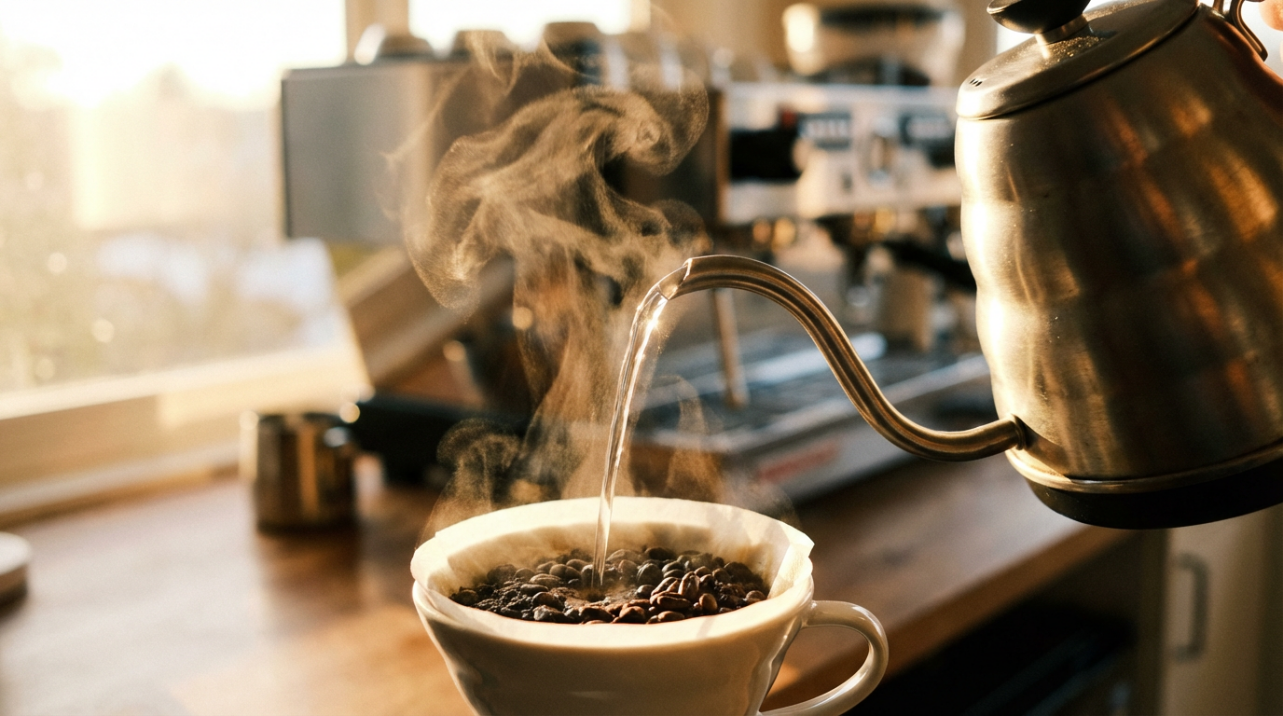
As a smart hydration specialist who spends as much time around kettles and espresso machines as around filtration systems, I see the same scene play out over and over. Someone has invested in phenomenal beans, a precise grinder, even a high‑end brewer. The coffee is good, but not special. Then we tune one variable they never really thought about: the water. Suddenly the same beans taste sweeter, clearer, more layered. That jump from “pretty good” to “championship level” almost always rides on water quality.
In this guide, we will unpack what “good water” actually means for coffee, using science from the Specialty Coffee Association, respected roasters, and water researchers, and translate it into practical choices you can make at home. The goal is simple: water that is healthy and pleasant to drink, kind to your equipment, and precise enough to unlock the full potential of your coffee.
Water: The Hidden 98 Percent Of Your Cup
Brewed coffee is overwhelmingly water. Multiple coffee and water studies put a typical drip brew at roughly 98–99% water with only about 1–2% dissolved coffee solids, and espresso at around 90% water. That means the liquid in your mug is mostly not coffee; it is water carrying dissolved flavor compounds.
Water is not just H₂O. It is a solvent loaded with minerals like calcium, magnesium, sodium, bicarbonate, and sometimes treatment chemicals such as chlorine. Those dissolved substances change how aggressively water extracts oils, acids, and aromatics from your grounds. They also contribute their own taste and smell. Two cups brewed from the same beans and recipe can taste dramatically different when made with different waters; roasters, the Specialty Coffee Association, and water-focused books such as “Water for Coffee” have all demonstrated this.
When I run tasting sessions, I often brew the same coffee three ways: with hard tap water, with good filtered water, and with distilled or reverse osmosis water that has almost no minerals. Most people immediately taste the differences. Hard water dulls acidity and makes the cup feel heavy or chalky. Ultra‑pure water makes the coffee strangely hollow, almost as if someone turned the flavor down. The sweet spot lies in between.
A simple way to visualize your cup is:
Component |
Approx share in drip coffee |
Role in your experience |
Water |
About 98–99% |
Solvent, carries flavor, affects aroma and feel |
Dissolved coffee solids |
About 1–2% |
Actual coffee flavors, aromas, body, and color |
That tiny 1–2% is what you obsess over with roast level, grind size, and brew ratio. But the other 98–99% is deciding how much of that goodness you actually get.
The Core Water Chemistry, Made Simple
You do not need to become a chemist to brew championship-level coffee, but you should understand a handful of concepts. These are the same variables professional baristas and water technologists work with.
Total Dissolved Solids (TDS): The Big Picture Number
TDS measures how much material is dissolved in your water in parts per million. It counts everything: useful minerals such as calcium and magnesium, but also sodium, bicarbonates, and trace contaminants. It does not tell you which ions are present, only how much “stuff” is in the water.
Historically, industry guidelines leaned heavily on TDS, with many standards pointing toward an “ideal” around 150 ppm. Roasters and water companies echo this, noting that water near that level often produces full, balanced cups, while water below roughly 75 ppm tends to make thin, under-extracted coffee and water above about 250 ppm easily becomes muddy or harsh.
More recent research from coffee technologists and roasteries has shown that TDS by itself is a blunt tool. Raising TDS by adding something like sodium chloride, for example, can leave measured flavor compounds almost unchanged even as TDS skyrockets. That is why professionals now treat TDS as a coarse indicator rather than a precise target.
In practice, TDS is still very useful at home.

Inexpensive TDS meters give you a quick snapshot of your tap, bottled, or filtered water. One popular filter jug or under‑sink system might consistently drop your tap from 250 ppm to around 120 ppm; another might nearly zero it out. Knowing those numbers provides a baseline as you experiment.
For filter coffee, some specialists recommend relatively soft water, in the neighborhood of about 30–100 ppm TDS, to let brightness and fruit notes shine. For espresso, many aim somewhat higher, often around 70–150 ppm, to keep shots tasting rich and protect machines from scale. The exact number matters less than having a consistent, moderate level rather than extremes.
Hardness (GH): Calcium and Magnesium For Body And Sweetness
General hardness is mainly the concentration of calcium and magnesium in your water. These minerals are crucial for both coffee flavor and machine health.
Moderate hardness generally helps extraction. Calcium and magnesium bind with flavor compounds and help pull them out of the grounds, contributing to body and perceived sweetness. Studies from roasters and the Specialty Coffee Association indicate that very soft water with almost no hardness tends to under-extract and taste flat. Hard water, on the other hand, can mute high notes and emphasize bitterness while also building scale inside kettles and boilers.
Several professional sources converge on a similar hardness zone:
- The Specialty Coffee Association’s ideal standard calls for calcium hardness between 50 and 175 ppm as calcium carbonate.
- A year‑long study by Seven Miles Coffee Roasters and the University of New South Wales measured flavor compounds in espresso and recommended a narrower band of about 50–80 ppm as calcium carbonate for hardness, noting that pushing much above about 90 ppm did not help flavor and did accelerate scale.
In the field, when I see hardness significantly above that range, espresso machines usually show heavy limescale buildup, and brew water tends to flatten the coffee’s acidity and nuance. When hardness is well below it, filter coffee often tastes papery or thin, even when all other brew parameters look good.
Alkalinity (KH): The Acid Buffer That Shapes Brightness
Alkalinity, often called carbonate hardness or KH, describes how much your water resists becoming more acidic. Chemically, it is driven mostly by bicarbonate ions. Bicarbonate acts as a buffer, neutralizing acids. That can be helpful in protecting metal boilers, but it has a big sensory downside if there is too much.
Specialty coffee is defined by its acidity: citrus, berry, floral, and wine‑like notes. High alkalinity water neutralizes those acids. Research summarized by the Specialty Coffee Association, a BRITA‑sponsored study, and practical guides from water specialists such as Scott Rao all point toward the same pattern: when alkalinity is high, coffee tastes dull, bitter, and flat. When alkalinity is low to moderate, acidity feels lively but balanced.
Several sources place the sweet spot for coffee alkalinity around 30–40 ppm, with the SCA standard around 40 ppm and Scott Rao recommending roughly 30–40 ppm for modern, lightly roasted coffees. The book “Water for Coffee” popularized aiming for a hardness to alkalinity ratio of about 2:1, which matches those numbers if your hardness is near 60–80 ppm.
In my work, alkalinity is the first number I look at when someone describes their coffee as “muddy,” “chalky,” or “lifeless” despite using excellent beans. If the alkalinity is very high, even modest changes toward the 30–40 ppm range can make acidity pop and sweetness emerge without modifying the roast or grinder.

pH: Supporting Role, Not The Star
pH describes how acidic or alkaline a solution is on a scale where 7 is neutral. Coffee in the cup is mildly acidic, around pH 5. It is natural to assume water pH would be a primary driver of taste, but research and expert practice suggest it is less critical than alkalinity.
Guides from roasters and water organizations generally recommend water that is close to neutral, with pH roughly between 6.5 and 7.5. The Specialty Coffee Association specifies pH 7.0 in its ideal water standard, and several roaster‑labs have found good results with pH in a slightly wider range from 7.0 up to about 8.5 when other variables are controlled. The key is that alkalinity, not pH alone, largely determines how acids are buffered.
If your water is wildly outside that band, machinery and taste can suffer. But if pH is close to neutral and alkalinity and hardness are dialed in, tiny pH tweaks will not usually make or break your cup.
Chlorine And Water Treatment Chemicals
Municipal water suppliers often disinfect with chlorine or chloramine. Even at low levels, these compounds are noticeable in coffee.
The Specialty Coffee Association and sensory specialists from BRITA point out that chlorine can react with organic residues in water, producing off‑odors and unpleasant tastes. If your tap water smells faintly of a swimming pool, your brewed coffee is likely to echo that.

Even when you cannot obviously smell chlorine, it can still react with delicate coffee aromatics and alter the flavor profile.
Multiple roasters and filtration companies recommend removing chlorine completely for brewing. Activated carbon filters, whether in a pitcher, under‑sink system, or plumbed espresso filter, are very effective at stripping chlorine and many associated off‑flavors.
From a hydration perspective, this is one of the easiest quality upgrades you can make. When we install a good carbon‑based system in a home with heavily chlorinated water, people almost always say they drink more water spontaneously because it simply tastes and smells better. Coffee benefits as a bonus.
Sodium, Chloride, And Other Ions
Beyond calcium, magnesium, and bicarbonate, a few other ions are worth noting.
Sodium is often elevated in softened water because many household softeners exchange calcium and magnesium for sodium. Sensorex and other water quality specialists observe that softened water tends to produce coffee that tastes muted, flat, or oddly bitter. High sodium levels also raise dietary concerns for some people, so softened water is rarely ideal as a primary brewing or drinking source.
Chloride is different from chlorine. It is an ion that can come from natural sources or from some water treatments. The Seven Miles Coffee Roasters study cautions that high chloride levels can drive corrosion in stainless‑steel boilers and contribute to malodorous notes. They recommend keeping chloride below about 60 ppm and ideally under 30 ppm for machine safety.
Potassium appears in some designer coffee waters and can support favorable extraction at modest levels, but high sodium and chloride are much more common troublemakers in real-world systems than high potassium.
Pulling The Numbers Together
Different organizations emphasize different metrics, but their recommendations overlap a lot. Synthesizing the ranges cited by the Specialty Coffee Association, Seven Miles Coffee Roasters’ analytical study, roasters such as Methodical, water technologists like Scott Rao, and detailed briefs from filtration companies, you get a practical “championship-style” target zone like this:
Parameter |
Practical target zone (brewing focus) |
Flavor risk if too low |
Flavor or equipment risk if too high |
TDS |
Roughly 75–150 ppm for all‑purpose use; 30–100 ppm for bright filter |
Thin, hollow, under-extracted cups |
Muddled, harsh cups; scale risk if minerals dominate |
Hardness (GH) |
About 50–80 ppm as CaCO₃ |
Flat, papery, weak body |
Muted acidity, chalky mouthfeel, heavy limescale |
Alkalinity (KH) |
Around 30–40 ppm as CaCO₃ |
Overly sharp, sour, spiky acidity |
Dull, bitter, flat coffee; muted fruit and floral notes |
pH |
Approximately 6.5–7.5 |
Potential corrosion; unstable flavor |
Chalky flavors; imbalance when combined with high alkalinity |
Chlorine |
As close to 0 ppm as possible |
Does not apply; chlorine is not beneficial |
Chemical, pool‑like aromas; damaged aromatics |
Chloride |
Below 60 ppm; ideally below 30 ppm |
Does not apply for normal waters |
Boiler corrosion; undesirable salty or metallic off‑notes |
You do not need to hit these numbers perfectly, but moving toward this neighborhood usually improves both flavor and equipment longevity.
How Water Interacts With Roast Level, Brew Method, And Temperature
Once you understand the chemistry, the next step is how it plays with your beans and choice of brewing method.
Roast Level: Matching Water To The Coffee’s Personality
Roast level strongly shapes how coffee responds to water.
Light roasts, roasted just past first crack, tend to have higher acidity with bright fruit and floral notes.

Medium roasts balance acidity, sweetness, and body, often showing chocolate and caramel notes. Dark roasts trade acidity for deeper, smoky, sometimes bitter flavors; they can overshadow the bean’s origin character. Importantly, the caffeine per gram changes very little across roast levels.
For light roasts that highlight nuance, low to moderate alkalinity is your friend. Guides from CoffeeChronicler, Methodical Coffee, and Scott Rao all align on the idea that high alkalinity mutes the sparkling acidity that makes light coffees special. If you love fruity pour-overs, targeting alkalinity around 30–40 ppm and keeping overall hardness moderate lets that brightness shine without turning sour.
Medium roasts are forgiving. Their balanced profile tends to taste pleasant over a wider water range, which is why they make a great everyday choice. Many home brewers find that once their water is roughly in the SCA ballpark—clean, neutral, modest hardness, and low alkalinity—the same medium roast tastes consistently good across drip, French press, and even espresso.
Dark roasts often benefit from slightly more buffering. Their natural bitterness and lower acidity mean that a bit higher alkalinity and slightly cooler brew temperatures can smooth edges. If you predominantly drink dark roasts, you may not need to chase ultra‑low alkalinity; you might even prefer water a little closer to 40–50 ppm alkalinity to soften any remaining sharpness.
Brew Method: Filter, Immersion, And Espresso
Different brew methods interact with water quality in distinct ways.
Pour-over and batch drip methods wash water through a bed of grounds. They tend to showcase clarity and high‑frequency flavors, both good and bad. Roasters like Ratio Coffee and Barista Magazine emphasize that soft water with low to moderate alkalinity lets pour-overs taste clean and layered, while hard, high-alkalinity water quickly flattens them. This is why many filter‑focused cafes in harder‑water cities use reverse osmosis systems with blending to achieve very soft final water around 30–50 ppm TDS and modest alkalinity.

Immersion methods such as French press and some AeroPress recipes soak coffee in water for several minutes. With longer contact time, they can pull more body and robustness even from slightly harder water. Ratio Coffee notes that immersion brews often feel satisfying and full when paired with somewhat higher hardness, although the same high alkalinity issues still apply.
Espresso is its own world. Here, water must deliver great flavor while preserving expensive machines. Several espresso‑focused guides recommend using soft to moderately hard water, often around 70–120 ppm TDS with balanced hardness and alkalinity. Too hard and you get scale and flat shots; too soft and shots taste thin and machines may see corrosion rather than scale. Espresso specialists also watch chloride carefully to protect stainless‑steel boilers, aiming below about 60 ppm and ideally under 30 ppm.
Temperature: The Underdog Variable That Water Makes Work
Water temperature is another lever that works hand-in-hand with water chemistry. Across multiple sources—from the National Coffee Association to roasters like Door County Coffee, Fernwood, Goldberry, and others—the recommended brewing range for most hot methods is a water temperature between 195°F and 205°F.
Within this range, several things happen:
Water that is too cool extracts slowly. You get weak, bland coffee lacking sweetness, body, and complexity. Oils and some sugars simply do not dissolve enough.
Water that is too hot extracts aggressively. You pull out bitter compounds and tannins, burying nuance and leaving a harsh or dull cup.
Grind size and temperature must be matched. Finer grinds extract faster and may prefer the lower part of the range around 195°F, while coarser grinds often benefit from temperatures closer to 205°F to maintain extraction.
Different methods also have their own sweet spots. Many drip and pour-over brewers work well within the standard 195–205°F range. French press and other longer immersions often use water near 200°F to offset heat loss over a four‑minute steep. AeroPress recipes commonly dip to 175–185°F to create a smoother, less bitter cup. Espresso, brewed under pressure and in seconds, usually lands somewhere in the mid‑190s°F depending on the machine and roast.
Altitude adds another wrinkle. The boiling point of water drops by about 2°F for every 1,000 feet above sea level. In a high‑altitude city around 5,000 feet, water boils near 202°F. If you take that boiling water off the stove and wait a minute before pouring, it may already have cooled below 195°F, leaving you with under‑extracted coffee unless you adjust grind size or brew time.
Water quality interacts with all this. Hard, high‑alkalinity water brewed at the top of the temperature range tends to emphasize bitterness and mute acidity. Very low‑mineral water brewed at the low end of the range can highlight sharp sourness and make coffee feel thin. When I help people tune both water and temperature, the biggest wins come from pairing moderate-mineral, low‑alkalinity water with steady brew temperatures and then making small, deliberate adjustments based on taste.
Choosing And Improving Your Water At Home
Now that the chemistry is clearer, how do you choose a practical water source for championship-level coffee in a real kitchen?
First, Assess Your Starting Water
Start with your senses. Fill a glass from your tap, chill it, and taste it. If it smells musty or chlorinated or tastes metallic or salty, you already know your coffee will echo those notes. If it tastes clean and pleasant, you might be closer than you think.
Next, look up your local water report. Municipal suppliers in most regions publish hardness, alkalinity, and sometimes TDS and chloride. The values may fluctuate, but you will get a sense of whether your water is soft, moderate, or very hard, and whether alkalinity is high.
If you want a bit more precision, an inexpensive TDS meter is a practical tool. It will not tell you exactly how much calcium or bicarbonate you have, but it will show whether your tap is closer to 80 ppm or 350 ppm and how much your pitcher or under‑sink filter actually changes that number.
Comparing Tap, Bottled, Filtered, And RO/Distilled Water
Different water sources come with distinct trade-offs for both flavor and health. Pulling together recommendations from roasters, filtration companies, and espresso specialists, you can summarize them this way:
Source type |
Pros for coffee and hydration |
Watch-outs for flavor, health, or gear |
Unfiltered tap water |
Convenient; inexpensive; often safe to drink |
Chlorine taste and odor; variable hardness and alkalinity; scale buildup; off-flavors from local minerals |
Pitcher-filtered tap (carbon) |
Removes chlorine and many off‑odors; inexpensive; easy to use; improves taste |
Usually does not significantly reduce hardness or alkalinity; filters need regular replacement |
Under-sink filtration systems |
Continuous supply of clean, chlorine‑free water; can target hardness/alkalinity |
Higher upfront cost; requires proper sizing and maintenance; quality varies by design |
Bottled spring water |
Typically chlorine‑free; labeled TDS and minerals; often consistent by brand |
Some brands are very hard or too mineral‑poor; recurring cost; plastic waste |
Distilled or pure RO water |
Very low contaminants; consistent; ideal blank canvas for remineralization |
Too few minerals for good extraction on its own; flat coffee; can leach metals from equipment over time |
RO or distilled with minerals |
Lets you build near‑ideal water; used by baristas with mineral packets or DIY |
Requires buying packets or understanding recipes; higher ongoing cost than simple filtration |
Conventional softened water |
Reduces scale by lowering calcium and magnesium |
Often high in sodium; can produce flat, muted, or bitter coffee; not ideal as primary drinking water for many people |
Guides from Methodical Coffee, Fresh Water Systems, Difference Coffee, and others generally rank unfiltered hard tap water as the worst option for both taste and equipment. Bottled water sits in the middle: convenience and consistency, but with cost and sustainability concerns. Distilled and reverse osmosis water, when properly remineralized, can be outstanding, but they demand more involvement.
For most homes, the best balance of taste, health, and practicality is filtered tap water. A good filter removes chlorine and many off‑flavors while preserving enough calcium and magnesium for extraction. Under‑sink systems that pair sediment and activated carbon filtration with controlled softening or blending are particularly powerful because they deliver this water to every glass you drink, not just to the kettle.
When I design home hydration setups, I aim for one system that gives families clean, pleasant drinking water and also sits in the right mineral range for coffee. That way, you are not juggling different waters for sipping and brewing, and you are more likely to stay well hydrated throughout the day.
A Practical Routine To Dial In Championship Coffee Water
Once you have a decent water source, how do you refine it toward championship quality without turning your kitchen into a lab? A simple, repeatable routine works best.
Begin by locking in a baseline water. If your tap is already relatively soft and low in chlorine, a good pitcher or under‑sink carbon filter may be all you need. If your tap is very hard or heavily chlorinated, consider either a more advanced home system or starting from bottled spring water chosen for moderate TDS and low sodium.
Next, brew side-by-side comparisons. Pick one favorite coffee and brew it with two different waters in as identical a way as possible: same grinder setting, brew ratio, temperature, and method. Many roasters, including Five Star Coffee Roasters and Ratio Coffee, recommend exactly this kind of experiment. When you taste the cups side by side, pay attention to sweetness, clarity, acidity, and aftertaste.

Good water tends to reveal cleaner flavors, clearer separation between notes, and a sweeter finish.
If your coffee tastes thin and sour even when brewed properly, your water may be too soft or too low in minerals. Try a water with moderately higher TDS and hardness or blend a small proportion of mineral‑rich water into your base. If it tastes flat and bitter, alkalinity may be too high; softer water or a filter that reduces carbonate hardness can help.
If you want more control, distilled or reverse osmosis water plus mineral packets formulated for coffee, such as the widely used ready‑made blends mentioned by several coffee guides, allow you to build precise water profiles. Some advanced home brewers mix their own concentrates using salts like potassium bicarbonate and magnesium salts, but experts caution against overusing Epsom salt because the sulfate component can produce strange, chemical-tasting water even when hardness numbers look ideal. Unless you are ready to study water chemistry, following tested recipes from reputable coffee water companies is safer.
Finally, protect your equipment. Even if your water tastes great, very hard water is tough on boilers and kettles. Espresso specialists warn that limescale from hard water can clog valves, insulate heating elements, and throw off temperature control. On the other end of the spectrum, prolonged use of completely demineralized water can contribute to corrosion and confuse some machines’ sensors. Using moderately hard, low‑alkalinity water and following manufacturer recommendations for periodic descaling strikes a sensible balance.
If you write down what water you used, how it tasted, and how your gear responds over time, you will quickly build a personalized map of what works best in your kitchen.
A Brief Note: Water Shapes Coffee Long Before Your Brew
One fascinating piece of recent research looks at water quality during coffee processing at origin. In washed and semi‑washed coffees, producers ferment sugary mucilage off the beans in water tanks. Studies summarized by espresso and water specialists show that mineral content and pH of that fermentation water dramatically affect microbial activity, the speed of mucilage breakdown, and final cup attributes like acidity and clarity.
Water rich in calcium and magnesium tends to slow fermentation but often produces cleaner, brighter cups with enhanced fruity notes when managed well. Acidic water, common in some volcanic regions, speeds things up and can lead to vibrantly floral and citrusy coffees. Alkaline water high in bicarbonates slows fermentation and can lead to flatter cups unless producers compensate by adjusting fermentation time or adding organic acids.
For you as a brewer, the takeaway is that water quality has already been influencing your coffee long before it reached your grinder. When you then pair that coffee with thoughtful brew water and temperature control at home, you are aligning with decisions that farmers and processors made upstream.
FAQ: Quick Answers For Everyday Decisions
Do I really need special water to brew championship coffee?
If you genuinely love how your coffee tastes right now, even with tap or simple filtered water, you do not have to change anything. Several roasters and water guides emphasize that taste is the ultimate judge. However, most tap water worldwide is not ideal for coffee. It often has excess calcium carbonate, high alkalinity, and chlorine, all of which can mute flavor and stress equipment. If your coffee tastes “fine” but not exciting, or if it tastes different week to week even with the same beans, improving water is usually the fastest way to get a more consistent, more vibrant cup. Think of it less as chasing perfection and more as removing obstacles that keep your coffee from tasting as good as it could.
Is distilled or reverse osmosis water bad for coffee?
Distilled and pure reverse osmosis water are not dangerous, but on their own they are too pure for great coffee. Multiple coffee and filtration companies point out that water with essentially zero dissolved solids struggles to extract sweetness and body and can yield dull, flat coffee. Over long periods, such aggressive water can also leach metals from boilers. That said, these waters can be outstanding when you add minerals back in. Many roasters and espresso specialists recommend exactly this: start with very low‑TDS water and remineralize using purpose‑made coffee water packets or carefully measured concentrates. That approach avoids local contaminants and gives you precise, repeatable water, but it does require a bit more effort than simply turning on the tap.
What about alkaline water from the grocery store?
“Alkaline water” sold at pH 8–9 is not the same thing as water with ideal alkalinity for coffee. As Methodical Coffee and water technologists explain, pH describes how acidic or basic water is, while alkalinity describes how strongly it resists becoming more acidic. Many alkaline waters also have elevated alkalinity from added minerals. In coffee, that extra buffering tends to neutralize the very acids that make high‑quality beans taste bright and interesting. If you brew with strongly alkaline water, especially with lighter roasts, you may find your coffee tastes oddly flat. It will not harm you, but it is unlikely to be your best choice for nuanced brewing. Most championship-style water sits closer to neutral pH with moderate, not extreme, alkalinity.
Dialing in water for coffee is not about chasing a magic number on a lab report. It is about aligning your brewing water with what we know from science, roaster experience, and your own palate, while also supporting healthy everyday hydration and protecting your equipment. When you bring clean, chlorine‑free, moderately mineralized water into your home—whether through a smart under‑sink system, a well‑chosen pitcher, or carefully remineralized distilled water—you are giving both your coffee and your body a better foundation.

From there, every small adjustment in grind, temperature, and recipe has a clearer, more delicious impact, and your morning cup starts to taste a lot more like something worthy of a championship stage.
References
- https://www.baristamagazine.com/achieving-the-perfect-pourover-part-i-water-temperature/
- https://www.bonlifecoffee.com/blog/water-temperature-why-does-it-matter-so-much-when-brewing-coffee?srsltid=AfmBOooqQbmwwW-a9KnG1hxMlvU3AUvjilwBTFew82JRUm_KjRlDmC2h
- https://coffeechronicler.com/best-water-for-coffee/
- https://pillarcoffee.com.au/journal/top-brewing-waters?srsltid=AfmBOor6IDnLPpSu2bMxUKuGrIy5sRn_ePa_MqoTkcVrWneBOV7zT9AB
- https://sensorex.com/coffee-water-quality/?srsltid=AfmBOorQO7nQIBR7e5dS3Vwfi_lo1cw0MVd7UDIkZkC_i5PpbCTgb3GG
- https://5starcoffeeroasters.com/blogs/coffee-education/hidden-ingredient-waters-impact-on-your-coffee-brewing-experience
- https://ravecoffee.co.uk/blogs/news/the-best-water-for-coffee?srsltid=AfmBOopMTGdUcWffZp9AT-9IMwh1blqkPxbYoeL-vYfW0ze8ghVtweuX
- https://www.coffeebean.com/blogs/blog/water-and-coffee-understanding-how-temperature-affects-your-cup
- https://crockettcoffee.com/blogs/small-batch-coffee/the-water-effect-how-water-quality-affects-coffee-taste?srsltid=AfmBOoooFl3uPXHmZUxZLb5mT09Vqyu0l-4LvpsET7ya2PCiTaq-3Lhs
- https://doorcountycoffee.com/blog/how-brewing-temperature-impacts-coffee-extraction/

Share:
Understanding the Impact of Alkaline Water on Blood pH Levels
Understanding Why Bartenders Prioritize Water Quality Over Alcohol