

As a Smart Hydration Specialist and Water Wellness Advocate, I meet a lot of people who proudly hold up a clear plastic bottle and say, “It’s purified by reverse osmosis, so it must be the healthiest, right?” The label sounds scientific and reassuring. But what does “RO” on bottled water really mean, and how does it compare to having reverse osmosis right at your kitchen sink?
Using evidence from public health agencies, water-quality researchers, and long‑time water treatment professionals, this guide unpacks the real benefits and drawbacks of bottled water produced with reverse osmosis, and how it stacks up against home RO filtration.
What “RO” on Bottled Water Really Means
When you see “purified by reverse osmosis” on a bottle, it usually means the water has been pushed under pressure through an ultra-fine membrane that lets water molecules pass while rejecting most dissolved substances. Multiple studies and industry summaries report that well-designed RO systems can remove roughly 90–99 percent of dissolved salts and many contaminants when operated within their rated pressure and temperature ranges.
In practical terms, that membrane helps reduce total dissolved solids and a long list of potential contaminants, including heavy metals such as lead and arsenic, hardness minerals like calcium and magnesium, and many pesticides, solvents, and industrial chemicals. Research cited by the Water Quality Association and the Environmental Working Group points to RO as one of the most effective ways to lower levels of PFAS “forever chemicals,” arsenic, and other risky pollutants that can slip through simpler filters.
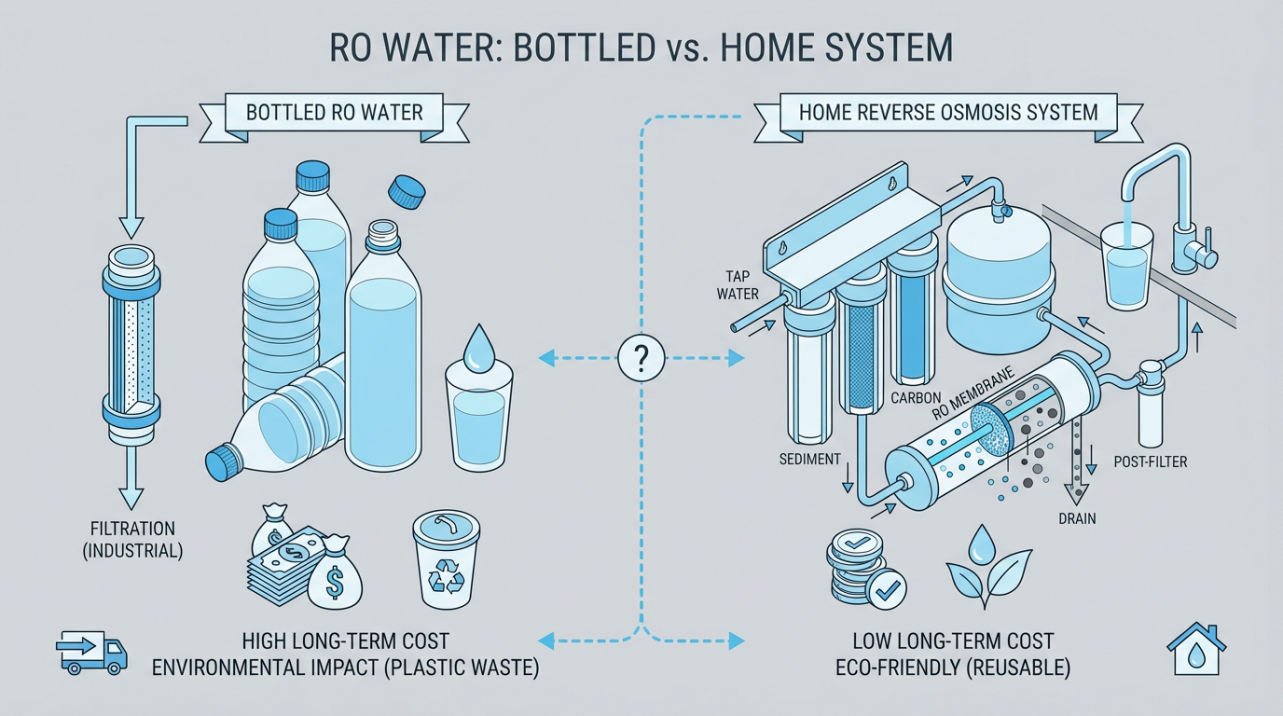
Most RO setups, whether in a bottling plant or under a kitchen sink, are multi-stage systems. Water typically passes through a sediment prefilter that captures grit and rust, then through activated carbon that reduces chlorine and many organic compounds, then through the RO membrane itself, and finally through a post-filter that polishes taste and odor before the water reaches your glass. Some systems add a final remineralization stage to restore a small amount of calcium or magnesium for better flavor and a more natural mineral profile.

In bottled water plants, that same core technology is used at a larger scale, often with robust pre-treatment to protect the membrane from fouling. The result is a very low‑mineral, high‑purity water that can taste noticeably cleaner than many municipal supplies.
The Real Health Benefits of RO‑Purified Water
Evidence-based health benefits of RO water do not depend on whether the water ends up in a plastic bottle or in a reusable glass at your sink. The core advantages come from the contaminants it can remove.
Public health agencies, including the Centers for Disease Control and Prevention, note that reverse osmosis can significantly reduce many concerning chemicals, including lead, copper, chromium, chloride, sodium, and, depending on the certified claims of the system, arsenic, fluoride, nitrate, and others. CDC guidance also points out that viruses such as norovirus and hepatitis A and bacteria such as E. coli are so small that you need technologies like nanofiltration or reverse osmosis to reliably block them.
Clinical and field reports from water professionals echo this. Articles from companies that routinely test and treat tap water for homes and businesses describe RO systems removing up to about 99 percent of common tap-water contaminants, including lead, nitrates, fluoride, arsenic, PFAS, and many volatile organic compounds. That level of reduction is especially relevant for families in areas with aging infrastructure, agricultural runoff, or known contamination events similar to the Flint water crisis.
For people with higher vulnerability, such as infants using formula mixed with tap water, older adults, or anyone with a weakened immune system, clinicians often recommend higher barriers against microbial and chemical contaminants. According to both the CDC and multiple water-treatment providers, reverse osmosis can be part of that higher protection when it is correctly installed, properly certified, and well maintained.

From a user-experience standpoint, many households and commercial clients report that RO water tastes cleaner and smells fresher because chlorine, metallic notes, and earthy off-flavors are significantly reduced along with total dissolved solids. Better taste sounds like a minor perk, but in practice it matters: people tend to drink more water when it actually tastes good, which supports hydration, digestion, and overall wellness.
The Nutrient Question: Does RO Water “Strip Everything Out”?
One of the biggest myths I hear at kitchen tables and in wellness forums is the idea that RO water is “too pure to be healthy” or that it “leaches minerals” from your body. The truth is more nuanced, and several of the sources in our research base tackle it directly.
It is accurate that RO significantly reduces beneficial minerals such as calcium and magnesium, along with contaminants. Low-mineral water can taste flatter than moderately mineralized tap water or spring water, and sensory research on remineralized RO water shows that carefully adding minerals back changes flavor, mouthfeel, and even the sense of “freshness” in the water. That is why many modern RO systems, including those highlighted by multiple manufacturers, add back a controlled amount of minerals in a final stage.
The health impact of mineral removal, however, appears limited in normal diets. Water-treatment articles citing expert opinions emphasize that most essential minerals come from food rather than from drinking water. In energy-dense diets, the mineral contribution of tap water is relatively small compared with what you get from fruits, vegetables, grains, and other whole foods. Several RO education pieces explicitly note that the modest reduction in minerals from drinking water is generally outweighed by the benefit of removing heavy metals and synthetic chemicals.
There is caution from authorities such as the World Health Organization about relying exclusively on demineralized water long term, largely because extremely low mineral content can have implications for taste, plumbing corrosion, and possibly mineral balance under certain conditions. In response, many RO manufacturers and installers recommend either remineralized RO water or a mixed approach where RO is used mainly for drinking and cooking while other taps provide normal mineralized water.
For bottled RO, you see the same pattern.

Many “purified” bottled waters are essentially RO or similar membrane-treated water that is either left very low in minerals or deliberately remineralized for taste. What matters for your health is the whole picture: what contaminants are being removed, what minerals you get from your diet, and what kind of water encourages you to drink enough every day.
The Hidden Costs of Bottled RO Water
When people tell me they rely on bottled RO water because it feels safer, I acknowledge that there are cases where bottled water is genuinely helpful, especially during short-term contamination events or when you are traveling and do not control the plumbing. But for everyday use at home, bottled RO carries two significant costs: financial and environmental.
On the financial side, bottled water adds up quickly. Beverage Marketing Corporation reported that in 2020 the average wholesale price for bottled water in the United States was about $1.17 per gallon. That is wholesale, not the higher retail price you pay at the store. Another technical review translates typical household use into real dollars: if a family uses just 2 to 3 gallons of drinking water per day and pays between $3 and $10 per gallon for bottled options, that can reach roughly $6 to $30 per day, which is many hundreds or even thousands of dollars per year.
By contrast, analyses of home RO systems show typical hardware costs in the range of a few hundred dollars, plus a few hundred more for installation, with filter changes every 6 to 12 months. One water-treatment manufacturer estimates that households can save around 30 percent annually on bottled water costs by switching to RO, with some families saving on the order of $1,200 per year.

While your exact numbers will vary, it is clear that paying by the bottle is the most expensive way to buy purified water over time.
The environmental cost is equally important. Several of the articles in our research base point out that bottled water is often simply treated tap water in plastic packaging. Bottles generate enormous plastic waste and can contribute to microplastics in both the environment and, potentially, the water itself. One education piece on RO from a home purifier brand explicitly stresses that bottled water is not a sustainable alternative because it is frequently repackaged tap water, is expensive, can contain microplastics, and produces plastic that can persist in landfills and ecosystems for decades or longer.

When you overlay this with the reality that many US households already have access to tap water that is among the safest in the world, according to the US Environmental Protection Agency, it becomes clear that bottled RO should be a backup plan, not a permanent lifestyle if you have the option to treat water at home.
RO Wastewater and Efficiency: Bottled vs Home Systems
One of the most important “truths” behind bottled RO is invisible to consumers: the water wasted during production. Reverse osmosis works by splitting feed water into a purified stream and a reject stream known as concentrate or brine. The concentrate carries away the rejected salts and contaminants.
The EPA’s WaterSense program has examined point-of-use home RO systems and found that a typical unit sends five gallons or more of reject water down the drain for every gallon of treated water produced, with some inefficient systems wasting up to ten gallons per gallon of drinking water. That is a large water footprint if you are in a drought-prone region or paying high water and sewer rates.
Because of this, WaterSense created a performance specification for under-sink RO units that limits waste to 2.3 gallons or less for every gallon of treated water, while still requiring strong contaminant reduction and at least a one-year membrane life. The EPA estimates that replacing an older RO system with a WaterSense-labeled model can save more than 3,100 gallons of water every year, or about 47,000 gallons over the life of the system.

If all point-of-use RO systems sold in the United States met this standard, the country could save more than 3.1 billion gallons of water annually, equivalent to the typical yearly indoor water use of tens of thousands of homes.
In bottled water factories, similar physics apply. Whenever RO is used, there is a concentrate stream. Large plants may recover some of this water for non-potable uses like equipment washdown, but the process is still water intensive by design. The difference is that you do not see that waste when you buy a bottle; it is embedded in the supply chain.
At home, you do see it, because reject water usually flows to your drain under the sink. That visibility is uncomfortable for many eco-conscious homeowners, but it can be managed. Some sources recommend reusing RO reject water for non-potable tasks such as watering ornamental plants or cleaning, and newer systems, including high-efficiency platforms highlighted by manufacturers like Pentair and others, are engineered to cut reject volumes dramatically compared with older RO designs.
Taste, Sensory Quality, and Remineralization
Taste is often the deciding factor when a family finally adopts or abandons bottled RO. Research on RO-treated groundwater published in the scientific literature helps explain why.
When anaerobic groundwater is treated with RO membranes, the permeate is almost free of minerals such as calcium and magnesium and has extremely low levels of trace pollutants like pesticides and medicines. While this is excellent for safety, the resulting water can taste “empty” or flat. Scientists studying the sensory quality of RO water found that mineral ions are the main drivers of taste, and that even when individual minerals are below their normal taste thresholds, mixtures of salts are still perceived by trained panels.

The same research shows that remineralizing RO water after treatment helps with both taste and corrosion control. Small additions of minerals can shift the water from bland to pleasantly fresh, change mouthfeel, and reduce metallic sensations that sometimes occur with very low-mineral water. It is not surprising, then, that many purified bottled waters are deliberately remineralized, and that many modern residential RO systems now include a remineralization cartridge or “alkaline” post-filter as a standard or optional feature.
From an everyday perspective, this means that if you like the crisp taste of your favorite bottled RO water, you can often get a very similar profile by choosing a home RO system with a remineralization stage tuned to your preferences.
Bottled RO vs Home RO vs Basic Filters
Bottled RO, home RO, and simple pitcher or refrigerator filters all have a place, but they are not interchangeable. Public health guidance from the CDC and technical descriptions from water-treatment experts help clarify the roles.
Most consumer pitchers and fridge filters use activated carbon. They are very good at improving taste and odor by reducing chlorine and some organic compounds and may reduce certain heavy metals such as lead. However, they are generally not designed to remove germs and are not as effective for a broad spectrum of dissolved contaminants.
Reverse osmosis, by contrast, is capable of rejecting a much wider range of dissolved solids, heavy metals, and many pathogens. Articles from several water professionals highlight that RO systems substantially outperform basic carbon filters when it comes to reducing total dissolved solids, nitrates, arsenic, PFAS, and other contaminants.
Bottled RO water delivers this higher level of treatment at the factory; home RO delivers it at your tap. In both cases, the system should be certified to appropriate standards. NSF International and the Water Quality Association maintain standards and certifications such as NSF/ANSI 58 for reverse osmosis, NSF/ANSI 42 for taste and odor, and NSF/ANSI 53 for reduction of parasites and certain other contaminants. APEC, for example, markets home RO systems that carry the WQA Gold Seal, which signals that they have been independently tested for performance, durability, and materials safety.
A simplified comparison looks like this:
Aspect |
Bottled RO Water |
Home RO System (under‑sink) |
|
Contaminant reduction |
High for many contaminants, depends on bottler |
High for many contaminants, when properly certified and maintained |
Mainly taste and odor, limited chemical and metal reduction |
Microbial reduction |
Often high, process-dependent |
High when system is designed and certified for cysts, bacteria, viruses |
Typically not designed for complete germ removal |
Convenience |
Very convenient on the go |
Very convenient at home once installed |
Convenient but slower, needs frequent cartridge changes |
Cost over time |
High recurring cost per gallon |
Higher upfront cost, much lower cost per gallon over time |
Moderate recurring cartridge cost |
Environmental impact |
Significant plastic waste and transport footprint |
No plastic bottles; some reject water from RO process |
Low plastic waste; no RO reject water |
In my own field work, families who switch from bottled RO to a well-chosen under-sink RO system typically describe three changes.

First, they stop hauling heavy cases of water home. Second, they save noticeable money after the first year. Third, they feel more in control because they can see and maintain the system that is purifying their water.
Safety, Installation, and Maintenance Considerations
Whether you are relying on bottled RO or installing a system at home, safety and proper maintenance are non-negotiable.
Home RO systems must be installed correctly to avoid cross-contamination. Plumbing experts point out that if the drain line from an RO system is not protected, a clog or backup in the sink drain could allow contaminated water to flow back toward the RO unit. To prevent this, plumbing codes generally require an air-gap device that creates a physical break between the RO drain and the household drain system. This often appears as a small bump or cap on the sink deck, similar to what protects your dishwasher from backflow. Licensed plumbers and experienced water-treatment professionals are trained to install these devices so your purified water stays separated from wastewater.
Maintenance is equally important. Across multiple sources, the recommended pattern is consistent: sediment and carbon prefilters are typically replaced every six to twelve months, post-filters or polishing cartridges about every year, and RO membranes every two to five years depending on usage and local water quality. Some systems designed for high efficiency, like certain platforms discussed by manufacturers, promote annual cartridge swaps as the main routine task. The CDC advises following manufacturer schedules, wearing gloves when changing filters, washing hands afterwards, and periodically sanitizing systems to prevent germs from growing on or inside cartridges.

Bottled RO water shifts this maintenance responsibility to the bottler, which can be appealing if you do not want to think about filters. However, you also lose transparency and control. You are trusting that the plant maintains its membranes and filters, monitors water quality carefully, and keeps microbiological growth in check inside storage tanks and bottling lines.
For consumers who want control without being overwhelmed, I usually recommend working with a reputable local water-treatment company that can test your water, recommend an appropriately certified RO system, and set up a simple maintenance schedule. Many companies also offer reminders or service plans so you are not guessing when filters are due.
When Does Bottled RO Make Sense?
Despite the drawbacks, bottled RO still has a role.
It is a practical short-term solution during emergencies, boil-water notices, or temporary contamination events when your tap may not be safe and you do not have a certified RO system at home. It is also helpful when traveling in areas where tap water quality is uncertain and you have limited control over the plumbing.
In my own practice, I think of bottled RO as an excellent bridge, not a permanent foundation. It bridges gaps when you do not have immediate access to safe plumbed water or while you are planning and installing a long-term solution at home. But as a daily habit for households in places where you can treat tap water directly, bottled RO is usually the least efficient and least sustainable option once you look at cost, plastic waste, and the hidden water footprint of industrial RO.
How to Decide: Bottled RO or Home RO?
Choosing between bottled RO and a home RO system should start with one simple step: understanding your source water. If you are on a public water system in the United States, your utility is required to provide an annual water quality report that lists detected contaminants and how they compare to standards. The CDC recommends reviewing that report, and private well owners are advised to test their water at least once a year and whenever there are changes in taste, color, or smell.
Once you know what is in your water, you can decide what level of treatment you truly need. If your main concern is taste and odor and your water already meets safety standards, a high-quality carbon filter might be sufficient, and bottled RO could be unnecessary. If testing shows elevated levels of dissolved solids, nitrates, arsenic, or other more stubborn contaminants, or if there are immunocompromised individuals in your home, then RO becomes a stronger candidate.
Certification is your second checkpoint. For home systems, look for RO units certified under standards such as NSF/ANSI 58 and, when applicable, WaterSense labeling for improved efficiency. The WaterSense label indicates independent verification that the system meets both contaminant reduction and water‑use efficiency criteria. Some brands also carry the Water Quality Association’s Gold Seal, which is another sign of thorough testing.
If you are leaning toward continuing with bottled RO, you can still apply similar logic. Check the label for information on the treatment process and any reference to independent certifications or quality programs. Recognize that you are paying a premium for packaging and distribution, not just for purification.
From there, the decision becomes personal and practical: what fits your budget, your environmental values, your maintenance comfort level, and your family’s daily routines.
Short FAQ on Bottled RO and Home RO
Is bottled RO water safer than home RO water?
Not by default. Both can be very safe when the underlying RO systems are well designed, properly maintained, and appropriately certified. Bottled RO shifts responsibility to the bottler; home RO lets you see and control the system. Public health guidance emphasizes checking certifications and maintenance practices for any RO source rather than assuming the packaged option is automatically safer.
Does RO water from a bottle hydrate better than tap water?
RO water is excellent for hydration because it is free from many off-flavors and contaminants that discourage drinking. However, it does not have special hydrating properties beyond being clean, palatable water. What matters most is that you drink enough throughout the day; many people simply find RO water easier and more pleasant to drink, whether it comes from a bottle or an under‑sink tap.
If RO removes minerals, do I need supplements?
For most people eating a reasonably varied diet, minerals from food far outweigh minerals from water. Several RO education pieces point out that the health risks of contaminants such as heavy metals and certain chemicals are more significant than the modest reduction in minerals from water. If you have specific medical conditions or a very restricted diet, discuss mineral intake with your healthcare provider. You can also choose RO systems that remineralize water to restore some calcium and magnesium for both taste and peace of mind.
Closing Thoughts
Bottled water labeled “purified by reverse osmosis” is not a magic wellness shortcut; it is simply one way to deliver high‑purity water, with real strengths and real trade‑offs. When you zoom out and look at contaminant removal, long‑term cost, plastic waste, and water efficiency, a well-chosen, certified home RO system often offers the same or better protection with far more control and far less environmental impact. If you pair that with good water testing and sensible maintenance, you can enjoy crisp, clean, science‑backed hydration every day without depending on a disposable bottle to feel safe.
References
- https://www.epa.gov/watersense/point-use-reverse-osmosis-systems
- https://www.cdc.gov/drinking-water/prevention/about-choosing-home-water-filters.html
- https://www.ewg.org/news-insights/news/reverse-osmosis-water-filters-when-are-they-good-choice
- https://aquatekwater.net/the-transformative-benefits-of-reverse-osmosis-water-systems/
- https://www.apecwater.com/products?srsltid=AfmBOopJqA2vCxGaHvnPez2MXPPG4rAngz4NOF-rqP2fn34qTvb64h4p
- https://www.eenigenburgwater.com/everything-you-need-to-know-about-reverse-osmosis-water-systems
- https://www.flpureh2o.com/improving-drinking-water-quality-with-reverse-osmosis-system
- https://www.puresoftwatertreatments.com/pros-and-cons-of-reverse-osmosis-water-puresoft-water
- https://www.theperfectwater.com/reverse-osmosis?srsltid=AfmBOooppZyXTndXKKfJJBik4x54GMiVWkcY7b53IPqLNWHzeSuK-gux
- https://www.cummingswaterservices.com/blog/home-reverse-osmosis-water-filtration-is-about-better-taste-and-safety

Share:
Understanding the Impact of Alkaline Water on Blood pH Levels
Understanding Why Bartenders Prioritize Water Quality Over Alcohol