

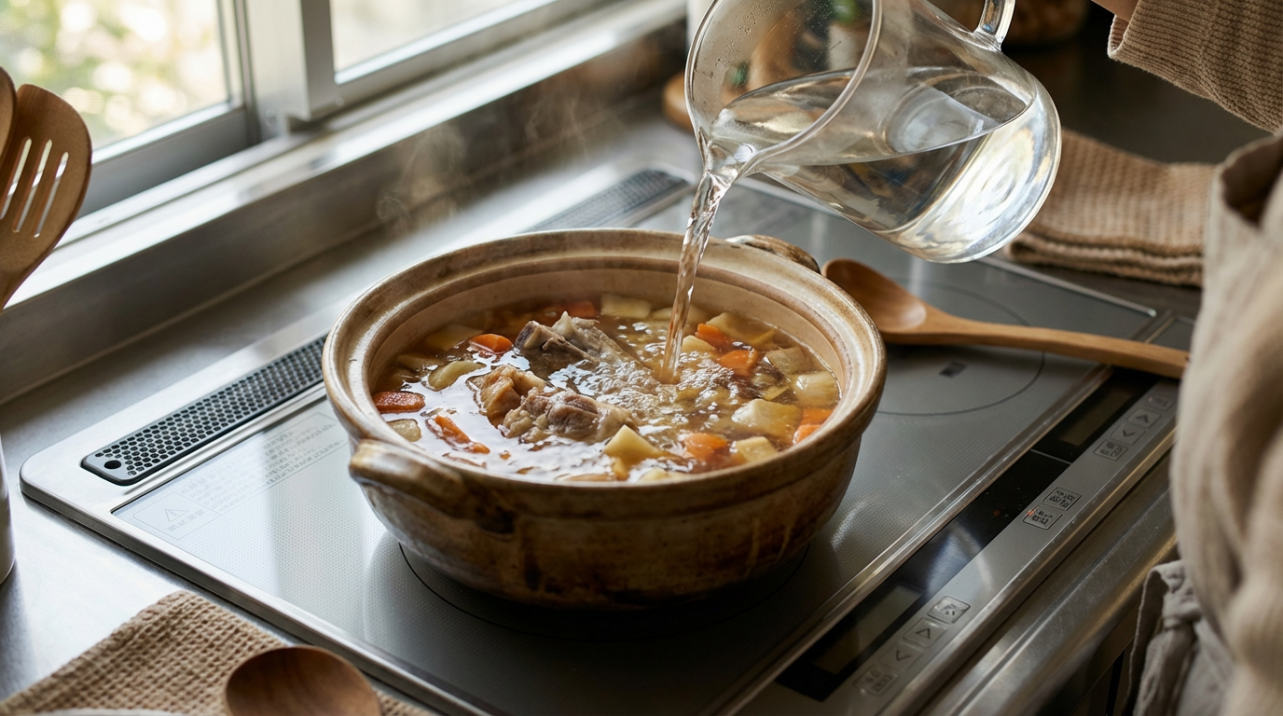
Why Your Soup Lives Or Dies By Its Water
When you make a slow-simmered soup or stew, it is easy to obsess over the bones, herbs, and hours on the stove, and almost forget the ingredient that fills most of the pot: water. For many homemade broths, water can make up more than three-quarters of the final bowl. Research on food and beverage quality keeps repeating the same message: water is not just a background player but a major driver of flavor, texture, color, and safety.
Engineers and food scientists describe water as a universal solvent. It dissolves minerals, chlorine, organic compounds, and trace metals from pipes and aquifers, and it pulls out amino acids, taste nucleotides, fats, and aromatics from your meat and vegetables. That chemistry is exactly why the same recipe can taste clean and delicate in one kitchen and flat, metallic, or oddly bitter in another.

As a smart hydration specialist, I look at soup pots the way I look at coffee brewers or ice machines. If the water going in is not right, no amount of premium ingredients can completely rescue what comes out. The fresh, rounded savoriness we call “xian” in a long-simmered broth is really an interaction between ingredients and water chemistry. To understand whether tap water or purified water is best for that “most flavorful” soup, we need to be specific about what is in each type.
What Do We Mean By Tap Water And Purified Water?
Tap water: safe, convenient, but highly variable
Municipal tap water usually starts its life in rivers, lakes, or groundwater. Along the way it picks up minerals like calcium and magnesium, trace metals such as iron and manganese, and sometimes organic compounds from soil and agriculture. At the treatment plant, disinfectants such as chlorine or chloramines are added to kill microbes. By the time the water reaches your kitchen, it may be hard or soft, slightly acidic or slightly alkaline, and more or less chlorinated.
Studies of cooking water, including work summarized by AquaMaya and industrial water experts at Fluence, show that these factors matter in pots and pans. Hard water, rich in calcium and magnesium, tends to leave scale in kettles and make beans, pasta, and vegetables cook more slowly and stay firmer. Chlorine can introduce a chemical edge to foods and beverages, especially in delicate applications like tea, coffee, and light soups. High iron or manganese can tint light-colored dishes and add a faint metallic taste.
In other words, typical tap water is not neutral.

Sometimes that is helpful, sometimes not.
Purified water: cleaner, often softer, sometimes too “blank”
Purified water is an umbrella term. In homes and professional kitchens, it usually means water that has passed through activated carbon filtration, reverse osmosis, ion exchange softening, or a combination of these. Systems described by New York WaterMaker, Puritech, Hague, and others are designed to remove chlorine, sediments, many heavy metals, and much of the dissolved mineral load.
Softened or reverse osmosis water is usually low in calcium and magnesium and free of chlorine odor. Many manufacturers and water engineers emphasize that this kind of water tastes cleaner and allows more accurate flavor expression in food and drink. In beverage manufacturing, reverse osmosis is used to create a high-purity “blank canvas,” and then minerals are sometimes added back in controlled amounts to tune taste and mouthfeel.
For home soup making, that distinction matters.

Purified water can protect you from off-flavors and contaminants, but ultra-low mineral water behaves differently in the pot compared with moderately mineralized tap water. To decide which gives you the freshest soup, we need to look at how water composition interacts with flavor chemistry.
The Science: How Water Chemistry Changes Your Soup
Several aspects of water quality show up again and again in research and culinary practice: hardness, pH, chlorine and chloramines, and contaminants such as iron or lead. Each one influences how ingredients extract and how the final broth tastes and feels.
Hard water, driven mainly by calcium and magnesium, is safe to drink but can be a troublemaker in the kitchen. AquaMaya’s cooking research and multiple filtration companies report similar patterns. Hard water makes starchy foods like pasta and rice cook more slowly and stay firm or even chewy. Beans and lentils can remain tough despite long simmering. In soups, the same hardness can make meat feel slightly firmer and reduce the “fall-apart” tenderness many people expect from a long braise.
Soft water, by contrast, lets moisture move more easily into plant and animal tissues. Puritech and Texas Blue Water note that soft water tends to accelerate cooking and allows foods to cook more evenly. That means beans and grains soften sooner and meat fibers loosen more readily. From a flavor point of view, soft or purified water often extracts aromas and colors more efficiently, which is an advantage for subtle soups based on vegetables, herbs, or light meats.
pH also plays a role. Most tap water falls in a mildly acidic to mildly alkaline range, roughly in the mid-sixes to mid-eights. Higher-pH, more alkaline water can dull the color of green vegetables and may push soups toward a slightly soapy or flat taste. Lower-pH water can amplify the perceived sharpness of acidic ingredients, such as tomatoes or vinegar, and shift the balance of a broth.
Disinfectants introduce another variable. Municipal chlorine and chloramines are essential for safety, but both AquaMaya and New York WaterMaker note that residual disinfectants leave noticeable flavors and aromas. In soups, that can show up as a faint swimming-pool smell or a bitterness that clashes with delicate herbs. Chlorine also reacts with organic molecules from meat and vegetables, creating byproducts that further nudge the flavor profile away from clean, rounded umami.
Contaminants like iron, manganese, and heavy metals are less forgiving.

Iron and manganese can discolor rice, pasta, potatoes, and light broths and add metallic notes. Heavy metals like lead and mercury raise safety concerns rather than culinary benefits. Boiling kills microbes but does not remove chemical pollutants or metals, which is why clean source water is a public health issue as well as a taste issue.
All of this sets the stage for a natural question. Is the “freshest” soup the one with the least minerals and the cleanest possible water, or is there a sweet spot where some minerals help your broth taste better?
What Real Measurements Show: When Water Alone Changes Soup Flavor
One of the clearest demonstrations that water type alone can change soup flavor comes from a detailed study on mutton soup published in the scientific literature. Researchers cooked Tan sheep ribs using three different waters: municipal water from one city, municipal water from another city, and laboratory ultrapure water. They then analyzed the resulting broths with instruments and sensory tools.
The municipal water with higher natural sodium and other minerals produced soup richer in taste nucleotides, especially 5′‑IMP. These nucleotides work hand in hand with glutamic acid to build that deep, mouth-filling umami associated with meat broths. The ultrapure, very low mineral water produced soup with the highest levels of free amino acids like glutamic acid. In other words, in one case the broth favored amino acids, in the other it favored nucleotides, even though the meat and cooking method stayed the same.
Volatile aroma compounds also shifted. Only a portion of the aroma molecules were shared across all three soups. The rest varied with water source, showing that minerals and trace metals influence how fats oxidize and how Maillard browning reactions unfold in the pot. Electronic nose and tongue instruments, along with statistical analyses, confirmed significant differences in aroma, saltiness, bitterness, and astringency between batches.
From a practical standpoint, this study supports an important idea.

Cooking water is not just a neutral carrier; it is a controllable processing parameter. If you want to reproduce a regional soup flavor elsewhere, you may need to adjust the mineral profile of your cooking water, not just the recipe. And if you want maximum flavor from your home soup, you should treat water composition as seriously as ingredient quality.
Field experience in places with widely varying water supports this. AquaMaya points out that the same traditional dishes taste noticeably different in Nigerian regions that have hard coastal water, softer spring water, or iron-rich groundwater, even when cooks follow the same methods. Similarly, beverage and food manufacturers in the United States invest heavily in water treatment for the simple reason that inconsistent water makes products taste inconsistent.
Tap Water For Soup: Real Advantages And Real Risks
Tap water has three clear advantages for soup. It is convenient, it is inexpensive, and it often contains minerals that can help build body and savoriness. Moderate levels of calcium, magnesium, and sodium can give a broth gentle mineral structure and a faint saltiness before you add any seasoning. In meat-based soups, these ions influence protein solubility, which can affect how collagen and muscle proteins move into the cooking liquid and contribute to mouthfeel.
In many cities, tap water meets strict safety regulations, which means it is microbiologically safe to drink and cook with. For a quick weeknight soup, filling the pot from the faucet feels natural.
However, the drawbacks are equally real. The same hardness that adds structure can lengthen cooking times and keep beans, lentils, and some vegetables stubbornly firm. When you are aiming for a silky, falling-off-the-bone texture, very hard water can work against you. Chlorine and chloramines add another layer of complexity. They protect public health but can flatten nuance, especially in light broths designed to showcase vegetables and aromatics.
Then there are local contaminants. SmartLivingHP and similar sources list common issues such as iron and manganese, which can impart metallic tastes and discolor soups, and more concerning pollutants like pesticides, herbicides, or bacteria in poorly controlled supplies. While not every tap system has these problems, the variation is large enough that two neighboring households may experience the same soup recipe very differently.
Finally, tap water chemistry can change over time, as utilities adjust treatment or switch sources.

That means your beloved family chicken soup might not taste exactly the same year to year, even if you never change the way you cook it.
Purified Water For Soup: Clean Canvas, Subtle Tradeoffs
Purified water, whether from an under-sink filter, reverse osmosis unit, or a well-designed whole-home system, aims to solve many of these problems. Carbon filtration strips out chlorine and many organic compounds that cause off-tastes and odors. Reverse osmosis or nanofiltration removes a broad spectrum of dissolved solids, heavy metals, and excess minerals, creating a neutral starting point. Water treatment specialists describe this as a way to “reset” water quality so that flavors in food and beverages show up consistently.
In soups, that consistency can be a gift. Without chlorine, chemical notes disappear, and delicate flavors from herbs, mushrooms, and light meats become clearer. Several sources, including Puritech and Texas Blue Water, emphasize that low-mineral water allows coffee and tea to taste brighter and more complex. The same principle applies when your “brew” is a pot of bone broth. Soft water penetrates ingredients more readily, so flavors and colors are extracted efficiently, often leading to clearer broths and more vibrant vegetables.
However, going too far toward zero minerals introduces its own subtle tradeoffs. The mutton soup study suggests that completely mineral-free water maximizes free amino acids like glutamic acid but may not favor the highest levels of taste nucleotides or the same aroma spectrum as moderately mineralized water. Very soft water can also make doughs and some gels behave differently and may make some soups taste slightly “thin” unless you adjust salt and seasoning thoughtfully.
This is why many beverage producers that rely on reverse osmosis water then add a balanced mineral blend back before bottling. They want the control and purity of purification, combined with the flavor and mouthfeel benefits of a gentle mineral profile. For home soup makers using purified water, the equivalent approach is to remove what you do not want, such as chlorine, sediments, and heavy metals, while allowing or intentionally restoring a modest level of beneficial minerals.
Tap Water vs Purified Water: How They Tend To Behave In Soup
To make the comparison easier, it helps to look at the key factors side by side.
Factor |
Typical tap water |
Purified or softened water |
Likely impact on slow-simmered soup |
Minerals (hardness) |
Often moderate to high, varies by region |
Lower, especially with softening or reverse osmosis |
Hardness can toughen beans and lengthen cooking time; lower hardness improves tenderness and extraction |
Chlorine / chloramines |
Present as disinfectants |
Largely removed by carbon or reverse osmosis |
Can add chemical notes in tap water; purified water tastes cleaner and lets subtle flavors shine |
Trace metals (iron, manganese) |
Possible, especially in older pipes or wells |
Greatly reduced with appropriate filtration |
Tap water may create metallic taste or discoloration; purified water protects color and flavor |
Taste consistency |
Can shift with seasonal or treatment changes |
More stable once a treatment system is tuned |
Tap-based soup flavor may drift over time; purified water supports repeatability |
Flavor “blankness” |
Rarely neutral; always carries some background |
Can feel very neutral or even a little “flat” |
Minerals in tap water add a bit of natural backbone; ultra-low mineral water may need careful seasoning |
The practical takeaway is that neither tap water nor purified water is automatically “best.” Tap water brings free minerals but also chlorine, scale, and possible contaminants. Purified water gives you a safer and more neutral base but may benefit from intentional seasoning and, in some cases, controlled remineralization to match the flavor profile you want.
So Which Water Makes Soup Taste “Most Fresh”?
When my colleagues in water treatment look at the data, and chefs look at their pots, their conclusions converge. The freshest-tasting soup usually comes from water that is microbiologically safe, free of chlorine and obvious contaminants, and modestly mineralized rather than completely stripped.
In practice, that often means starting with filtration or reverse osmosis to remove what you do not want, and then relying on either residual minerals in the system or a gentle mineral blend to avoid a completely “empty” profile. The mutton soup research suggests that some sodium and other ions promote the formation or stability of key taste nucleotides, while very low mineral water maximizes free amino acids. For most home cooks, adjusting salt, time, and ingredient balance is easier than adjusting raw water chemistry, so a sane middle ground is helpful.
If your local tap water is very hard, heavily chlorinated, or known to have issues with iron, manganese, or other contaminants, filtered or purified water is the safer and more reliable choice for soup. You protect both flavor and health, and you free yourself from worrying about what your pipes are contributing. If your tap water is already fairly soft and low in chlorine, using it for hearty, strongly flavored soups can work well, especially if you enjoy the subtle mineral character it adds.
The key is to recognize water as an ingredient you can choose and control, not a default you are stuck with.
Practical Kitchen Guidance: Choosing Water For Different Soups
For light, clear broths where you want every ingredient to speak distinctly, such as vegetable soups, chicken and rice soups, or simple herbal tonics, chlorine-free, low-contaminant water is especially valuable. Here, purified water or tap water passed through a good carbon filter will help you avoid any chemical edge and allow gentle aromatics to shine. Because purified water may be lower in natural minerals, be ready to season a little more assertively with salt and aromatics until the broth tastes rounded rather than hollow.
For robust, strongly flavored stews featuring beef, lamb, or heavily spiced legumes, the subtle hardness and mineral taste of decent tap water can be an asset as long as it is not extremely hard or heavily chlorinated. In such dishes, the richness from bones and the strength of spices and aromatics often overwhelm minor differences in mineral profile. However, if you notice cloudiness, metallic notes, or unexpected bitterness, that is a sign your tap water is working against you, and switching to filtered water is likely to help.
Beans and lentils deserve special attention. Research and practical cooking guides agree that hard water can keep beans stubbornly firm and lengthen cooking times significantly. If you live in a hard-water zone and find your bean soups or stews never quite reach that creamy, tender texture, cooking them with softened or purified water is a smart experiment. Softer water allows the beans to hydrate more completely and carry flavor more evenly through their centers.
Grain-based soups behave similarly. Rice, barley, and other grains cook more predictably when hardness and chlorine are under control. Using filtered or purified water can prevent grainy, uneven texture and helps the grains absorb seasoning rather than resisting it.
Throughout, remember that purified water changes how salt lands on the palate. Because there are fewer natural minerals contributing background salinity, you might need to salt a bit more to reach the same sense of depth. The safest approach is to season in stages, taste regularly, and notice how the broth evolves as simmer time increases.
A Simple Home Comparison Test
If you want to experience the difference directly in your own kitchen, you can set up a small, controlled test without needing any lab equipment. Choose a simple soup or broth where water plays a central role, such as a basic chicken broth made from wings and aromatics, or a vegetable soup with onion, carrot, celery, and a mild herb.
Prepare two identical pots side by side. In one, use your usual tap water. In the other, use water from your filtration system or a reliable purified source. Keep everything else the same: the amount and type of meat or vegetables, the cooking vessel, the heat level, and the simmering time. Season both very lightly at first so you can perceive base differences more clearly.
As they cook, pay attention to aroma at the stove. Is one pot giving off a cleaner or more vivid scent, or do they seem identical? When the soups are done, taste them blind if you can, or at least in rapid alternation. Notice not only saltiness and strength but also clarity of individual flavors, mouthfeel, and any aftertaste. If you have very hard or strongly chlorinated tap water, many people find that the purified-water broth tastes cleaner and lets the ingredients express themselves more clearly. If your tap water is moderate and relatively neutral, the differences may be more subtle.
This kind of home experiment is exactly how many chefs and beverage professionals decide when to upgrade their water treatment.

It replaces guesswork with direct sensory evidence and helps you choose what tastes best to you and your family.
Frequently Asked Questions About Soup And Water Quality
Is distilled water good for soup?
Distilled water is extremely low in minerals and very consistent, which can be attractive from a control standpoint. The mutton soup research suggests that very low mineral water can boost free amino acid extraction, including glutamic acid, which contributes umami. However, without some minerals, many people find broths made with distilled water taste a bit hollow or “empty” until they are carefully seasoned. For occasional use it is fine, but for everyday cooking, purified water with a modest mineral profile or a balanced filtration system is more practical and often tastes more natural.
Does boiling tap water remove chlorine and contaminants?
Boiling can drive off some free chlorine over time and kills many microbes, but it does not reliably remove chloramines, heavy metals like lead, or many organic contaminants such as pesticides. Multiple sources in water engineering emphasize that treatment is more effective than relying on boiling for chemical contaminants. If your tap water tastes strongly of chlorine or is known to have chemical issues, using a certified filtration system is a safer and more consistent solution for both drinking and cooking.
Is bottled water better than filtered water for soup?
Bottled water varies widely. Some brands are essentially tap water run through filtration, while others are mineral waters with higher natural dissolved solids. From a cooking standpoint, what matters most is the actual composition: minerals, chlorine, and contaminants. High-quality filtered water at home can match or exceed many bottled waters in taste and consistency, without the cost or plastic waste. If you prefer bottled water for convenience, choose one with a mineral profile you enjoy and that tastes clean and neutral when you drink it plain, and expect that character to carry into your soups.
Closing Thoughts From A Water Wellness Perspective
In a slow-simmered soup, water is both your most abundant ingredient and your most overlooked seasoning. When you choose cleaner, appropriately mineralized water for your stockpot, you are not only protecting your health and your cookware; you are giving every bone, bean, and vegetable the best possible medium to express its flavor. Treat water with the same care you give to your produce and proteins, and your next pot of soup will quietly show you just how much that choice matters.
References
- https://pmc.ncbi.nlm.nih.gov/articles/PMC8565249/
- https://aquamaya.org/how-water-quality-affects-cooking/
- https://forums.egullet.org/topic/143466-when-water-is-as-good-or-better-than-using-stock/
- https://www.fluencecorp.com/water-treatment-impacts-food-beverage-quality/
- https://kathleenflinn.com/soup/
- https://newyorkwatermaker.com/how-water-quality-impacts-food-taste/
- https://www.rebeccakatz.com/blog/5-ways-to-make-your-favorite-soup-even-better-and-5-soups-to-try
- https://simplysouperlicious.com/water-stretch-further/
- https://soupaddict.com/soup-stock-how-to-make-great-soup/
- https://spicesinc.com/blogs/how-make-best-homemade-soup?srsltid=AfmBOopaEeqZ2hAvgrRwaGztxE8jdO_SloH9p0qDPZOF_-v5zQRLMGkL

Share:
Understanding the Adhesion Phenomenon in Milk Powder Solutions
Using Purified Water for Aquarium Water Changes Safely