

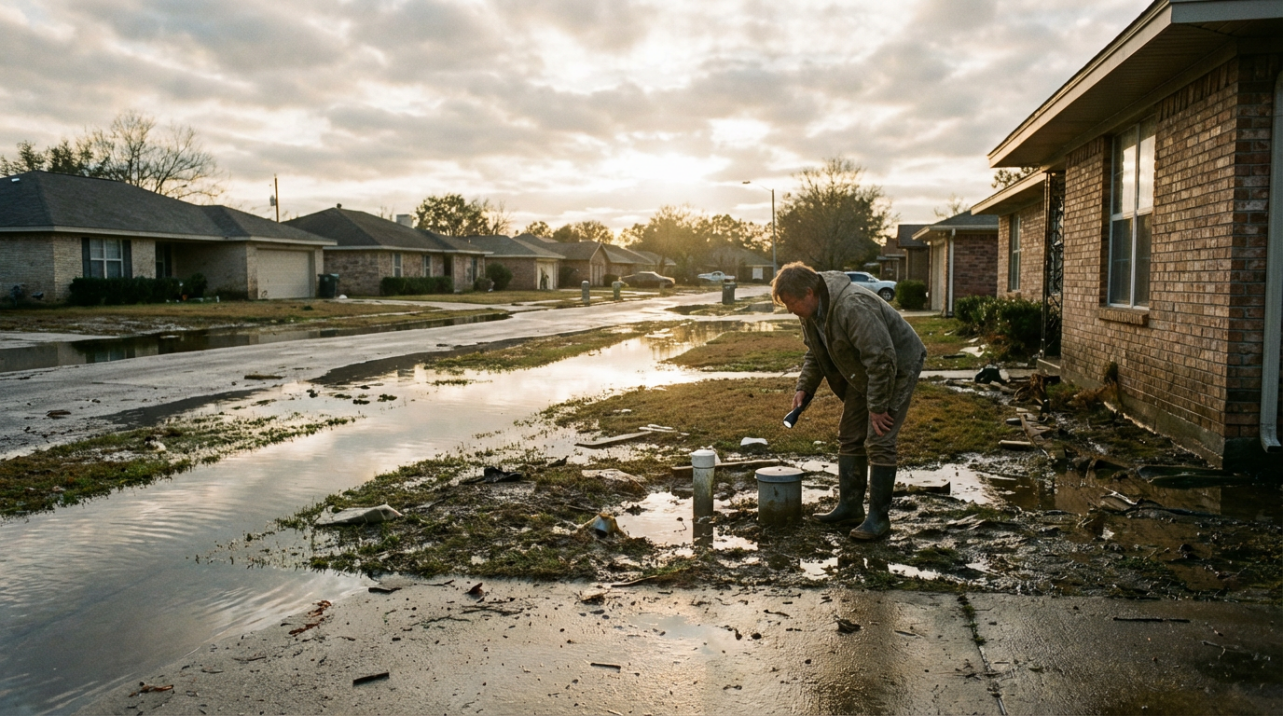
When I walk into a home days after a flood, the first question I always ask is not about the drywall or the flooring. It is, “What have you been drinking?” Floods turn familiar taps and trusted wells into potential exposure points for bacteria, viruses, parasites, fuel residues, and agricultural chemicals. The good news is that science-based steps can move you from “I have no idea if this is safe” to a clear recovery plan.
This guide focuses on what to do with your water sources after flooding, grounded in guidance from the US Environmental Protection Agency, the Centers for Disease Control and Prevention, FEMA, state health departments, and university extensions. The aim is to translate that into practical, homeowner-friendly actions that protect your family’s hydration and health.
How Flooding Contaminates Water Sources
Floods do more than get things wet. State environmental agencies, such as Alaska’s Department of Environmental Conservation, describe several types of flooding: slow river overflows, flash floods after intense rain or rapid snowmelt, urban floods when storm drains are overwhelmed, and coastal floods driven by storms. Any of these can overwhelm drinking water infrastructure.
Floodwater moves across roads, farm fields, industrial yards, fuel storage areas, and septic systems. According to CDC and state and county health departments, that water commonly carries sewage, animal waste, industrial and household chemicals, pesticides, heating oil, and physical debris. It can also hide downed power lines and sharp objects. When that mix surrounds or submerges a well, spring, cistern, water plant, or buried service line, contamination becomes likely.
Alaska’s drinking water program notes that shallow wells near rivers and wells in floodplains are particularly vulnerable when riverbanks erode or ice and debris slam into wellheads. Floodwaters and saturated soil can carry bacteria, viruses, protozoa, and petroleum products straight into well casings, spring boxes, or treatment plants. Even if your home itself did not flood, a nearby river overtopping its banks can still reach your well, or a distant treatment plant may have lost power or pressure.

University extension services define safe, potable water as water that is free of disease-causing microorganisms and harmful chemicals at levels that could pose a health risk. Whether that water comes from a public system, a private well, or a bottled source, anything less is not considered safe for drinking, cooking, or brushing teeth after a flood.
First Decisions: What Is Safe To Drink Right Now?
Immediately after flooding, the safest assumption is that any private water source in or near the flooded area is contaminated. Extensions in Nebraska and Pennsylvania, along with state health departments in Vermont and Oregon, advise that wells, springs, and cisterns that were submerged, surrounded by floodwater, or suddenly became cloudy or discolored should not be used for drinking, food preparation, or brushing teeth until they are disinfected and tested.
During these first days, you are making two key decisions: which water to drink and which water to hold in reserve for cleaning or flushing.
University and emergency management guidance converge on one clear point. Commercially bottled water in sealed containers is the preferred option for all drinking, food preparation, and oral hygiene immediately after a flood, until you know more about your regular supply. Bottled water has already gone through treatment and quality control, so it sidesteps the uncertainty around your well or tap.
Agencies such as the US EPA and FEMA also recommend that households maintain an emergency water supply of at least one gallon of drinking water per person per day for a minimum of three days, with more for hot climates and vulnerable family members. For a family of four, that means planning for at least twelve gallons of drinking water. In my field work, families who have those twelve gallons on hand have a noticeably calmer first week after a flood, because they are not forced into risky decisions while utilities and labs are still overwhelmed.

When bottled water is not available, you must rely on treating water yourself. At that point the question becomes, “Is my water from a public system under a boil-water advisory, or is it from a private source that may be directly flooded?” The answer determines your next steps.
To help organize choices, here is a quick comparison based strictly on the guidance in the research notes.
Situation |
Preferred drinking water source |
Practical notes |
Any household in a flood-affected area with uncertain tap safety |
Commercially bottled water in sealed containers |
Safest option recommended by university extensions and EPA until your normal source is confirmed safe. |
Public system under a boil-water advisory |
Tap water that has been properly boiled and cooled |
Follow local instructions; boiling targets microorganisms but not chemicals. |
Private well, spring, or cistern in or near flooded areas |
Bottled water or water from a known-safe regulated public source |
Vermont and other states define “known safe” as municipal taps or certified bulk haulers drawing from regulated systems. |
Suspicion of fuel or chemical spills near the water source or chemical odor |
Do not drink from that source; use only known-safe alternatives |
Vermont’s health department and Water Quality Association warn that boiling or chlorination do not remove many chemicals. |
No water pressure or very weak flow, no official advisory yet |
Treat any tap water used as if under an advisory |
Texas regulators urge customers to boil or disinfect water and immediately report outages or pressure loss. |
The pattern is simple. In the first week or two, if you have any doubt and any alternative, drink something that was never in contact with the flood in the first place.
Treating Tap Water During Boil-Water Advisories
If your local water utility issues a boil-water notice, they are telling you that water may contain microorganisms that can cause illness. Public health and water agencies in Texas, Alaska, and Queensland describe these notices as common after treatment plants flood, when the distribution system loses pressure, or when power failures interrupt normal disinfection.
Boiling Water Safely
The US EPA and university extensions emphasize boiling as the most reliable household treatment for most disease-causing microorganisms. The process is straightforward but must be done correctly.
First, if the water is cloudy, let it sit so that sediment settles to the bottom, then pour the clearer water off the top. Filter it through a clean cloth, paper towel, or coffee filter. This step matters because dirt and organic matter shield microorganisms from heat and disinfectants.
Next, bring the water to a rolling boil. EPA guidance calls for at least one minute of full rolling boil at typical elevations and three minutes at elevations above about 5,000 feet. Some state agencies, such as the Texas Commission on Environmental Quality, recommend boiling for two minutes to be conservative. University extension guidance in mountainous regions often suggests three minutes above about 6,500 feet. In practice, I advise families to follow whichever time is longer between local and federal instructions.
After boiling, allow the water to cool naturally and store it in clean containers with tight covers. To improve the flat taste that boiled water can develop, EPA suggests adding a pinch of salt to each quart of water or pouring it back and forth between clean containers to aerate it.
Boiling inactivates bacteria, viruses, and protozoa, but it does not remove heavy metals, salts, or many chemicals. If you suspect chemical contamination from fuel, solvents, or pesticides, agencies in Vermont and the Water Quality Association warn that you should not boil that water for drinking at all. Instead, switch to bottled or hauled water from a known-safe public source while the chemical situation is evaluated.
Disinfecting Clear Water With Household Bleach
When boiling is impossible, emergency disinfection with unscented household chlorine bleach is the next best option recommended by the EPA and university extensions. This is meant for relatively clear water that is microbiologically unsafe but not chemically contaminated.
Use only regular, unscented chlorine bleach that lists sodium hypochlorite as the active ingredient at a concentration around 5 to 8 percent. Do not use scented products, “color-safe” bleach, or bleach with added cleaners. EPA guidance stresses using bleach that is relatively fresh, stored at room temperature, and measuring doses with a clean dropper or measuring spoon.
For clear water, EPA’s emergency disinfection table translates into this practical example for a gallon of water. If your bleach is around 6 percent sodium hypochlorite, add eight drops per gallon. If it is around 8.25 percent, add six drops per gallon. Stir the water and let it stand for at least thirty minutes. After that contact time, the water should have a slight chlorine odor. If you do not detect any chlorine smell, repeat the dose and let it stand another fifteen minutes. If the chlorine taste is strong, pour the water back and forth between clean containers and let it sit for a few hours to let excess chlorine dissipate.

Nebraska extension guidance is consistent with this, describing emergency disinfection as adding a small, measured amount on the order of a few drops to about one eighth of a teaspoon per gallon, depending on the bleach concentration, and always allowing at least thirty minutes of contact time.
Cloudy or very cold water needs more disinfectant. EPA advises doubling the bleach dose in those cases and still waiting at least thirty minutes. Several sources emphasize that if water is muddy, you should first let sediment settle, then filter through a clean cloth or coffee filter before adding bleach, because suspended particles reduce the effectiveness of chlorine.
Other Emergency Disinfection Methods
If you do not have liquid bleach, the EPA describes several alternatives that can be effective when used correctly.
One option is granular calcium hypochlorite, often labeled high-test hypochlorite (HTH). You first make a concentrated chlorine solution by dissolving one heaping teaspoon, roughly one quarter ounce, of calcium hypochlorite granules in two gallons of water in a well-ventilated area while wearing eye protection. This produces a solution with approximately 500 milligrams of chlorine per liter. To disinfect drinking water, add one part of this chlorine solution to one hundred parts of the water you want to treat. EPA notes that this is roughly equivalent to adding one pint, which is sixteen ounces, of the chlorine solution to twelve and a half gallons of water. Because HTH is a strong oxidizer, the label’s safety instructions must be followed closely.
Another option is common household tincture of iodine at a two percent concentration. EPA guidance describes adding five drops of iodine to each quart of clear water and ten drops if the water is cloudy, then stirring and letting it stand for at least thirty minutes. This method can be useful in short-term situations, although iodine is not recommended as a long-term primary disinfectant for everyone.
Commercial water purification tablets are also available from pharmacies and outdoor suppliers. These may contain chlorine, iodine, chlorine dioxide, or other disinfecting agents. EPA’s central instruction here is simple: follow the product label directions exactly, because tablet strengths and required contact times vary.
All of these methods, like boiling and bleach, are aimed at biological contaminants. They are not designed to remove or neutralize pesticides, heavy metals, or other chemicals that may have entered water during flooding.
Restoring Private Wells and Small Systems After Flooding
Owners of private wells, springs, and cisterns bear full responsibility for their system’s safety, because these sources are generally not regulated like public water systems. Extensions from Pennsylvania and Nebraska, along with state drinking water programs in Vermont and Polk County, stress that any private source that was submerged or surrounded by floodwater, or whose water became suddenly cloudy or discolored during the flood period, should be assumed contaminated.
Shutting Down and Inspecting Safely
As soon as you suspect that floodwater reached your well or spring, you should stop using that water for any ingestion-related activities. That includes drinking, cooking, washing fruits and vegetables, brushing teeth, making ice, mixing beverages, and preparing baby formula. Vermont’s health department emphasizes that bacteria such as total coliform and E. coli are the most common contaminants after flooding, and they cannot be seen, smelled, or tasted.
Well owners should also protect the equipment itself. Alaska’s drinking water guidance and disaster response nonprofits recommend shutting off power to pumps that may be flooded and avoiding energizing any electrical components until wiring has been inspected and is no longer underwater. This prevents shock hazards and further damage to pumps and controls.
Once floodwaters recede enough for safe access, Vermont’s private water guidance suggests inspecting the immediate area for debris and mud, looking for stains on the well casing or spring box that indicate how high the water reached, and checking for visible damage. Bent or cracked casings, missing or loose caps, damaged seals, and exposed wiring all create direct paths for contamination. If any structural damage is suspected, homeowners are urged to contact a licensed well driller or regional engineer rather than attempting repairs on their own.
If fuel, heating oil, or other chemicals spilled near the well or spring, Vermont’s environmental agency directs residents to report spills to state spill management lines and to avoid drinking water from that source until chemical contamination has been evaluated and addressed. The Water Quality Association echoes this, warning that standard chlorination will not address many non-biological contaminants.
Shock Chlorination and Flushing
Once the well and its electrical components are safe and intact, the next step is typically a one-time, high-dose chlorination, often called shock chlorination. Nebraska extension and the Water Quality Association describe this as a process designed to disinfect the well, pump, and household plumbing system.
Polk County’s detailed guidance illustrates how this works for a typical household well. First, you flush the well by running water from an outside spigot until it runs clear, which may take from about thirty minutes to several hours or even longer depending on the well and the extent of sediment intrusion. This removes muddy water and surface contaminants.
Next, you prepare a strong chlorine solution. For a system with about two hundred gallons of water, Polk County recommends mixing four cups of household bleach in five gallons of water. This mixture is then poured into the well to disperse through the water column. The pump is run to circulate chlorinated water through all cold-water taps in the home until you can smell chlorine at each faucet. At that point, the system is left unused for at least eight hours, often overnight, to allow chlorine contact time that can inactivate bacteria and other microorganisms on well and plumbing surfaces.
After the contact period, all faucets are opened and water is run until the chlorine odor disappears. Because the initial chlorine level is high, Polk County advises that the system not be used for drinking, cooking, bathing, or washing during the contact period and initial flush. Discharged chlorinated water should be directed away from sensitive plants and septic systems where possible.
The exact amount of bleach needed depends on the size and construction of each well, so homeowners are encouraged to follow local health or extension guidance or work with professionals to determine appropriate doses. Over-chlorination does not make water safer and can damage some components.
Testing and Returning to Normal Use
Shock chlorination is not the final step. It is a reset that must be followed by laboratory testing. Extensions in Pennsylvania and Nebraska, along with Vermont and Polk County guidance, all emphasize that water from a flooded well should not be used for drinking or cooking until laboratory tests show that total coliform bacteria and E. coli are not detected.
Polk County recommends testing at least five days after shock chlorination and flushing, to ensure that any remaining bacteria have had time to regrow if the treatment was incomplete. Vermont’s health department advises purchasing a flood-specific test kit, flushing the well until water is clear before sampling, and following the sampling instructions exactly. Samples should be collected on the same day they will be delivered to the laboratory, typically early in the week, and results are usually available within about two business days.
In practice, this means that for a heavily flooded private well, you may be looking at a timeline of a week or more from the moment floodwaters recede to the point where you have laboratory confirmation that your water is bacteriologically safe. That reinforces why an emergency stock of drinking water and access to a known-safe public source are so valuable.

If test results show continuing contamination, the well and plumbing may need to be disinfected again and re-evaluated for construction flaws that allow surface water to enter. In some situations, long-term changes such as raising the well casing, improving the sanitary seal, re-grading the land so water drains away from the well, or permanently decommissioning an old flood-prone well may be the safest choices.
Dealing With Possible Chemical Contamination
Biological contamination is common and often treatable with shock chlorination. Chemical contamination is different. The Water Quality Association notes that well disinfection with chlorine addresses bacteria but does not remove pesticides, heavy metals, or many organic chemicals. Vermont’s guidance explicitly warns residents not to use or boil water that smells like fuel, chemicals, or has an unusual sweet odor, and to report suspected spills.
If your well is near farms, industrial sites, fuel tanks, or areas with known chemical use, and flooding has altered groundwater flow, additional testing for specific chemicals may be needed. That is where state health departments, environmental agencies, and qualified water treatment professionals are essential partners. In my experience, this is also the point where some families decide that hauling water from a regulated public system or switching to a properly designed treatment system is preferable to continuing to rely solely on the original well.
Working With Public Water Systems After Flooding
Customers on public water systems have a different set of responsibilities. When floods damage treatment plants, intake structures, or the distribution system, utilities are required to monitor water quality and communicate risks.
Texas’s drinking water regulations and guidance documents provide a clear example. If a public water system loses operating pressure in its distribution pipes, it must issue a boil-water notice, notify the state environmental agency, flush and disinfect the system, and collect representative samples for laboratory analysis before lifting the notice. Alaska’s drinking water program notes that issuing precautionary and boil-water notices is also common when treatment plants must be shut down or power to critical equipment is cut.
Residents should follow these notices exactly. A boil-water advisory means you can use tap water for drinking and cooking only after boiling it as directed. Some utilities, including those in Texas, specify bringing water to a full rolling boil for two minutes before cooling and using it. A “do not drink” or “do not use” notice indicates more severe concerns, often involving chemicals, and means you should not use tap water for drinking or sometimes for bathing until the utility lifts the notice.
Once your utility announces that water is safe again, you may still need to flush your home plumbing. Texas guidance suggests starting with the outside spigot farthest from the meter, running water until you notice a change in temperature or for up to about five minutes, then moving closer to the meter and flushing each fixture, including indoor faucets and showers, after removing aerators. Water heaters should be drained and refilled to remove water that sat stagnant or under low pressure during the event.
Even after service is restored, regulators warn that undermined or scoured soil can lead to water main breaks days or weeks later. Customers should watch for sudden drops in pressure, discolored water, or leaks in their yard and report these to their water system promptly. When I review post-flood events with utilities, they often note that quick customer reports helped them locate and repair hidden breaks faster, which in turn protected water quality for entire neighborhoods.
Cleaning Homes, Plumbing, and Septic to Prevent Recontamination
Water safety after a flood is not only about what comes out of the tap. The surfaces you touch, the walls around your plumbing, and the septic system that receives your wastewater all influence your overall exposure.
Clean First, Then Disinfect
Mississippi State University Extension describes a “clean first, then disinfect” method that lines up closely with FEMA and Minnesota guidance. Before you disinfect anything, you should remove all items that were wetted by floodwaters, especially porous materials like carpet, upholstered furniture, and saturated clothing that cannot be thoroughly cleaned and dried. These items trap contamination and act as reservoirs for mold.
Once contents are out, wash structural surfaces such as floors, walls, and wall cavities with water and a phosphate-free detergent to remove dirt and mud. Rinse away residues before applying disinfectants.
For many hard surfaces, Mississippi’s extension provides a bleach solution recipe of one half cup of ultra chlorine bleach in one gallon of water. This solution can be sprayed on contaminated walls and other surfaces and allowed to sit for five to ten minutes before rinsing with clean water. Disinfecting in this way not only kills many remaining microorganisms but also helps reduce the persistent musty or sewage-like odors that often linger after floodwaters recede.
Minnesota guidance adds that walls and insulation must be dealt with from the inside out. All interior wall finishes and insulation from the high-water mark plus any additional height that may have been reached by capillary action, often at least about one and a half feet above the visible line, should be removed and discarded if they are wet. Wet insulation does not dry out in place and remains contaminated. Solid wood trim and some wall finishes can sometimes be salvaged with proper cleaning, disinfection, and drying, but paneling and other vulnerable materials are usually not salvageable.
Standing water and mud should be removed quickly. Rinsing walls and floors before they dry makes cleaning and disinfection more effective. After rinsing, surfaces should be cleaned and then disinfected from the bottom upward using a bleach solution. Bleach must never be mixed with ammonia, because that combination produces toxic fumes. Mississippi State also warns against using chlorine bleach on or near HVAC systems, metals, fine woods, or non-colorfast surfaces, where it can cause corrosion or damage; alternative disinfectants, used strictly according to label directions, may be more appropriate.
Drying is just as important as disinfecting. Walls and framing must dry thoroughly to prevent decay and microbial regrowth. A moisture meter, available from building supply stores or home inspectors, can help locate hidden wet spots and determine when walls are dry enough to re-insulate and close. If no meter is available, Minnesota’s advice is conservative: when in doubt, discard materials rather than risk trapping moisture where it cannot be seen.
Personal Safety Around Floodwater and Cleanup
CDC, FEMA, and county health departments uniformly warn that floodwater is hazardous. They advise avoiding contact whenever possible. If contact is unavoidable, wear rubber boots, gloves, and eye protection. After any exposure, wash skin with soap and clean water or, if clean water is not yet available, use alcohol-based sanitizer or wipes until you can wash properly. Clothing that came into contact with floodwater should be washed in hot water with detergent before reuse.
Floodwater exposure can lead to gastrointestinal illness, skin rashes, and wound infections. Open wounds and rashes are at particular risk. CDC notes that certain bacteria that live in coastal waters can cause severe skin infections when they enter open wounds during floods. The recommendation is to keep wounds clean and covered with waterproof bandages, avoid exposing them to floodwater, and seek medical care promptly if you see redness, swelling, oozing, or develop a fever.
Electrical and chemical hazards also deserve respect. Public health guidance says never to touch or attempt to move propane tanks found in flooded areas; instead, report them to local fire services or authorities. Car batteries may still carry a charge and leak corrosive acid, so insulated gloves and extreme caution are needed. Power to buildings and equipment in flooded spaces should be turned off and structural safety verified before entering or operating any electrical devices.
Septic and Sewer Systems
Onsite sewer systems, including septic tanks and drainfields, are often affected by flooding. Alaska’s environmental department and county health agencies recommend inspecting for surfacing sewage and signs of ground deformation. Raised areas may indicate floating tanks, while depressions can suggest tank or drainfield collapse. People and pets should be kept away from contaminated areas.
Septic systems do not treat wastewater effectively when the soil around the drainfield is saturated or groundwater is at or near the surface. Using the system under these conditions can cause sewage to back up into the home or surface in the yard. Guidance from Alaska and Polk County is clear: avoid using the system until water levels have dropped below the field and soils have begun to dry.
Once groundwater and floodwaters have receded, septic tanks that are properly anchored can be pumped. Systems should then be monitored closely while household water use is limited for at least about thirty days to allow the drainfield to recover. Driving or operating heavy equipment over saturated drainfields can compact the soil and permanently reduce their ability to treat wastewater, increasing the risk of long-term failure and potential contamination of nearby wells.
Where Smart Filtration and Home Hydration Systems Fit In
As a smart hydration specialist, I am a strong advocate for well-chosen home filtration and hydration systems. But after a flood, it is crucial to understand exactly what these systems can and cannot do.
Nebraska extension and the Water Quality Association are blunt on one point. Common household filters such as pitcher filters, faucet-mounted units, and refrigerator filters are not designed to make heavily contaminated floodwater safe on their own. They are intended to improve taste, odor, and some specific contaminants in already treated or relatively clean water. After a flood, if your source water is questionable, these devices should only be used after boiling or chemical disinfection and only on water that is already clear.
The Water Quality Association distinguishes between point-of-use and point-of-entry treatment. Point-of-use systems treat water at a single tap, such as the kitchen sink. Point-of-entry, or whole-house, systems treat all water entering the home. Certain technologies, when properly selected and certified, can reduce pesticides, heavy metals, and other chemical contaminants. But no single device removes every possible contaminant, and many are not designed to handle the levels or types of contamination that can follow a flood.
Owners who already have water treatment systems installed are urged by the Water Quality Association to contact a qualified water treatment professional after flooding. Filters, softeners, reverse osmosis units, and UV systems may have been submerged or exposed to contaminated water on the “clean” side of the system. Cartridges and media can become saturated with contaminants and biofilms, and housings can trap dirty water. In many cases, components need inspection, sanitization, or replacement before the system can be trusted again.
To frame the role of treatments in a practical way, consider this comparison.
Treatment or source |
Best role after flooding |
What it does well |
Key limitations |
Commercially bottled water |
Primary drinking and cooking source during the acute phase |
Safest, already treated and sealed; avoids flood-related contamination entirely |
Requires pre-planning or access to supply lines |
Boiling |
Treating microbiologically unsafe public water during boil advisories |
Kills bacteria, viruses, and protozoa effectively when done correctly |
Does not remove chemicals; uses fuel and time; not suitable for chemically contaminated water |
Household bleach disinfection |
Emergency treatment of relatively clear water when boiling is not possible |
Inactivates many microorganisms with minimal equipment |
Requires accurate dosing; effectiveness drops with turbidity; does not address many chemical contaminants |
Shock chlorination of a private well |
Resetting a biologically contaminated well and plumbing system |
Disinfects well, pump, and plumbing surfaces when applied correctly |
One-time treatment; requires follow-up testing; not effective for pesticides, heavy metals, or many organic chemicals |
Point-of-use or point-of-entry filtration systems |
Long-term polishing of already-safe water; targeted removal of specific contaminants |
Enhances taste, removes certain metals or chemicals when certified, supports everyday water quality |
Not suitable as the only treatment for raw flood-contaminated water; must be inspected and serviced after floods |
In a well-designed home hydration strategy, bottled water and emergency disinfection methods carry you through the immediate crisis. Shock chlorination, infrastructure repair, and laboratory testing restore the integrity of your well or confirm the safety of your public supply. Smart filtration and hydration systems then help maintain and fine-tune water quality over the long term, but only after the foundational safety steps are complete.
Short FAQ
Q: If my tap water looks clear and tastes normal after a flood, is it safe to drink?
No. Extensions in Nebraska and Pennsylvania, along with Vermont’s health department, all emphasize that clear, good-tasting water can still contain bacteria, viruses, or other microorganisms after flooding. Visual appearance is not a reliable indicator. Until your public water provider lifts advisories or your private well has been disinfected and laboratory-tested for total coliform and E. coli with “not detected” results, use bottled water or properly treated water for all ingestion-related uses.
Q: Can I rely on my refrigerator or pitcher filter to make floodwater safe?
Not by itself. University extension guidance and the Water Quality Association both state that home filters such as pitcher, faucet, and refrigerator units are not designed to make heavily contaminated floodwater safe. At best, they can improve taste and remove some additional contaminants from water that has already been boiled or chemically disinfected and that is free of visible debris.
Q: Why does my water still smell like chlorine days after shock chlorination?
After a strong chlorine treatment, some residual odor is normal during the initial flushing. Polk County’s well disinfection guidance shows that you should run water at all faucets until the chlorine odor disappears, which can take time. If the smell persists or is very strong, additional flushing may be needed. However, you should not assume the water is safe just because the chlorine odor fades; laboratory testing for total coliform and E. coli is still required before resuming normal use for drinking and cooking.
Floods are disruptive, but they do not have to define the safety of your home’s water for years to come. With a clear sequence—protect health first with safe alternative water, apply proven disinfection methods where appropriate, confirm results through testing, and then use smart filtration and hydration systems to maintain quality—you can restore confidence in every glass you pour. My role, and the role of every water wellness advocate, is to help you make those decisions calmly and with evidence on your side, so your focus after a flood can shift from “Is this safe?” to “How do we rebuild well?”
References
- https://www.epa.gov/ground-water-and-drinking-water/emergency-disinfection-drinking-water
- https://www.fema.gov/blog/stay-safe-cleaning-after-flood
- https://extension.psu.edu/post-flood-drinking-water-safety-for-private-water-systems/
- https://extension.umn.edu/flooding/cleaning-after-flood
- https://disaster.unl.edu/water-options-and-treatment-during-and-following-flooding/
- https://www.cdc.gov/floods/safety/floodwater-after-a-disaster-or-emergency-safety.html
- https://www.healthvermont.gov/environment/drinking-water/after-flood-private-drinking-water-guidance
- https://extension.msstate.edu/blogs/extension-for-real-life/after-flood-how-clean-and-disinfect
- https://www.tceq.texas.gov/drinkingwater/homeland_security/flood_safewater.html
- https://www.in.gov/health/eph/files/flood_information.pdf

Share:
Can Reverse Osmosis Make Volcanic‑Ash–Polluted Water Safe to Drink?
Special Treatments for Well Water Contaminated by Agricultural Fertilizers