

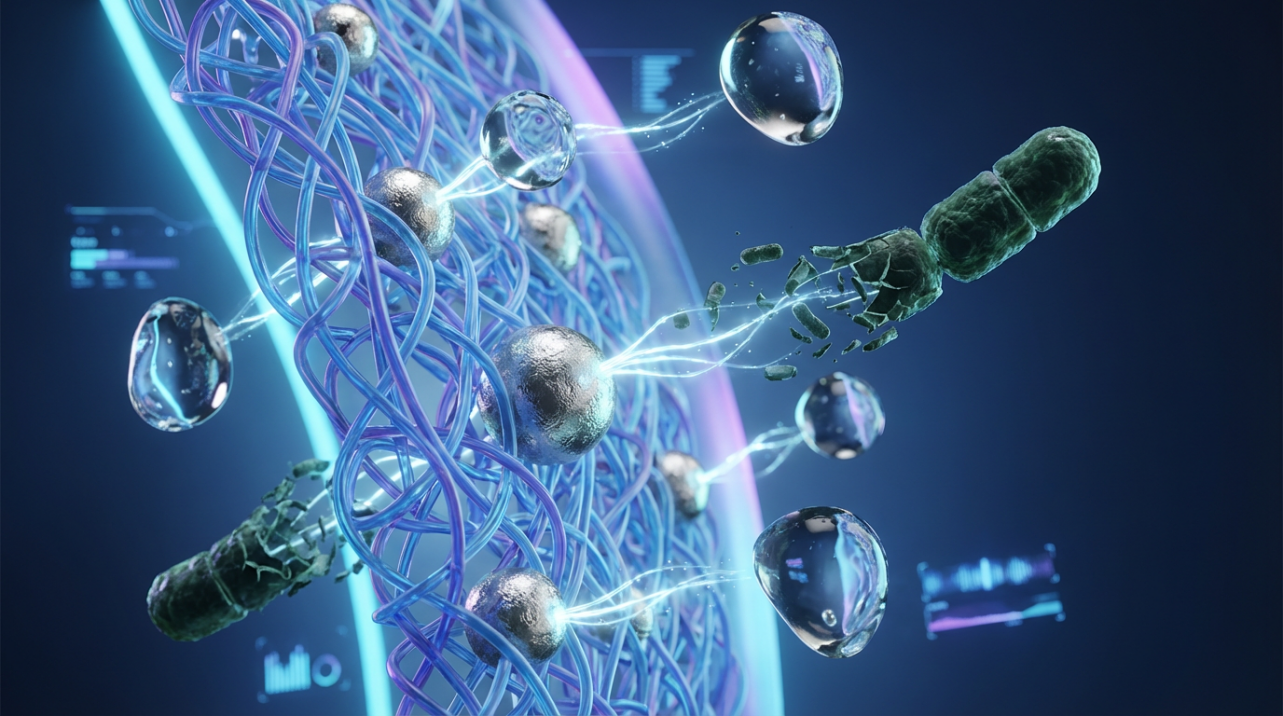
As a smart hydration specialist, I often meet families who have done their homework. They know silver has been used to keep water safer for centuries, they have heard about “nano silver ion” filters that promise self-disinfecting performance, and then they ask the key question: how long does that antibacterial effect actually last in real life?
Behind the marketing, there is a solid body of science on silver nanoparticles, silver ions, and their behavior in real filter materials. In this article, I will unpack what we know from peer‑reviewed research and technical reports, and translate it into practical guidance for home water and hydration systems.
What Exactly Is a Nano Silver Ion Filter?
When manufacturers advertise “nano silver ion” filters, they are usually talking about materials that contain silver nanoparticles (often in the 1–100 nm range) that slowly release bioactive silver ions (Ag⁺) into a very local micro-environment around the filter surface.
A review on silver nanoparticle disinfectants in PubMed Central describes how silver nanoparticles are embedded into water filters, textiles, and food packaging to provide broad-spectrum antimicrobial action. Silver has served as an antimicrobial since at least 1000 BCE, and modern nanotechnology simply refines it: shrinking silver down to the nanoscale boosts surface area and allows a controlled, sustained release of silver ions where microbes land.
In water and air filtration, nano silver can be built into:
- Ceramic or polymer water filters impregnated with silver nanoparticles
- Low-pressure microfiltration and ultrafiltration membranes with silver incorporated into the membrane matrix
- Porous carriers (such as zeolites or clays) loaded with silver nanoparticles and silver ions, then mixed into coatings or filter media
Some manufacturers, including those highlighted in technical overviews of nano silver, claim that ultra-small, high-purity silver nanoparticles on surfaces show no obvious expiry under exposure to light, heat, or radiation. From a materials standpoint, the metal itself is indeed stable. But for a home user, what matters is not whether the metal still sits in the filter, but whether enough silver ions continue to be released to meaningfully suppress bacterial growth over time.
How Nano Silver Kills Microbes – And Why That Matters for Lifespan
Understanding the kill mechanism is the first step in understanding longevity.
A technical paper on nano silver powder describes how silver nanoparticles are drawn to negatively charged microbial cell membranes, attach and penetrate cells, release silver ions, generate reactive oxygen species, and disrupt DNA replication and key enzymes. A review in a Wiley microbiology journal reinforces that silver ions are the primary toxic species. All silver forms, from salts to nanoparticles, largely work by releasing Ag⁺, which binds to thiol groups in proteins, damages membranes, and interferes with respiration and DNA.
In practical terms, that means three things for longevity.
First, the nanoparticles act as a reservoir. They sit on or inside the filter material and, over time, oxidize and release silver ions into surrounding moisture. As long as there is metallic silver available and conditions support oxidation, the filter continues to generate antibacterial ions.
Second, antimicrobial power depends on maintaining a certain minimum silver ion concentration where microbes contact the surface. The antimicrobial review in the Wiley journal reports effective bacterial kill at low microgram‑per‑milliliter levels for nanoparticles in the 7–20 nm range. If ion release falls below those thresholds in the filter’s micro-environment, the antibacterial effect may become more cosmetic than functional.
Third, water chemistry shapes how much of the released silver remains active. The PubMed Central review on silver nanoparticle disinfectants notes that silver’s bactericidal effect depends on concentration, pH, exposure time, temperature, and dissolved constituents. Calcium and sulfide ions can reduce silver’s antibacterial activity, while chloride has less impact. That means the same nano silver filter can behave very differently in two homes with different water hardness and composition.
In other words, the antibacterial “clock” is governed by how fast the silver reservoir converts to ions and how quickly those ions are neutralized by the water they encounter.
What “Longevity of Antibacterial Effect” Really Means
It helps to distinguish between three related but different lifespans.
One is the mechanical filtration life. Activated carbon and sediment media clog over time as they adsorb contaminants and trap particles. Research on charcoal filters in purifiers emphasizes that higher contaminant loads, continuous operation, and high humidity shorten this mechanical lifespan. When pores are saturated or blocked, flow drops and filtration performance declines, even if silver is present.
Another is the structural life of the filter housing and media. The plastic shell or ceramic body might last for years if you never touched it. That does not mean it is wise to drink through it for years without replacement.
The third is the antibacterial life: the period during which the silver-treated surfaces still deliver a meaningful reduction in microbial growth compared with the same filter without silver. That is the focus here.
Manufacturers sometimes imply that because the silver is “built in,” the antibacterial effect is essentially permanent. The research paints a more nuanced picture: nano silver can dramatically extend the duration of antibacterial protection compared with a simple spray of disinfectant or a silver salt coating, but it is still finite and shaped by design, water quality, and use.
Science Snapshot: How Long Can Nano Silver Keep Working?
There is no single “years of life” number that applies to all nano silver ion filters, but several studies shed light on the durability of the antibacterial effect.
Insights from Coating and Carrier Studies
A detailed study in the journal Coatings examined composite antibacterial agents where silver nanoparticles and silver ions were loaded onto two inorganic carriers: montmorillonite clay and LTA zeolite. These composites were then incorporated into powder coatings and tested against bacteria.
In instant antibacterial tests, coatings without any silver allowed bacterial counts to grow from around 3.5 × 10^6 colony-forming units per milliliter to 6.9 × 10^8 over 24 hours. In contrast, all coatings containing silver nanoparticle–silver ion composites achieved more than a 99.99 percent reduction in viable bacteria, corresponding to a reduction of 5–6 orders of magnitude. This confirms that properly integrated nano silver can deliver extremely strong antibacterial action in a coating format, which is conceptually similar to a filter surface.
The same Coatings study then looked at durability under repeated washing and wiping. Coatings using ex situ silver nanoparticles on montmorillonite or zeolite carriers maintained antibacterial rates above 99 percent even after more than 20 washing cycles and 1,200 wipes. Silver-ion-only coatings fell below 99 percent reduction after around 12 washing cycles, and some in situ nanoparticle systems (where particles formed directly inside the zeolite pores) showed weaker performance because surface layers of silver blocked ion exchange and were prone to being washed away.
The authors concluded that silver nanoparticles stored in carriers with larger pores, such as montmorillonite, act as a long-term reservoir: they gradually oxidize to release fresh silver ions near the surface, sustaining antibacterial activity far longer than systems that rely solely on mobile silver ions or superficial coatings.
While these are coating tests, not complete household filters, the principle carries over. Nano silver integrated deep into a porous matrix that remains in place as the filter is used can continue to fuel antibacterial action through many cycles of wetting, drying, and mild abrasion.
The PubMed Central review on silver nanoparticle disinfectants echoes this reservoir concept in water treatment. It describes silver-impregnated ceramic water filters, silver-loaded cryogels with high porosity and strong water absorption, and polyurethane foams coated with silver nanoparticles. In one application, silver-coated polyurethane foam used at a flow rate of about half a liter per minute produced filtrate free of Escherichia coli, indicating the material retained antibacterial efficacy under realistic flow conditions. The same review notes that silver nanoparticle–modified membranes showed enhanced antibiofouling performance and up to seven-fold increases in water flux compared with unmodified membranes, suggesting that antimicrobial effectiveness can remain high while the membrane is still physically functional.
Taken together, these studies show that well-designed nano silver systems can sustain strong antibacterial performance across many use or cleaning cycles.

That is a very different profile from a one-time disinfectant spray, but it is still not infinite.
Comparing Nano Silver with Short-Contact Disinfectants
A useful way to understand longevity is to compare nano silver with something familiar like alcohol.
An industry article on disinfectant choice points out that 70 percent ethyl alcohol is a very effective germicide on small surfaces, but it begins to evaporate almost immediately. Because it dries quickly, the actual contact time on a surface is brief, and the antimicrobial effect essentially ends once the surface is dry. Repeated use can also damage materials and alcohol is flammable, which limits its practicality for large areas or continuous protection.
Nano silver systems are designed to do almost the opposite: they work slowly and continuously. Silver nanoparticles in a filter or coating release small amounts of silver ions over time, providing ongoing antibacterial pressure as long as moisture and oxygen are present and the particulate or organic fouling is not completely blocking the treated surface.
The comparison below summarizes these differences conceptually.
Technology or treatment |
How it works on microbes |
Typical duration of action after a single application or installation |
Where it is strongest |
Alcohol-based disinfectant (around 70 percent ethanol) |
Rapidly denatures proteins and disrupts membranes while the surface remains wet |
Limited to the brief period before the alcohol evaporates |
Quick disinfection of small, non-porous surfaces such as handles, switches, and small device housings |
Nano silver ion integrated material |
Silver nanoparticles in the material release silver ions over time, damaging membranes, enzymes, and DNA |
Continues as long as the material is intact and can release enough silver ions without blockage |
Long-term antimicrobial surfaces and components, such as filters, housings, and medical or food-contact coatings |
Plain mechanical filter without nano silver |
Physically traps particles in a fibrous or porous matrix, without chemically inactivating microbes |
Lasts until the filter clogs or degrades; there is no active antimicrobial effect |
Bulk removal of particulates, including many microbes, as part of multi-stage air or water purification |
For home hydration systems, nano silver should be seen as a built-in, long-acting antimicrobial feature that complements mechanical filtration, not as a permanent shield that makes maintenance optional.

Real-World Factors That Control Antibacterial Longevity
The laboratory studies provide controlled snapshots. At the kitchen sink, a range of practical factors control how long nano silver can keep doing its job.
Water Quality and Chemistry
The silver nanoparticle disinfection review in PubMed Central stresses that silver’s antibacterial performance depends on concentration, pH, exposure time, and temperature, as well as water constituents. Calcium and sulfide in particular reduce bactericidal activity; sulfide readily forms silver sulfide, a much less soluble and less bioactive form, while calcium can influence microbial cell walls and precipitation behavior. Chloride, by contrast, has less impact at typical drinking water levels.
This has two implications for longevity.
One is that filters treating harder, more mineral-rich water, or water with higher sulfide levels, may consume the active silver reservoir more quickly because more silver is tied up into inactive forms. The other is that filters must be engineered to keep released silver within safe drinking water limits. Both the World Health Organization and the United States Environmental Protection Agency, as cited in the PubMed Central review, consider dissolved silver concentrations below about 0.1 milligrams per liter in drinking water to be acceptable. Designs that aggressively release silver ions might show strong early antibacterial performance but could risk exceeding guideline levels if not carefully controlled.
In plain language, the more chemically demanding your water is, the harder a nano silver filter has to work to maintain the same antibacterial effect, and the more carefully it must be designed to remain both effective and safe.
Filter Design and Silver Placement
Not all nano silver filters are created equal. The Coatings study on silver nanoparticle–silver ion composites illustrates how carrier structure and synthesis method shape performance over time.
Montmorillonite clay has relatively large pores and interlayers that can host pre-made silver nanoparticles. When ex situ nanoparticles are loaded into this carrier, they sit in sheltered spaces yet still connect to the surface, gradually oxidizing to release silver ions. This configuration maintained antibacterial rates above 99 percent after more than 20 washing cycles, with only a gentle decline.
LTA zeolite, by contrast, has much smaller pore openings. When silver nanoparticles are formed in situ within its pores, they tend to overflow and coat external surfaces, blocking ion-exchange sites and creating loosely attached surface layers that can be lost during washing. These in situ zeolite systems showed weaker and less durable antibacterial performance.
For home filters, the analogy is straightforward. Silver that is merely sprayed onto the outside of a filter cartridge may deliver a strong initial kill but can be worn off or buried under fouling relatively quickly. Silver that is integrated throughout the depth of a porous medium, in well-dispersed nanoparticle form, can act as a long-term reservoir, continuously supplying fresh silver ions close to where water flows.
The PubMed Central review describes several creative supports for silver nanoparticles in water treatment, including ceramic filters, cryogels with high porosity, and polymer matrices. In many cases, the most effective designs are those that balance three goals: they bring microbes into contact with silver-treated surfaces, they physically filter out particles that could form dense biofilms, and they hold silver nanoparticles in positions where oxidation and ion release can proceed without washing the particles away.
Loading, Usage, and Maintenance
Even the best-designed nano silver filter will not last forever if it is overloaded.
Research on conventional air and water filters shows the same pattern across different media. Charcoal filters saturate more quickly when they handle heavier pollutant loads. Air purifier studies note that high dust, smoke, or pet dander environments, or continuous high-speed operation, shorten filter life. Cleanroom experts emphasize that HEPA filter lifespan depends on filter load, pressure drop, and the cleanliness class of the environment; dirtier environments lead to more frequent replacement.
For a nano silver water filter, intensive use, high microbial or organic load, and poor pre-filtration can all accelerate clogging and fouling. Once thick layers of biofilm or organic deposits form on top of a silver-treated surface, water and microbes contact that biofilm first, not the silver. At that point, even if some silver ions still diffuse outward, the antibacterial effect is partially shielded, and flow rates may have dropped enough that the entire system needs replacement.
This is why many air and water treatment systems rely on pre-filters to intercept larger particles before they reach expensive media. Several air purifier manufacturers highlight washable pre-filters and fabric covers that extend HEPA and carbon filter life by capturing dust and hair. The charcoal filter article also recommends pre-filters for large particles to reduce the load on activated carbon. The logic is identical for nano silver filters: a simple sediment pre-filter upstream can dramatically extend both mechanical filtration life and the useful antibacterial life of the nano silver stage.
Pros and Cons of Long-Lived Nano Silver Ion Filters
From a water wellness perspective, nano silver brings real advantages, but they come with important trade-offs.
On the positive side, silver is a remarkably broad-spectrum antimicrobial. Technical summaries of nano silver powder claim activity against more than 650 types of disease-causing microorganisms, including bacteria, viruses, and fungi. The Wiley microbiology review reports that silver nanoparticles are effective against a wide range of Gram-positive and Gram-negative bacteria, including multidrug-resistant strains, and show antifungal and antiviral action as well. The Coatings study demonstrates that even thin nano silver–containing layers can cut viable bacteria by 5–6 orders of magnitude under test conditions.
Nano silver also works at very low doses. Minimum inhibitory concentrations for silver nanoparticles reported in the Wiley review are in the low microgram‑per‑milliliter range. The nano silver powder overview notes that strong antimicrobial effects can be achieved at low concentrations, which helps keep costs manageable and limits the total amount of silver that needs to be incorporated into a filter.
Because nanoparticles act as a reservoir, nano silver systems tend to have a long functional shelf life and sustained antimicrobial performance, as long as the material remains intact and is not overly cleaned or abraded. The durability tests in the Coatings study, where antibacterial effects remained high after many washing cycles and hundreds of wipes, are a good example of that longevity.
On the cautionary side, several independent reports highlight health and environmental concerns. An article in Environmental Health Perspectives reviewing nanosilver use notes that elemental silver is extremely toxic to aquatic organisms, ranking second only to mercury among common metals, and that nanosilver released during product use and washing can enter wastewater treatment plants and agricultural soils. Friends of the Earth and other organizations report emerging evidence of cytotoxic, genotoxic, and immunological effects in cell and animal studies, and warn about the potential for nanosilver to cross key biological barriers.
There is also the issue of microbial resistance. Both the Environmental Health Perspectives article and the Friends of the Earth report raise concerns that widespread, low-level use of nanosilver in everyday products could encourage silver resistance in bacteria. Because silver-resistance genes often sit on the same mobile genetic elements as antibiotic-resistance genes, selection for silver resistance can inadvertently co-select for resistance to medically important antibiotics.
Regulatory frameworks have not fully caught up. Friends of the Earth argues that nanosilver should be treated as a new active ingredient, not assumed equivalent to bulk silver, and calls for nano-specific risk assessments that look at particle size, coatings, release rates, environmental fate, and chronic low-dose effects. They also recommend restricting nanosilver to high-benefit uses, such as critical medical applications, while avoiding non-essential consumer uses where safer alternatives exist.
From a home hydration standpoint, the takeaway is that nano silver is a powerful tool that should be used thoughtfully.

It is most defensible where the added antibacterial resilience offers clear health protection, such as point-of-use water treatment in households with vulnerable members or uncertain microbial quality, and where overall silver release is kept low and well-controlled.
How I Advise Clients to Think About Longevity When Choosing a Nano Silver Ion Filter
When I help someone evaluate a nano silver ion filter for a kitchen system or a whole-home hydration setup, I focus less on marketing buzzwords and more on a few science-informed questions.
One question is how the silver is integrated. I look for technical descriptions that sound like the systems in research, where silver nanoparticles are embedded in ceramics, clays, or polymers, not just sprayed onto the surface. Designs that use carriers with accessible pores, similar to the montmorillonite composites in the Coatings study, are more likely to support long-term antibacterial release. Systems that rely solely on silver salts painted on the outside may show strong early results but weaker durability.
Another question is whether the manufacturer cites robust testing. Lab data showing several orders of magnitude reduction in bacteria, ideally under repeated use or cleaning cycles, carries more weight than vague claims of “antibacterial for life.” The Coatings research demonstrates that it is possible to test antibacterial performance after many washing cycles, and some home-focused brands do commission similar repeated-use tests for food-contact or water components. Asking to see that data is reasonable when you are counting on a filter to protect your family’s drinking water.
I also stress that nano silver is a supplement, not a substitute, for basic filter maintenance. The charcoal filter research and multiple air purifier studies all reinforce that filters are consumables. They clog and saturate and can even become sources of secondary pollution if used far beyond their life, as trapped contaminants re-enter the air or water. Nano silver can slow bacterial growth on a filter surface, but it does not stop particles, organic matter, and biofilm from accumulating indefinitely. Following the manufacturer’s replacement schedule, and erring on the side of timely changes in higher-risk environments, remains essential.
For households on well water, or families with immune-compromised members, I often suggest combining a robust mechanical treatment train with targeted nano silver use and regular water testing. The silver nanoparticle review notes that household drinking water quality in many regions would benefit from point-of-use treatments, and nano silver can provide a valuable additional barrier in systems where chlorine use is limited by taste or by formation of unwanted by-products. At the same time, I remind clients that independent testing for microbial indicators is still the gold standard for verifying safety, whether or not nano silver is present.
Finally, I encourage people to think about the bigger picture. Technical surveys report that nano silver appears in several hundred to more than 1,000 consumer products across sectors, from textiles and cosmetics to appliances and food storage. That cumulative use increases the amount of nanosilver entering wastewater and the environment. Choosing nano silver where it genuinely improves safety, and not simply because it sounds high-tech, is a responsible way to balance personal health benefits with broader environmental stewardship.
FAQ: Common Questions about Nano Silver Filter Longevity
Does the antibacterial effect last as long as the filter housing?
The plastic or ceramic body of a filter might last for many years, but the antibacterial effect depends on how much active silver remains and how much of it can still release ions into the water. As silver gradually oxidizes and reacts with water constituents, and as fouling layers build up, the effective antibacterial strength declines. In practice, the antibacterial life of a nano silver filter is shorter than the structural life of its housing, and it should always be considered within the replacement intervals recommended for the filter media.
Can I “recharge” the nano silver by cleaning or backwashing the filter?
Cleaning can sometimes restore flow by removing loose debris, and some advanced membranes and cryogel systems described in research are designed for multiple cleaning cycles. However, cleaning does not create new silver. The silver nanoparticle reservoir is finite, and each period of use converts some metallic silver into ions and then into inactive compounds. Like the charcoal filters discussed in longevity articles, nano silver filters are generally not regenerable in a home setting. Once their performance falls outside the tested range, they should be replaced rather than relied on indefinitely.
Is more silver always better for longer-lasting antibacterial protection?
More silver is not automatically better. The Coatings study shows that overloading certain carriers can actually reduce long-term performance by blocking ion-exchange sites and creating thick surface layers that wash away easily. There is also the need to stay below safe silver levels in drinking water, as indicated by World Health Organization and United States Environmental Protection Agency guidance. The most effective designs find a balance: enough well-dispersed silver nanoparticles to sustain ion release over time, in carriers that hold them securely, without overshooting safety thresholds or undermining the material’s physical integrity.
As with any powerful tool, nano silver works best when it is thoughtfully engineered and intelligently used. When you pair a well-designed nano silver ion filter with solid mechanical filtration and sensible maintenance, you can enjoy cleaner, safer hydration with a clearer understanding of how long that antibacterial protection really lasts.
References
- https://ehp.niehs.nih.gov/121-a220/
- https://www.ashrae.org/technical-resources/filtration-disinfection
- https://www.centerforfoodsafety.org/files/nano-silver_product_inventory-in-food-12514_66028.pdf
- https://foe.org/wp-content/uploads/2017/12/NanoSilver-U.S.-version.pdf
- https://cleanroomtechnology.com/when-to-replace-your-hepa-filter-according
- https://www.labmanager.com/best-practices-for-biosafety-cabinet-maintenance-and-use-32002
- https://powder.samaterials.com/antibacterial-ability-of-nano-silver-powder-the-basis-for-wide-applications.html
- https://www.discountfilters.com/blog/how-long-do-air-purifier-filters-last?srsltid=AfmBOopRS42e69w-X6XsRMm3IA0Kchsb0Usw-goSIcwQR47_vfDqIqPW
- https://hisoair.com/how-to-improve-the-lifespan-of-air-purifier-filters/
- https://learn.sensibo.com/b2c-blog/how-long-do-hepa-filters-last

Share:
Understanding the Need for Solenoid Valves in RO Systems
Understanding How Much Chlorine Your RO System Can Really Handle