

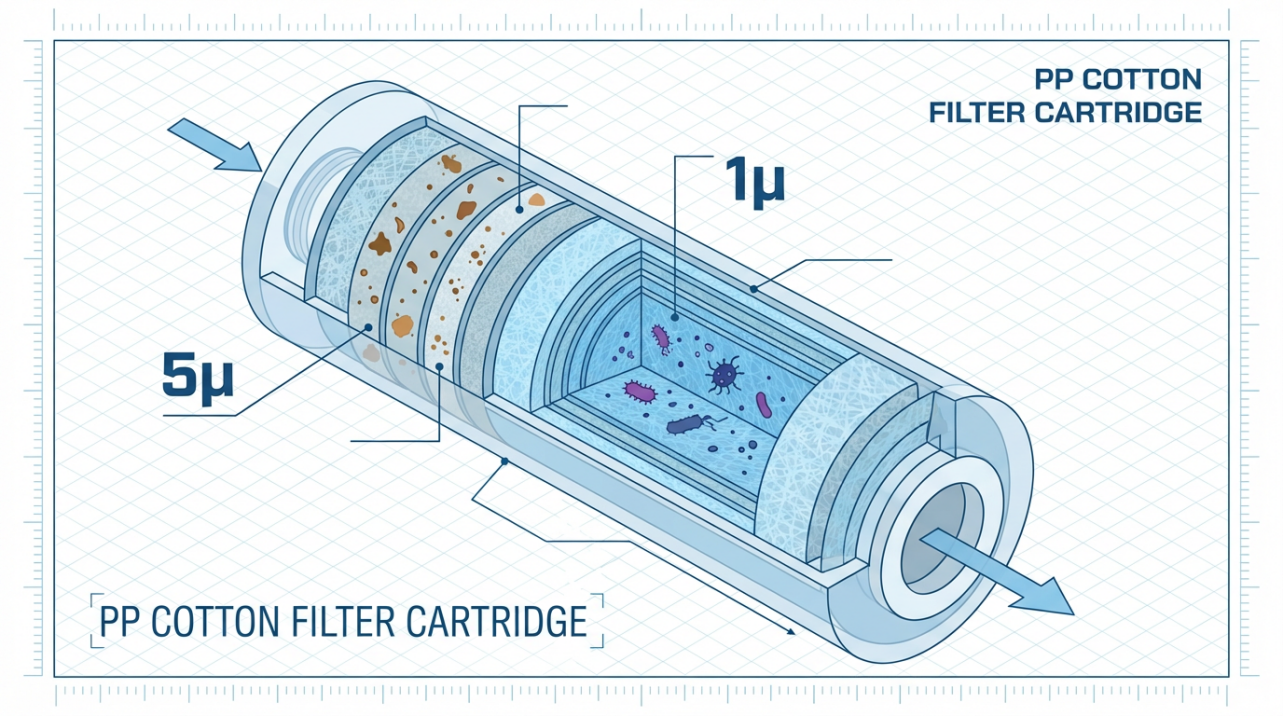
When you first start looking at water filters, it is easy to get lost in the jargon. Few terms confuse homeowners more than “micron rating,” especially when you are deciding between a 5 micron and a 1 micron PP cotton (polypropylene) sediment filter. Yet that tiny number controls something very practical: how clear your water looks, how often you change filters, and how healthy your downstream filtration stages stay.
As a Smart Hydration Specialist who spends most days troubleshooting cloudy water, clogged cartridges, and low pressure in real homes, I think of micron rating as the “resolution” of your sediment filter. Choosing between 5 micron and 1 micron PP cotton is not about picking the “better” number in isolation. It is about matching the filter’s resolution to the actual particles in your water and the performance your home plumbing can support.
This guide walks you through that decision with science-backed explanations and practical, field-tested advice, drawing on guidance from manufacturers and educators such as Simpure, Fresh Water Systems, Frizzlife, Aquasana, WaterFilterGuru, AllFilters, and others, as well as public health resources referenced by organizations like the CDC and EPA.
What a Micron Really Means in Your Water
A micron, or micrometer, is one millionth of a meter, which works out to about 0.00004 inches. Aquasana and other filtration experts use simple comparisons to show how small that is. A human hair is roughly 70 microns in diameter, household dust is around 40 microns, white blood cells are about 25 microns, and a typical red blood cell is about 5 microns. Particles below roughly 40 to 60 microns are too small to see with the naked eye.

When a filter is described as “5 micron” or “1 micron,” that number refers to the approximate size of the pores in the filter media. In simple terms, a 5 micron filter is designed to trap particles around 5 microns and larger, while a 1 micron filter targets particles around 1 micron and larger. Lower micron ratings mean smaller pores and finer filtration.
Filtration educators such as WaterFilterGuru, Commercial Filtration Supply, and Fresh Water Systems all emphasize two core truths about micron ratings. The first is that smaller micron numbers capture more and finer particles but clog faster and cause more pressure drop. The second is that the type of micron rating matters. Many residential cartridges use a nominal rating, which typically removes most (roughly 80 to 95 percent) of particles at the stated size. Absolute-rated filters are more tightly controlled and are often tested to block roughly 95 to 99.9 percent of particles at and above their micron rating. This difference becomes very important if you care about microbiological performance, such as cyst reduction.
What PP Cotton Sediment Filters Actually Do
Most 1 micron and 5 micron PP cotton filters are sediment filters. They are mechanical barriers that behave like very fine screen doors, catching solid particles suspended in water. Fresh Water Systems describes micron filters as devices that remove dirt, sand, rust, silt, and scale, while Simpure and Frizzlife discuss PP sediment filters as the first protection for your home water systems.
By stripping out this sediment, PP filters reduce turbidity or cloudiness, which makes water look clearer and helps downstream filters work more effectively. Watermill Express notes that removing suspended solids improves water appearance and can also improve taste and odor, because many off-flavors ride on particles that are removed by micron filtration. Sediment prefilters also protect more sensitive and expensive stages such as activated carbon blocks and reverse osmosis membranes, something emphasized by Bulk Reef Supply in the context of RO systems.
It is equally important to understand what PP sediment filters do not do. AllFilters and Everfilt point out that micron filters are not designed to remove dissolved contaminants such as chlorine, most organic chemicals, or dissolved metals. Those require media such as activated carbon, reverse osmosis membranes, or ion exchange. Micron filters also are not stand-alone disinfection devices. Sources such as Fresh Water Systems and SpringWell explain that while fine filters can capture many bacteria and parasitic cysts, viruses are typically much smaller, and even bacteria can pass unless the filter is designed, rated, and certified for that purpose. That is why organizations like the CDC and EPA, as referenced by Watermill Express, treat mechanical filtration as one part of a multi-barrier strategy rather than a complete solution by itself.

With that context, the 5 micron vs 1 micron decision comes into focus. Both are sediment filters; the key difference is how fine they go, how hard they work, and how they affect your system.
5 Micron PP Cotton Filters: Coarse but Durable Workhorses
Across multiple sources, 5 micron PP sediment filters are described as a sweet spot for general sediment control, especially in whole-house and high-sediment applications.
Fresh Water Systems explains that 5 micron filters remove everything that larger micron filters (such as 10, 25, or 50 micron) can, plus far more fine silt, some molds, certain bacteria and cysts, and additional asbestos fibers, although they are not reliable for comprehensive bacteria or virus removal. WaterFilterGuru notes that 5 microns is a common “smallest” sediment rating used as an early stage to capture silt and fine sediment in well water. Simpure adds that a 5 micron PP filter is coarser than 1 micron and therefore allows higher flow, clogs more slowly, and generally has a longer service life.
Simpure gives a practical replacement guideline: in typical household conditions a 5 micron PP cotton cartridge might last around 6 to 12 months, compared with a much shorter interval for 1 micron. They also point out that in heavy sediment, a 5 micron filter often needs to be preceded by a coarser prefilter such as a 50 micron screen to avoid rapid clogging. Frizzlife and WaterFilterGuru describe common well-water setups that start with a 20 to 50 micron spin-down or mesh filter, followed by a 5 micron sediment cartridge.
In my own work, I see 5 micron PP cotton used as the “workhorse” cartridge that keeps sand, rust flakes, and clouding silt from reaching water heaters, fixtures, and downstream carbon filters. When homeowners have gritty well water or visible debris, moving to a 5 micron PP prefilter almost always improves both water appearance and the lifespan of everything downstream.
1 Micron PP Cotton Filters: Fine Polish and Extra Protection
A 1 micron PP sediment filter pushes filtration to a finer level. Simpure describes 1 micron PP filters as providing more thorough filtration, capturing smaller particles and some bacteria that a 5 micron filter might let through. Fresh Water Systems states that 1 micron filters are fine enough to remove most types of bacteria and parasites, including organisms such as E. coli, Shigella, and Salmonella, and to catch very fine dirt, silt, and asbestos fibers. Watermill Express also notes that some waterborne bacteria and protozoa are large enough to be captured by 1 micron filtration, which can help reduce risk.
At the same time, Fresh Water Systems and AllFilters are careful to stress that micron filters in the 1 micron range are better seen as reduction tools, not guarantees. They can reduce many bacteria and some cysts, but for reliable cyst removal (for example Cryptosporidium and Giardia) these sources recommend going to about 0.5 micron with an absolute rating and relevant NSF certifications.
The cost of this finer straining shows up in performance. Simpure emphasizes that 1 micron PP filters have smaller pores, so they clog faster, have shorter life, and can cause more pressure drop than 5 micron filters. They suggest that 1 micron cartridges may need replacement in roughly 3 to 6 months depending on water quality, with illustrative examples where a 1 micron filter in dirty water might last about a month while a comparable 5 micron filter in the same system might last several months.
Because of that, both Simpure and AllFilters position 1 micron PP filters as better suited for polishing stages rather than as the only sediment filter in a high-load, whole-house position. They recommend using 1 micron filters downstream of a coarser prefilter when you want especially clear water and additional protection for drinking-water stages such as carbon blocks or reverse osmosis.
1 Micron vs 5 Micron PP Cotton: Key Differences at a Glance
To make the trade-offs concrete, it helps to place the two side by side. The following comparison reflects guidance from Simpure, Fresh Water Systems, WaterFilterGuru, AllFilters, Watermill Express, and Frizzlife.
Aspect |
||
Approximate particle size targeted (nominal) |
Captures sand, rust flakes, larger silt, and many visible or near-visible particles around 5 microns and up |
Captures very fine silt, small rust particles, many bacteria-sized particles, and other fine sediment around 1 micron and up |
Typical contaminants |
Sand, coarse and fine sediment, rust flakes, scale, some molds and cysts depending on rating |
Fine silt and clay, very small sediment, many bacteria and parasites, asbestos fibers, and cloudiness that can slip through 5 micron stages |
Effect on flow and pressure |
Lower resistance for a given cartridge size; maintains higher flow, especially in whole-house applications |
Higher resistance; more prone to pressure drop as loading increases, especially if used as the only sediment stage |
Typical service life under similar conditions |
Often around 6 to 12 months in moderate conditions according to Simpure, longer than finer filters |
Often around 3 to 6 months in moderate conditions; may be significantly shorter in high-sediment water |
Best placement in a system |
Common as a whole-house or main sediment prefilter, sometimes following a coarser 20 to 50 micron screen |
Common as a drinking-water polishing stage or as a second sediment stage after a coarser filter to protect carbon or RO |
Microbial performance |
Can help reduce larger organisms such as some cysts and molds but is not reliable for full bacteria or virus control |
Can reduce many bacteria and parasites, according to Fresh Water Systems and Watermill Express, but still not a stand-alone disinfection method |
Maintenance demands |
Slower clogging when sediment load is high; longer intervals between changes |
Faster clogging; requires closer monitoring and more frequent replacement, especially in well water or high sediment |
The core pattern is clear. A 5 micron filter is your durable, broad net for sediment. A 1 micron filter is your fine polish that tightens the net but demands more attention.

Nominal vs Absolute: Reading the Label Before You Rely on It
Before you decide that a “1 micron” label will solve a microbial problem, it is important to understand what that number actually represents. WaterFilterGuru, AllFilters, Fresh Water Systems, and Frizzlife all highlight the distinction between nominal and absolute micron ratings.
A nominally rated filter has pores that are approximately the stated size and is typically tested to remove most of the particles at that size, often in the range of 80 to 95 percent. Some particles at or slightly above the stated micron size will pass through. Many consumer sediment cartridges and even some carbon filters use nominal ratings because they provide good performance without overly restricting flow.
An absolute-rated filter is built and tested to a tighter standard. AllFilters notes that absolute filters are often specified to remove roughly 95 to 99.9 percent of particles at the rated size under defined test conditions. Fresh Water Systems points out that when cyst removal is critical, such as for Cryptosporidium and Giardia, an absolute 0.5 to 1 micron filter certified to standards such as NSF 53 or NSF 58 is recommended rather than relying on a nominal rating.
For PP cotton sediment filters, you will find both types on the market. When your goal is general sediment control and protection of plumbing or RO membranes, a nominal 5 micron followed by a nominal 1 micron is often sufficient. When you are specifically targeting health-related organisms, you should treat micron rating and certification together. Sediment filters alone are rarely enough; they should be paired with disinfecting technologies or certified fine filters designed for that purpose.
How Micron Choice Affects Pressure, Flow, and Filter Life
Every filter adds some resistance to water flow. The finer the pores and the more loaded with sediment they become, the more pressure is needed to push water through. That is why Bulk Reef Supply, in its guidance on sediment filters for RO systems, repeatedly warns that undersized or overly fine sediment filters can cause pressure to drop at the RO membrane, which they list as the most common cause of poor RO performance.
Bulk Reef Supply notes that a high-quality sediment filter that is correctly sized and new causes minimal initial pressure loss. If the filter is too fine for the sediment load or not changed on time, particles pass through and clog carbon blocks, which in turn increases pressure drop and shortens the life of those more expensive components. They find that, because very fine sediment is relatively uncommon in many applications, 5 micron sediment filters are generally a good balance between effective filtration and manageable pressure drop. A 1 micron sediment filter is better when you are aiming for maximum performance or protecting sensitive components such as chloramine-specific carbon blocks, as long as you are prepared to change it more often.
Frizzlife adds another important dimension: surface area and housing size. They recommend using larger cartridges, such as 20 by 4.5 inch “Big Blue” housings, or pleated filters with more surface area when you need fine micron ratings but also need to maintain flow. Their guidance suggests aiming for a relatively low clean pressure drop across the filter train and planning to replace or resize components once pressure loss reaches a noticeable level, often monitored with two pressure gauges placed before and after the filters. Fresh Water Systems similarly advises using pressure drop and flow reduction as practical signals that a micron filter is near the end of its life.
Simpure offers a simple, homeowner-friendly rule of thumb. Start with a relatively fine filter, such as 5 microns, and observe how long it takes before pressure and flow noticeably decline. If the filter clogs in less than about three months, move to a higher (coarser) micron rating such as 20 microns or add a coarser prefilter ahead of the 5 micron cartridge, with the goal of reaching roughly a 3 to 6 month service interval.
Taken together, these recommendations all lead to the same conclusion: the “right” micron rating is not just about cleanliness; it is about balancing cleanliness with pressure, flow, and practical maintenance.
Choosing Between 5 Micron and 1 Micron PP Cotton in Real-World Situations
With the science in mind, the decision becomes surprisingly practical. You match micron size to water source, system layout, and goals.
For Well Water with Visible Sediment
Well water often carries sand, rust, and other visible debris. WaterFilterGuru describes common well setups that start with a coarse sediment filter in the 50 to 100 micron range to capture large chunks, followed by a 5 micron sediment filter to catch smaller particles, and then finer filters for bacteria or chemical contaminants. Frizzlife echoes this pattern, recommending spin-down or screen filters in the 50 to 100 micron band as a first defense, then 5 micron sediment filters, and then, when appropriate, 1 micron or 0.5 to 1 micron carbon blocks at the drinking tap.
In that kind of environment, a 5 micron PP cotton filter is usually the right first choice for a whole-house cartridge. It can intercept the bulk of the sediment without clogging instantly. Once that stage is in place, adding a 1 micron PP filter immediately downstream only makes sense if your pressure is strong and your sediment load is moderate. Otherwise, many households do better reserving 1 micron filtration for point-of-use locations such as under-sink or countertop systems where the flow demand is lower and filter changes are easier.
Simpure specifically recommends using 5 micron PP filters for heavily sedimented sources or as a first stage, and then using 1 micron filters as polishing filters for household drinking water and to protect RO membranes. That staged approach lets the 5 micron cartridge do the heavy lifting while the 1 micron filter focuses on fine clarity.
For Municipal (City) Water with Mild Sediment
City water supplies are usually treated and filtered before they reach your home. While they can occasionally carry fine rust, scale, or construction debris, they seldom contain the heavy sand loads seen in some wells.
Because of this, AllFilters suggests that relatively clear municipal water aimed at higher clarity or cyst reduction may justify a 1 micron stage, especially near drinking taps. Frizzlife notes that many municipal homes do well with a single 5 micron whole-house sediment filter for plumbing protection, while keeping finer 0.5 to 1 micron carbon block filters at the kitchen sink to handle taste, odor, chlorine or chloramine, and, when certified, contaminants such as lead or PFAS.
From an everyday hydration standpoint, that means a typical city-water home can often use a 5 micron PP cotton filter for whole-house sediment control, with 1 micron filtration reserved for specific taps where you drink and cook. If you are dealing with recurring fine cloudiness or have a specific concern about small particles, a 1 micron PP filter can be added as a polishing stage, but you will want to monitor pressure and replacement intervals more closely.
Protecting RO and Ultrafiltration Systems
Reverse osmosis and ultrafiltration membranes are highly sensitive to clogging. Simpure explains that domestic RO membranes operate at around 0.0001 micron, and ultrafiltration membranes operate from about 0.001 to 0.1 micron. That level of precision allows them to remove very small contaminants, including many dissolved substances and microorganisms, but it also means they must be protected from sediment.
Simpure and Frizzlife both recommend staged sediment protection before RO, often using a combination of 5 micron and 1 micron filters. A practical configuration, aligned with their guidance and with Bulk Reef Supply’s experience, is to use a 5 micron PP filter as a first sediment stage, followed by a 1 micron PP filter as a second stage, and then carbon and RO. In some high-sediment cases, a coarser prefilter such as a 20 or 50 micron screen is placed even earlier.
In this context, the 1 micron PP filter is not just about water clarity; it is an insurance layer that keeps fine particulates from reaching expensive carbon blocks and membranes. Because the flow rate through under-sink RO systems is relatively low, the additional pressure drop from a 1 micron sediment filter is usually manageable as long as you keep up with cartridge replacement.
When to Prioritize 1 Micron Over 5 Micron
You should lean toward 1 micron PP cotton filtration when your water already has basic sediment control but still looks slightly cloudy, leaves fine silt in glasses or kettles, or when you are specifically trying to reduce bacteria-sized particles as part of a multi-barrier system. Sources such as Fresh Water Systems and Watermill Express indicate that 1 micron filters can meaningfully reduce many bacteria and protozoa, which can be valuable in combination with other treatments.
Households that already have a reliable 5 micron stage, good water pressure, and a desire for very clear drinking water are good candidates for adding or switching a polishing stage to 1 micron, especially at drinking taps. The key is to place 1 micron filters where flow demands and change-out logistics are manageable.
When to Stay with 5 Micron as Your Primary Sediment Filter
On the other hand, a 5 micron PP filter is usually the better choice when sediment loads are high, when your home’s water pressure is limited, or when you want to minimize maintenance. Simpure’s example of a 1 micron filter lasting only about a month in heavy sediment while a 5 micron filter lasted much longer is a useful reminder of how expensive “over-filtration” can become.
If your main complaints are gritty particles, stained fixtures, or clogged aerators, and you do not have a specific bacterial concern, a 5 micron PP filter is often enough. AllFilters and WaterFilterGuru both recommend 5 micron sediment filters as the first line for heavily sedimented or whole-house applications, reserving 1 micron stages for when you want extra clarity or protection downstream.
When I assess systems that suffer from chronic low pressure, I often find a very fine sediment cartridge being asked to do the entire job. Stepping that filter back to 5 microns, and adding a coarser prefilter when needed, usually restores flow without sacrificing meaningful protection.
Practical Steps to Dial in the Right Micron Level
Beyond the theory, homeowners need a clear way to tune their system. Simpure suggests a practical, iterative method that fits well with the experience of installers and manufacturers.
First, assess your water source. For wells, look at visible sediment, rust, and turbidity; for city water, consider whether issues are mostly aesthetic (taste, odor) or particulate. When lab analysis is not available, Simpure advises starting with a relatively fine but reasonable sediment filter, such as 5 microns, and then watching how long it takes before you see a noticeable reduction in flow or pressure. If a 5 micron PP filter clogs in less than about three months, you can step up to a higher micron rating such as 20 microns or add a coarse prefilter ahead of the 5 micron cartridge to share the load.
Second, size your housings and cartridges to your flow. Frizzlife and Fresh Water Systems highlight that larger cartridges, such as 20 inch length and 4.5 inch diameter, provide more surface area and dirt-holding capacity than small 10 by 2.5 inch cartridges at the same micron rating. That extra area means less pressure drop and longer life for 5 micron and 1 micron filters alike.
Third, monitor your system. Fresh Water Systems recommends watching for increased pressure drop and reduced flow as cues that a micron filter has reached capacity. Frizzlife suggests using pressure gauges before and after the filter train to track this more objectively, and Simpure provides time-based guidelines, suggesting roughly 3 to 6 months for 1 micron PP cartridges and 6 to 12 months for 5 micron PP cartridges in typical conditions, with the understanding that dirty water will shorten those intervals.
Finally, remember that neither 5 micron nor 1 micron PP filters address dissolved contaminants on their own. AllFilters, Everfilt, and SpringWell all stress that mechanical filtration should be paired with technologies such as activated carbon, reverse osmosis, ultrafiltration, or disinfection when you need to reduce chlorine, organic chemicals, heavy metals, or microbes beyond what size exclusion can handle.
Common Questions About 1 Micron and 5 Micron PP Cotton Filters
A question I hear often is whether a 1 micron PP filter by itself is enough to make water microbiologically safe. The consensus from Fresh Water Systems, AllFilters, Watermill Express, and Everfilt is that while 1 micron filters can reduce many bacteria and protozoa, and definitely improve clarity and aesthetics, they are not a complete substitute for disinfection or certified fine filtration. Viruses are typically far smaller than 1 micron, and even bacteria can slip through nominal filters. Organizations such as the CDC and EPA, cited by Watermill Express and Everfilt, view micron filtration as one barrier among several, meaning you should pair it with appropriate disinfection or certified advanced filtration when microbes are a concern.
Another common concern is whether 1 micron filtration is “too fine” for whole-house use. Bulk Reef Supply and Frizzlife show that 1 micron filters are not inherently too fine, but they require careful staging and sizing. When a 1 micron PP filter is placed behind a 5 micron stage and housed in a large cartridge with plenty of surface area, many homes can support it without unacceptable pressure loss. The problem arises when a single, small 1 micron cartridge is asked to handle all the sediment for an entire house with multiple showers running at once. In those cases, the better strategy is to let a 5 micron PP filter do the bulk work and reserve 1 micron stages for points where flows are lower and replacement is easier.
People also ask where exactly PP cotton belongs in a home filtration train. Aquasana’s explanation of whole-house systems is helpful here. They describe water entering through a sediment prefilter, often designed to capture particles down to around 1 micron, before flowing through more advanced main filters such as 0.5 micron carbon blocks and optional polishing filters. Other manufacturers like Simpure and Frizzlife map similar flows, with 50 micron screens or spin-down filters, then 5 micron PP sediment, then 1 micron sediment and carbon, and finally RO or ultrafiltration where needed. Across these examples, PP cotton filters are consistently placed near the front of the train: first to protect everything downstream, and when used in multiple micron sizes, always arranged from coarser to finer.
Closing Thoughts as a Smart Hydration Specialist
If you think of 5 micron PP cotton as your sturdy broom and 1 micron PP cotton as your fine dust cloth, the choice between them becomes less mysterious. Heavy, gritty messes demand the broom first; the cloth comes in once most of the load is gone. In practice, that means starting with 5 microns for whole-house sediment control and using 1 micron where you need extra clarity or extra protection for drinking water stages.
When you align micron size with the actual challenges in your water, and you respect the trade-offs between fineness, flow, and maintenance, your filters work with your home rather than against it.

That is the heart of smart hydration: water that is not only safe and clear in the lab, but dependable, comfortable, and easy to live with every day at the tap.
References
- https://sawmillcreek.org/threads/what-is-the-micron-rating-of-an-air-filter.287908/
- https://www.allfilters.com/blog/1-micron-vs-5-micron-filters?srsltid=AfmBOopAfIYONyhneI1k7-8YS5Ip9mcNrEFOAKezif2HC1uh46m6_K_O
- https://www.aquasana.com/info/what-do-micron-levels-have-to-do-with-whole-house-water-filters-pd.html?srsltid=AfmBOoqJAvDq5yY6FaIZ6YgTfFu6ympmnvS_BFgDdCS55sTPaYSIBBPf
- https://www.brotherfiltration.com/how-many-microns-should-your-water-filter-be/
- https://dropconnect.com/water-filter-micron-ratings-explained/?srsltid=AfmBOoqmJOW_X0SuNhkoZQzQTP_MVBbOwfyzLCVe0hdWkJ48z7h77JON
- https://www.everfilt.com/post/understanding-the-difference-between-microns-parts-per-million-ppm-in-water-filtration
- https://www.rusco.com/blog/what-is-a-micron-and-how-does-mesh-size-correlate
- https://www.springwellwater.com/micron-rating-explained/?srsltid=AfmBOorjCWaQ-dmG-UziJsVyfY8p-9q22DB2ytayoxhMtjqBhY_zEoFW
- https://waterfilterguru.com/what-size-micron-filter-for-well-water/
- https://www.bulkreefsupply.com/content/post/Selecting-the-Right-Sediment-Filter-How-To-Tuesday?srsltid=AfmBOoqvoL5K9H8iAy54hNAcIZW1Jwb3tLr7Fz1Dyn9am_MRHzTbxsZX

Share:
Impact of Membrane Fiber Density on RO Performance Analysis
95% vs 98% RO Membrane Desalination: How Much Difference Does It Really Make?