

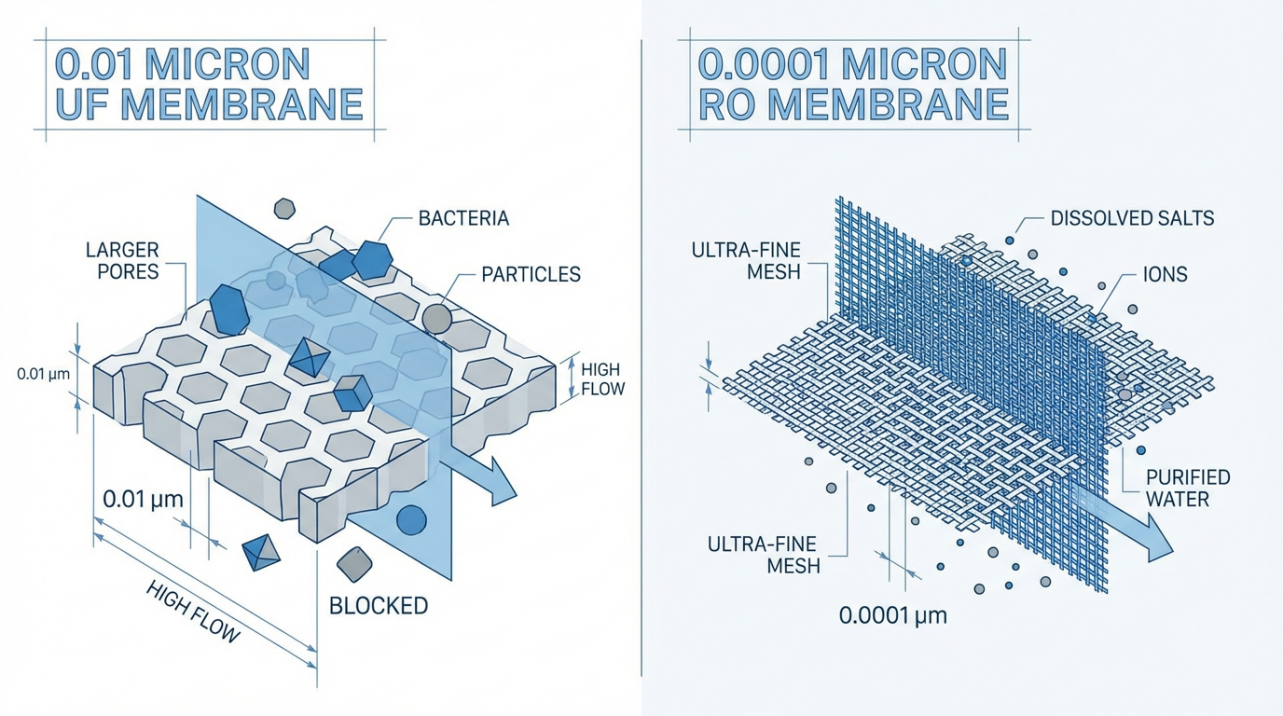
When I sit down with a homeowner to design a drinking water system, the same question comes up again and again: should I choose ultrafiltration or reverse osmosis? On spec sheets the answer looks simple. One membrane is rated at 0.01 micron, another at 0.0001 micron, and it is tempting to assume “smaller is always better.”
In practice, that is not how smart hydration works.
As a water treatment specialist, I have seen both technologies perform brilliantly when they are matched to the right water and the right health goals. I have also seen reverse osmosis systems installed where a good 0.01 micron ultrafiltration unit would have delivered better taste, less waste, and lower cost, and the reverse is just as common.
In this guide, I will walk you through what those pore-size numbers really mean, how 0.01 micron ultrafiltration (UF) and 0.0001 micron reverse osmosis (RO) membranes work, what each is best at, and how to choose the right configuration for your home hydration setup. The explanations draw on technical work from groups such as Ecologix Environmental Systems, Veolia Water Technologies, University of Nebraska Extension, FreshWaterSystems, and Membrane Solutions, combined with field experience in real kitchens and utility rooms.
Microns, Molecules, and What Those Numbers Really Mean
A micron is a millionth of a meter. You will sometimes see pore sizes shown as microns or nanometers; for household decisions, you can think in relative rather than absolute terms.
Technical data compiled by Ecologix Environmental Systems and others places typical ultrafiltration pores in the range of about 0.01 to 0.1 micron. That is small enough to physically block most bacteria, protozoa such as Giardia and Cryptosporidium, many viruses, colloids, and fine suspended solids, but still large enough that dissolved salts and most small organic molecules slip through.
Reverse osmosis membranes are different. They do not behave like “little strainers” with open holes. Their effective cut-off is around 0.0001 micron, roughly a thousand times finer than a 0.1 micron filter, and closer to the scale of hydrated ions. Water moves through the dense membrane layer by diffusion, while most dissolved salts, heavy metals, and many low‑molecular‑weight contaminants are rejected.
From a health perspective, that difference in scale shows up clearly in performance:
Ultrafiltration is excellent at clarifying water and removing pathogens. It dramatically reduces turbidity and can remove up to about 99.99 percent of bacteria and many viruses, according to membrane manufacturers such as Hydramem and Ion Exchange, as well as technical overviews from Veolia Water Technologies.
Reverse osmosis adds full demineralization to that picture. Sources such as Ecologix Environmental Systems, FreshWaterSystems, and University of Nebraska Extension report that RO membranes typically remove around 95 to 99 percent of dissolved salts and many inorganic contaminants, and can reduce total dissolved solids (TDS) to below about 10 milligrams per liter in properly designed systems.
Those are very different tools. One is mainly a microbiological and clarity barrier. The other is a broad-spectrum purifier that targets dissolved chemistry as well.
How 0.01 Micron Ultrafiltration Membranes Work
Ultrafiltration is a pressure-driven membrane process. In both industrial and residential systems, the feed water is pushed along or through hollow fibers or flat-sheet modules. Water and small dissolved substances pass through the membrane wall; larger species are retained and flushed away.
What 0.01 Micron UF Actually Removes
Across multiple technical sources, including Applied Membranes, Hydramem, Membrane Solutions, and Veolia Water Technologies, the performance picture is consistent for a 0.01 micron-class UF membrane.
It reliably removes suspended solids, fine silt, and colloids that make water cloudy. It removes bacteria, typically sized around 0.2 to 10 microns, and protozoa such as Cryptosporidium and Giardia, which sit in the one to one hundred micron range. It removes many viruses, particularly those larger than about 0.02 micron, and high‑molecular‑weight organics such as some natural organic matter and large macromolecules.
Ecologix Environmental Systems notes that ultrafiltration can drive turbidity down to below 0.1 NTU in well-designed systems, which is a level associated with very clear, sparkling water.
At the same time, UF allows most dissolved salts and small molecules to pass. Sodium, calcium, magnesium, chloride, sulfate, and similar ions remain essentially unchanged. Nitrates, most pesticides in their dissolved form, and very small neutral organics are only weakly affected. This is also emphasized in technical material from Applied Membranes and Newater, which classify ultrafiltration as a “high‑molecular‑weight cutoff” technology.
This behavior is exactly why many people love UF for everyday hydration. You gain a strong physical barrier against pathogens and particulates while retaining the natural mineral profile and basic flavor of the source, assuming the incoming water is not chemically contaminated.
Operating Conditions, Energy Use, and Water Recovery for UF
One of the most practical advantages of a 0.01 micron UF system is how gently it operates.
According to Ecologix Environmental Systems and Applied Membranes, typical ultrafiltration systems run at pressures around 15 to 145 pounds per square inch. Because the membrane does not have to overcome large osmotic forces, the energy demand per gallon is relatively low. Veolia and other membrane suppliers highlight that UF tends to be more energy-efficient than nanofiltration or reverse osmosis for the same flow rate.
Ultrafiltration is also very water-efficient. Educational material from Ecologix and Seven Seas Water reports that UF systems often recover more than 90 percent of the feed water as product, with only a small fraction discharged as waste when backwash or flushing cycles occur. There is no continuous brine stream like you see with RO. For a homeowner trying to reduce water and sewer bills, or for anyone in a drought-prone region, that difference is meaningful.
From a maintenance standpoint, UF membranes are cleaned primarily by backwashing and occasional chemical cleaning. Newater and Membrane Solutions recommend routine backwash cycles, periodic chemical cleans when flux drops by roughly ten percent or more, and regular integrity tests to ensure fibers and seals remain intact. Under normal operating and cleaning practices, Newater notes that UF membranes can last around five to eight years.

Where 0.01 Micron UF Shines in Home Hydration
Because UF leaves minerals in place, it tends to preserve a “natural” taste profile, especially on municipal water that already meets the Safe Drinking Water Act standards.
In my own residential projects and in the experience reported by suppliers such as FreshWaterSystems and Ion Exchange, 0.01 micron ultrafiltration works particularly well in scenarios such as whole‑house clarity and safety where the main concern is particulate and microbial control; under-sink drinking water on relatively low‑TDS city water where customers want a clean but mineral‑rich taste; pretreatment in front of an RO unit to protect the RO membrane from fouling and extend its life; and point‑of‑entry treatment for private wells with variable turbidity but acceptable dissolved solids.
However, ultrafiltration by itself is not intended to handle high levels of dissolved contaminants such as nitrates, arsenic in true dissolved form, or very salty water. In those cases, it serves best as the first barrier feeding a tighter membrane process.
How 0.0001 Micron Reverse Osmosis Membranes Work
Reverse osmosis membranes take water treatment several steps further. Instead of acting like sieves, they behave more like selective diffusion barriers.
Technical reviews from Wikipedia, Ecologix Environmental Systems, Veolia Water Technologies, and Puretec describe RO membranes as thin‑film composite structures. Water is driven by pressure across a very thin active layer, supported by porous backing layers. The driving pressure must be high enough to overcome the natural osmotic pressure of the solution. For seawater, that osmotic pressure alone can be around several hundred pounds per square inch, so industrial systems operate far above everyday plumbing pressures.
What 0.0001 Micron RO Actually Removes
Because the effective pore size is on the order of 0.0001 micron, RO membranes remove a much broader spectrum of contaminants than ultrafiltration.
Data compiled by Ecologix Environmental Systems, Puretec, FreshWaterSystems, University of Nebraska Extension, and Veolia Water Technologies shows that well-designed RO systems can remove around 95 to 99 percent of dissolved salts and ions, including sodium, chloride, calcium, magnesium, and sulfate. They significantly reduce heavy metals such as lead, arsenic, mercury, uranium, and others, often in the 95 percent or higher range when the feed concentration is not extreme.
RO also removes many inorganic species of health concern, including nitrates and fluoride, although Nebraska’s guidance makes an important point: at very high feed concentrations, even a high rejection percentage may not be sufficient to bring the treated water below regulatory limits. That is why water testing is essential before relying on any device as the sole treatment step.
Reverse osmosis membranes are also effective against many small organics. Technical notes from Ecologix, Puretec, and AXEON Water Technologies highlight strong rejection of a wide range of pesticides, pharmaceuticals, per‑ and polyfluoroalkyl substances (PFAS), and other micropollutants. They also block bacteria, protozoa, and most viruses, although University of Nebraska Extension and FreshWaterSystems caution that RO is not classified as a primary disinfection barrier. Membranes can develop pinholes or be bypassed by leaks, so UV or other disinfection is still recommended when microbial risk is significant.
RO is less effective for certain dissolved gases and very small neutral organics. Carbon dioxide passes relatively easily, which is why RO permeate can have slightly lower pH. Hydrogen sulfide and some volatile organics may also require additional treatment such as activated carbon or aeration.
Pressure, Energy, and Wastewater in RO Systems
The same tight separation that makes RO powerful also makes it more demanding.
Industrial data summarized on Wikipedia and in Ecologix’s technical overview shows that RO systems treating brackish water commonly operate around tens to hundreds of pounds per square inch, while seawater desalination plants can run between about 600 and 1,200 psi. Household systems sit at the lower end. FreshWaterSystems and University of Nebraska Extension report that residential thin‑film composite membranes require at least about 40 to 50 psi feed pressure at the membrane to work properly. Homes with lower pressure often need a booster pump.
Higher pressure translates into higher specific energy use compared with UF, especially on salty water. That is why energy‑recovery devices and more permeable membranes have been such an active research area in the RO industry.
Reverse osmosis also produces a continuous concentrate, or brine, stream. Educational materials from Puretec, Ecologix, FreshWaterSystems, and University of Nebraska Extension describe typical recovery rates for conventional RO systems. Industrial designs often recover roughly 50 to 75 percent of feed water as permeate, with the rest discharged as concentrate, while advanced high‑recovery designs on low‑salinity water can reach about 80 to 95 percent. At the household scale, University of Nebraska Extension notes that many under‑sink RO systems are designed around 20 to 30 percent recovery, meaning around 70 to 80 gallons go to drain for every 20 to 30 gallons of treated water produced. FreshWaterSystems adds that a permeate pump can significantly reduce that waste, although the exact savings depend on the model.
In real kitchens, that looks like this: if your RO faucet delivers one gallon of purified water, three to four gallons of more concentrated water have usually gone down the drain unless you capture them for non‑potable uses such as plants or cleaning.
RO System Architecture in the Home
Unlike a compact inline ultrafilter, an RO system is more of a mini treatment train.
University of Nebraska Extension, FreshWaterSystems, and Veolia Water Technologies describe a standard configuration as including sediment filtration to catch visible particles and protect downstream components; activated carbon prefiltration to remove chlorine that would damage most RO membranes and to reduce some organics; the RO membrane itself, which does the heavy separation work; a flow‑restricted drain line that carries concentrate away; a pressurized storage tank, often in the two to five gallon range for under‑sink units; and a final carbon “polishing” filter to improve taste before the dedicated drinking-water faucet.
Most residential RO units are installed at a single point of use, such as the kitchen sink or a refrigerator line. Whole‑house RO is reserved for severe water problems such as saltwater intrusion or very high silica, and usually requires pretreatment for hardness and iron, significant storage, and robust disinfection afterward.
UF versus RO at a Glance
To pull the technical details together, the following simplified table is based on data from Ecologix Environmental Systems, Seven Seas Water, Membrane Solutions, FreshWaterSystems, and Veolia Water Technologies.
Aspect |
0.01 Micron Ultrafiltration (UF) |
0.0001 Micron Reverse Osmosis (RO) |
Typical pore or cut‑off |
Around 0.01 to 0.1 micron |
Effective cut‑off around 0.0001 micron |
What it removes best |
Suspended solids, colloids, bacteria, protozoa, many viruses, high‑molecular‑weight organics |
Dissolved salts and ions, heavy metals, nitrates, fluoride, many pesticides and pharmaceuticals, PFAS, plus particles and microbes |
What it largely leaves in |
Most dissolved minerals and salts, many small neutral organics |
Very low dissolved solids; many beneficial minerals also removed; some gases and very small neutrals can pass |
Typical operating pressure |
Roughly 15 to 145 psi |
From about 40 psi in residential units to hundreds of psi in seawater applications |
Water recovery |
Often above 90 percent, with only periodic backwash waste |
Commonly around 50 to 75 percent industrially; many residential units operate around 20 to 30 percent recovery without efficiency upgrades |
Taste impact |
Keeps natural mineral taste when source water is balanced |
Produces very “clean” low‑TDS water; taste is often customized with post‑remineralization |
Typical home role |
Whole‑house clarity and pathogen barrier, pretreatment to RO, under‑sink mineral‑preserving drinking water |
Under‑sink or whole‑house drinking water where high TDS, heavy metals, nitrates, or complex chemistry are concerns |
This table is not about “better” versus “worse.” It is about matching the membrane to your actual water and health priorities.
Health and Taste: Minerals, Contaminants, and Your Glass
A common concern I hear is that reverse osmosis “removes all the good minerals.” That statement is partially true and partially misleading.
FreshWaterSystems and University of Nebraska Extension both note that RO does strip out a significant share of dissolved minerals such as calcium and magnesium. However, they also emphasize that most essential minerals in the diet come from food rather than water. For an otherwise healthy adult eating a varied diet, the loss of mineral intake from water is generally small compared with total intake.
Where RO shines from a health perspective is in its ability to reduce dissolved contaminants that UF cannot touch. Nitrates, for example, are a concern in many private wells. Nebraska’s guidance provides a clear illustration: if the well water contains 40 milligrams per liter of nitrate and the RO system rejects about 85 percent, the treated water would be around 6 milligrams per liter, below the Environmental Protection Agency’s maximum contaminant level of 10 milligrams per liter. If the feed has 80 milligrams per liter, that same rejection would leave about 12 milligrams per liter in the treated water, still above the limit. In both scenarios, a 0.01 micron UF filter alone would not significantly reduce the nitrate level at all.
Similar logic applies to dissolved arsenic, uranium, and many synthetic organic chemicals. When these are present above regulatory limits, a 0.0001 micron‑class RO membrane (often combined with additional polishing steps) becomes much more than a luxury; it becomes a primary safety barrier.
On the other hand, if your municipal water report already shows low levels of dissolved inorganics and the primary risks are microbial intrusion in the distribution system or intermittent turbidity, a well‑designed 0.01 micron UF system can provide excellent protection. Veolia’s ultrafiltration documentation emphasizes that UF can consistently produce low‑turbidity, low‑silt‑density index water, even when the raw water quality fluctuates, and that is exactly what you want feeding your tap.
From a taste perspective, RO water often tastes very “clean” or even slightly flat because the TDS is so low. Many modern consumer RO systems address this by using a remineralization cartridge that adds a controlled amount of calcium and magnesium back into the permeate. UF‑treated water, by contrast, reflects whatever mineral balance your source water had in the first place.
Practical Selection: When to Choose 0.01 Micron UF, 0.0001 Micron RO, or Both
When I help a household pick a membrane, I start with three simple but non‑negotiable pieces of information: a recent laboratory analysis of the water, the family’s health priorities, and local constraints such as water scarcity or under‑sink space. Here is how the decision typically unfolds, in line with guidance from Membrane Solutions, Seven Seas Water, FreshWaterSystems, and Newater.
If your water is already low in dissolved salts and heavy metals but suffers from cloudiness, sediment, or microbial concerns, and you value keeping minerals and avoiding wastewater, a 0.01 micron ultrafiltration system is often the most balanced choice. This is particularly true for many city‑supplied waters that meet chemical standards but pick up particles or biofilm in aging distribution lines. A point‑of‑entry UF system can protect the whole house, while a point‑of‑use UF unit under the kitchen sink can polish drinking and cooking water.
If testing reveals elevated dissolved contaminants such as nitrates, arsenic, uranium, high TDS, or a mix of industrial or agricultural chemicals, a 0.0001 micron reverse osmosis system becomes the core of the treatment strategy. In these cases, I typically still include a 0.01 micron UF or at least robust multimedia and cartridge filtration as pretreatment, following recommendations from Ecologix, Veolia, and University of Nebraska Extension. The pretreatment protects the RO membrane from fouling, keeps performance stable, and can improve overall recovery.
In some homes, a hybrid approach is ideal. For example, it is common to install a whole‑house UF system for pathogen and particulate control, then feed a compact under‑sink RO unit from that clean UF permeate for the kitchen drinking water. This combination reduces the fouling load on the RO, improves efficiency, and ensures that showers and other non‑drinking fixtures still benefit from clarified, microbially safer water.
Budget, operating costs, and maintenance habits matter as well. FreshWaterSystems notes that residential RO systems generally cost about $200.00 to $400.00 up front, reflecting the membrane, storage tank, and additional hardware, while UF systems are often a bit cheaper to purchase but require more frequent cartridge or module replacement. RO membranes tend to last several years if prefiltration and cleaning are done correctly; UF membranes can last five to eight years, according to Newater, provided backwashing and fouling control are handled properly.
Water use is another key factor. If you live in an area with high water and sewer costs or strict conservation rules, the continuous concentrate discharge from an RO system may be a disadvantage unless you choose a high‑efficiency design and make use of the reject water for non‑potable needs. UF’s high recovery makes it comparatively gentle on water resources.
Maintenance Realities: Keeping Either Membrane Healthy
Neither technology is “set and forget.” Their long‑term safety depends on maintenance, and the patterns are different.
For 0.01 micron ultrafiltration, Newater and Membrane Solutions emphasize regular backwashing to clear accumulated solids from the membrane surface, occasional chemical cleaning when flux or quality declines, and careful attention to pressure spikes that could damage hollow fibers. Seal integrity is critical; O‑ring leaks can allow untreated water to bypass the membrane. Routine monitoring of differential pressure and product water quality is how professionals catch those issues early.
For 0.0001 micron reverse osmosis systems, University of Nebraska Extension, Puretec, and AXEON Water Technologies highlight several operational necessities: sediment and carbon prefilters must be replaced on schedule to avoid fouling or chlorine damage to the membrane; flow restrictors and drain lines must stay clear so that concentrate can carry rejected ions away; and periodic chemical cleaning is needed when scaling or organic fouling builds up. Regular tracking of feed, permeate, and concentrate pressures and conductivities is the standard method in industry and is increasingly offered in simplified form on residential control panels.
From a home‑hydration perspective, the most important point is this: a membrane is only as safe as the testing and maintenance that surround it. A 0.01 micron UF or a 0.0001 micron RO membrane that has been bypassed by a cracked housing, clogged by fouling, or left unmonitored for years cannot deliver the protection its rating suggests.
Short FAQ on UF and RO for Home Hydration
Does a 0.01 micron UF membrane make water as safe as boiling?
A 0.01 micron UF system can remove bacteria, protozoa, and many viruses very effectively, and it dramatically improves clarity. However, boiling and chemical disinfection inactivate microbes by a different mechanism. Technical sources from Veolia and Water Technologies emphasize that ultrafiltration is best treated as a powerful physical barrier that may still be paired with a disinfection step, especially when virus risk is significant or when regulatory compliance is required.
Will drinking low‑mineral RO water harm my health?
FreshWaterSystems and University of Nebraska Extension both note that reverse osmosis does remove many dissolved minerals, but they also point out that the majority of essential minerals come from food rather than drinking water. For most people with a balanced diet, RO water is safe. If you prefer a particular taste or want some mineral content back, many RO systems offer remineralization cartridges that add a controlled blend of calcium and magnesium to the permeate.
Can I just install RO without any pretreatment?
Technically you can, but it is not advisable. Ecologix, Puretec, and University of Nebraska Extension all stress that pretreatment is critical for membrane life and performance. Sediment and carbon prefilters, and often ultrafiltration or other fine filtration on challenging sources, protect the RO membrane from fouling, scaling, and chemical attack. Skipping pretreatment usually leads to poor performance, higher waste, and shorter membrane life.
Stepping back, the most important takeaway is that 0.01 micron UF and 0.0001 micron RO membranes are complementary tools, not competitors. When you understand what each one does best, and you ground your choices in a proper water test and realistic maintenance plan, you can design a home hydration system that is science‑sound, resource‑smart, and genuinely supportive of long‑term health.
References
- https://en.wikipedia.org/wiki/Reverse_osmosis
- https://extensionpublications.unl.edu/assets/html/g1490/build/g1490.htm
- https://www.aquariumwaterfilters.com/RO-Membranes--How-do-they-work_b_28.html?srsltid=AfmBOoq0upYuRh4mM3TZZn3p5OQfDt9UxMMhQszVWcC5TiRcQ03BdoYj
- https://www.membrane-solutions.com/blog-Ultrafiltration-Membranes-An-Overview-of-Membrane-Solutions
- https://www.appliedmembranes.com/pages/about-uf
- https://ecologixsystems.com/articles/uf-ro-overview
- https://hydramem.com/how-the-ultrafiltration-process-works-in-water-treatment/
- https://ionexchangeglobal.com/why-ultrafiltration-vital-for-modern-industries/
- https://www.newater.com/common-faults-of-ultrafiltration-membranes-in-water-treatment/
- https://samcotech.com/ultrafiltration-common-industrial-applications-uses/

Share:
Impact of Membrane Fiber Density on RO Performance Analysis
95% vs 98% RO Membrane Desalination: How Much Difference Does It Really Make?